
Ingredients Categories
Finished Products
Finished Food Categories
- Bakery
- Beverages / Juices
- Cereal and grain products
- Confectionery
- Cooking Fats & Oils
- Dairy
- Egg products
- Fruits & Vegetables
- Infant & Baby food
- Meat, Poultry & Fish
- Nuts & Seeds products
- Other Finished Food Categories
- Pet Food
- Plant-based foods
- Prepared foods
- Sauces & Seasonings
- Sweet & Savoury Spreads
Health & Wellness Areas
Delivery Formats
Operations & Services
- 3D printing
- Analysis/ Testing
- Auditing & certifications
- Blending & mixing
- Bottling
- Certification
- Clinical Trials
- Co-packing
- Coating
- Consulting
- Contract manufacturing
- Drying
- Electrospinning
- Encapsulating
- Enzymatic processing
- Extracting
- Extrusion
- Fat structuring
- Fermentation
- Filling
- Flavour development
- Freeze Drying
- Granulating/ grinding/ milling / mixing
- High pressure processing
- Labelling
- Other Operations & Services
- Packaging
- Packet filling
- Pasturising
- Quality assurance
- Saccharification
- Sheer cell processing
- Spray drying
- Sterilisation
- Storage & Logistics
- Tabletting
- Toasting / roasting
- Ultra-high temperature processing
Sponsored Content
Particle size reduction technologies for selected foods and food additives
15 Feb 2023
In the food, luxury food or food additive sector, micronization is one of the most important
processing steps. For that unit operation, NETZSCH Food & Confectionery
offers advanced processing technologies to reduce particle sizes. Examples are natural
food colorants, diverse hydrocolloids, fibres, sugar and sweeteners, but also nut
and oil seed pastes, cocoa and chocolate related products.
In the
specific field of dry milling and classifying, a wide range of machines are
available. This includes flexible fine impact mills, as well as classifier and jet
mills for fineness below 20 µm. For fibrous products like cellulose or carob,
fine-cutting mills are installed. The machines and systems must meet highest
requirements regarding safety, hygienic design and disinfectability, which
makes NETZSCH a proven and reliable partner for processing of high quality food
and food additives by dry-milling.
In addition to
this, one can also depend on NETZSCH´s experience and expertise as a worldwide
leading company in the area of wet-grinding and dispersing. With innovative dry
and wet processing technology, an economical solution that suits your
requirements is always found.
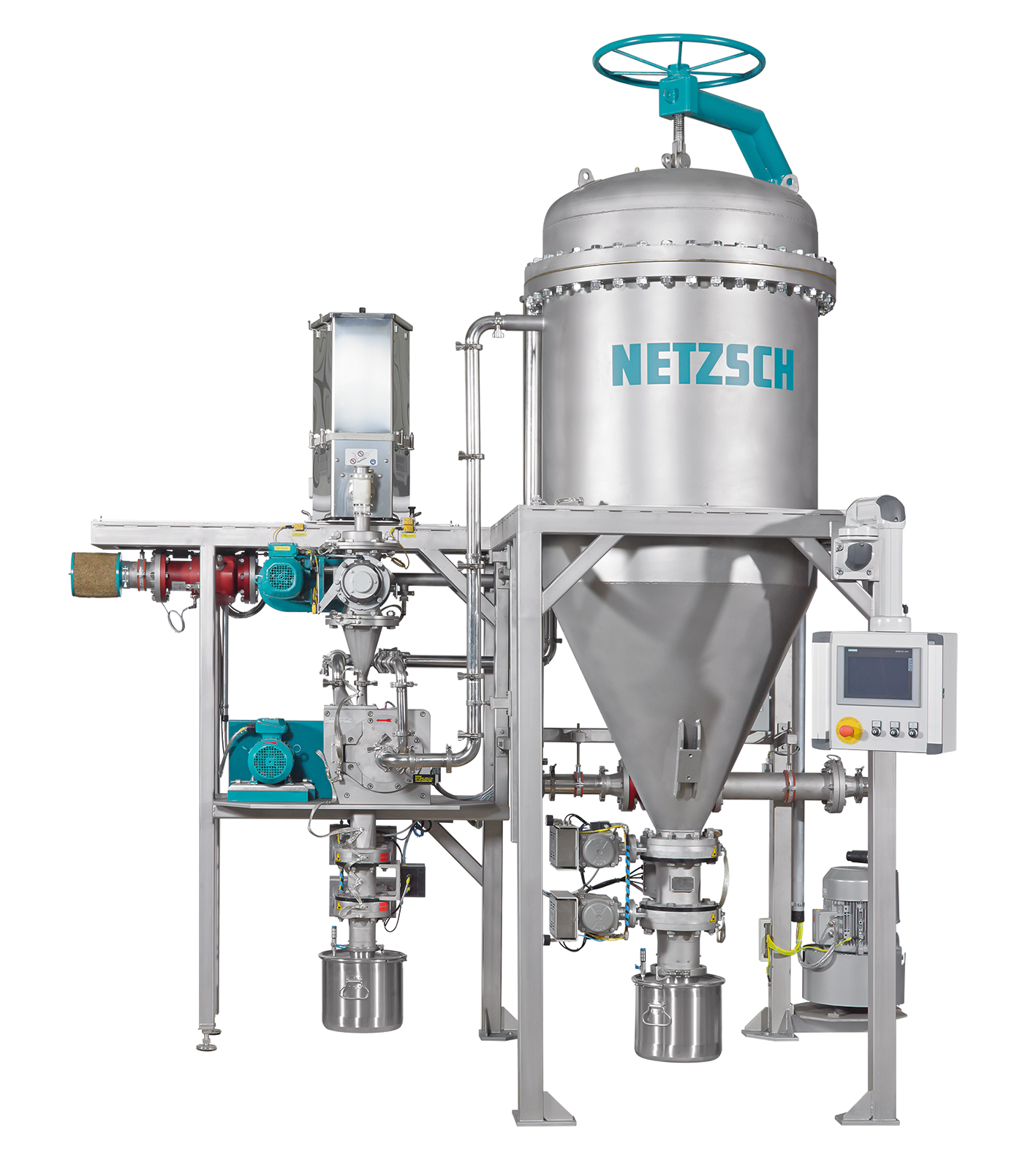
Application example: Protein Shifting and Enrichment with the use of Dry
Grinding and Classifying
The worldwide
nutritional demand for plant-based proteins is increasing enormously. The main
sources are soybeans, wheat or peas. More often, regional crops such as faba
beans are being taken into consideration. Semi manufactured products are
amongst others protein-enriched flours or high-protein containing isolates
using wet processes. The use of large amounts of water, chemicals and energy
for drying makes isolate production a laborious, complex and resource consuming
process.
NETZSCH
focuses itself on protein shifting by dry grinding. This process, taken from
classical flour production, is being used successfully to process legumes such
as yellow peas, faba beans, mung beans or chickpeas. The aim of the process is
to gain a protein-rich fraction by fine-grinding and classifying, in which the
amount of protein is considerably higher than in the original product.
Processing step 1 – Production of refined flour
Ideally, the
cleaned legumes are dehulled prior to the protein shifting process to a
residual portion of < 1 %. The refining serves to break the cell structure
and to isolate the relatively large starch granules from the smaller protein
granules. Depending on the product, the proteins have a particle size of < 3
µm, whereas the starch granules range from 3 to 40 µm.
Most important
for the subsequent separation is that during grinding, the difference in size
between the protein and starch granules remains as large as possible. Care must
be taken not to damage the starch granules in the process. The most effective
and gentle way to achieve this is through impact grinding in a NETZSCH
Classifier Mill, model CSM.
Processing step 2 – Efficient separation using a high-efficiency
classifier, model CFS/HD-S
The resulting
refined flour, which has to be separated into a high-protein and low-protein
fraction, has a particle size between 40 and 70 µm. This is a range that brings
conventional sifting to its limits. For this reason, fractionation with dynamic
air classifiers has become widely accepted.
The NETZSCH
High-Efficiency Fine Classifier, model CFS/HD-S achieves the highest yields
with a minimal loss of protein in the high-starch fraction. In contrast to
conventional classifiers, this classifier is highly compact and is equipped
with a guide vane cage for most efficient dispersion and separation – the
decisive advantages when viewing the economics of protein enrichment. Dependent
on raw materials, protein values > 60 % in the protein rich fraction are
obtainable!
Companies mentioned

Related news

Alvinesa Natural Ingredients announces the appointment of Olivier Lavaud as new CEO
13 May 2026
The new leadership reinforces the company’s ambition to accelerate its international growth in natural, sustainable, high value-added ingredients.
Read more
A new standard for omega-3 experience
13 Apr 2026
Omega-3 quality is no longer just about purity or concentration. Senses™ by Naturmega delivers ultra-pure, sensory-optimised omega-3 with no taste, no odour, and improved stability.
Read more
PharmaLinea’s iron supplement delivers improvements in hemoglobin comparable to ferrous sulfate with fewer side effects
23 Feb 2026
PharmaLinea, a Slovenian developer and manufacturer of private label food supplements, has announced the completion of a clinical study evaluating its finished formulation for iron deficiency.
Read more
LomaChelateX® – power in magnesium bisglycinate
12 Feb 2026
Gentle and effective: magnesium bisglycinate is setting a new standard. Through its LomaChelateX® brand, Dr. Paul Lohmann® delivers magnesium bisglycinate and a broad range of fully reacted mineral bisglycinates made in Germany.
Read more
Fucoidan leader reports record production
22 Jan 2026
The global leader in fucoidan science, Marinova Pty Ltd, reported record annual fucoidan production for 2025. The company's total production volume has more than doubled over the past three years.
Read more
India Honours Ashwagandha with Commemorative Postal Stamp at WHO Global Summit
6 Jan 2026
HYDERABAD, December 20, 2025 – India’s Prime Minister Mr. Narendra Modi, alongside WHO Director-General Dr. Tedros Adhanom Ghebreyesus, released a commemorative postal stamp honoring ashwagandha at the recently concluded Second WHO Global Traditional...
Read more
PharmaLinea delivers actionable 2026 insights at the first ever NutraLoop™ Summit
22 Dec 2025
PharmaLinea held its first-ever NutraLoop™ Summit this December. The virtual event featured 12 speakers from companies such as IQVIA, NHCO, Radicle Science, and BeyondBrands, who provided comprehensive insights across the scientific and commercia...
Read more
FrieslandCampina strengthens its global protein position with acquisition of Wisconsin Whey Protein
11 Dec 2025
Royal FrieslandCampina N.V. intends to acquire Wisconsin Whey Protein, a respected producer of whey protein isolates in the United States. Wisconsin Whey Protein will become part of FrieslandCampina Ingredients, a global leader in proteins and prebioti...
Read more
dsm-firmenich names ‘Frosted Star Anise’ as Flavor of the Year 2026, capturing a global desire for warmth and freshness
11 Dec 2025
Kaiseraugst (Switzerland), Maastricht (Netherlands), December 5, 2025 dsm-firmenich, innovators in nutrition, health, and beauty, announces ‘Frosted Star Anise’ as its Flavor of the Year for 2026. This...
Read more
Balchem Makes Strategic Investment in U.S. Food Ingredients Market with New Microencapsulation Manufacturing Facility
11 Dec 2025
Montvale, New Jersey, (10 December, 2025) – Balchem, a leading global manufacturer of specialty ingredients for human nutrition and health, is pleased to announce the development of a new, high-capacity man...
Read more