
Ingredients Categories
Finished Products
Finished Food Categories
- Bakery
- Beverages / Juices
- Cereal and grain products
- Confectionery
- Cooking Fats & Oils
- Dairy
- Egg products
- Fruits & Vegetables
- Infant & Baby food
- Meat, Poultry & Fish
- Nuts & Seeds products
- Other Finished Food Categories
- Pet Food
- Plant-based foods
- Prepared foods
- Sauces & Seasonings
- Sweet & Savoury Spreads
Specialised Finished Products
- Bee products
- Biotic products
- Dietary supplements
- Energy drinks
- Functional beverages
- Functional confectionery
- Functional food
- Functional powders
- Meal replacement products
- Nutricosmetics
- Other Specialised Finished Products
- Pet Dietary Supplements
- Pharma and OTC products
- Protein products
- Sugar replacers / Sweeteners
Health & Wellness Areas
Delivery Formats
Operations & Services
- 3D printing
- Analysis/ Testing
- Auditing & certifications
- Blending & mixing
- Bottling
- Certification
- Clinical trials
- Co-packing
- Coating
- Consulting
- Contract manufacturing
- Drying
- Electrospinning
- Encapsulating
- Enzymatic processing
- Extracting
- Extrusion
- Fat structuring
- Fermentation
- Filling
- Flavour development
- Freeze drying
- Granulating/ grinding/ milling / mixing
- High-pressure processing
- Labelling
- Other Operations & Services
- Packaging
- Packet filling
- Pasturising
- Quality assurance
- Saccharification
- Shear cell processing
- Spray drying
- Sterilisation
- Storage & Logistics
- Tabletting
- Toasting / roasting
- Ultra-high temperature processing
Sponsored Content
What LC-MS-QTOF Can Tell Us About Mushroom Extract Quality
25 Sep 2026Two mushroom extracts can be equally authentic yet contain very different levels and patterns of fungal metabolites. MUSHEEZ® uses Liquid Chromatography Mass Spectrometry Quadrupole Time-of-Flight analysis to look beyond extraction ratios and specifications, investigating what compounds are actually present in selected mushroom ingredients and how their profiles compare.
Two mushroom extracts can have the same species name, the same extraction ratio and similar basic specifications, yet differ substantially in their chemical composition.
That is one reason MUSHEEZ® does not assess mushroom ingredients using extraction ratios or beta-glucan percentages alone.
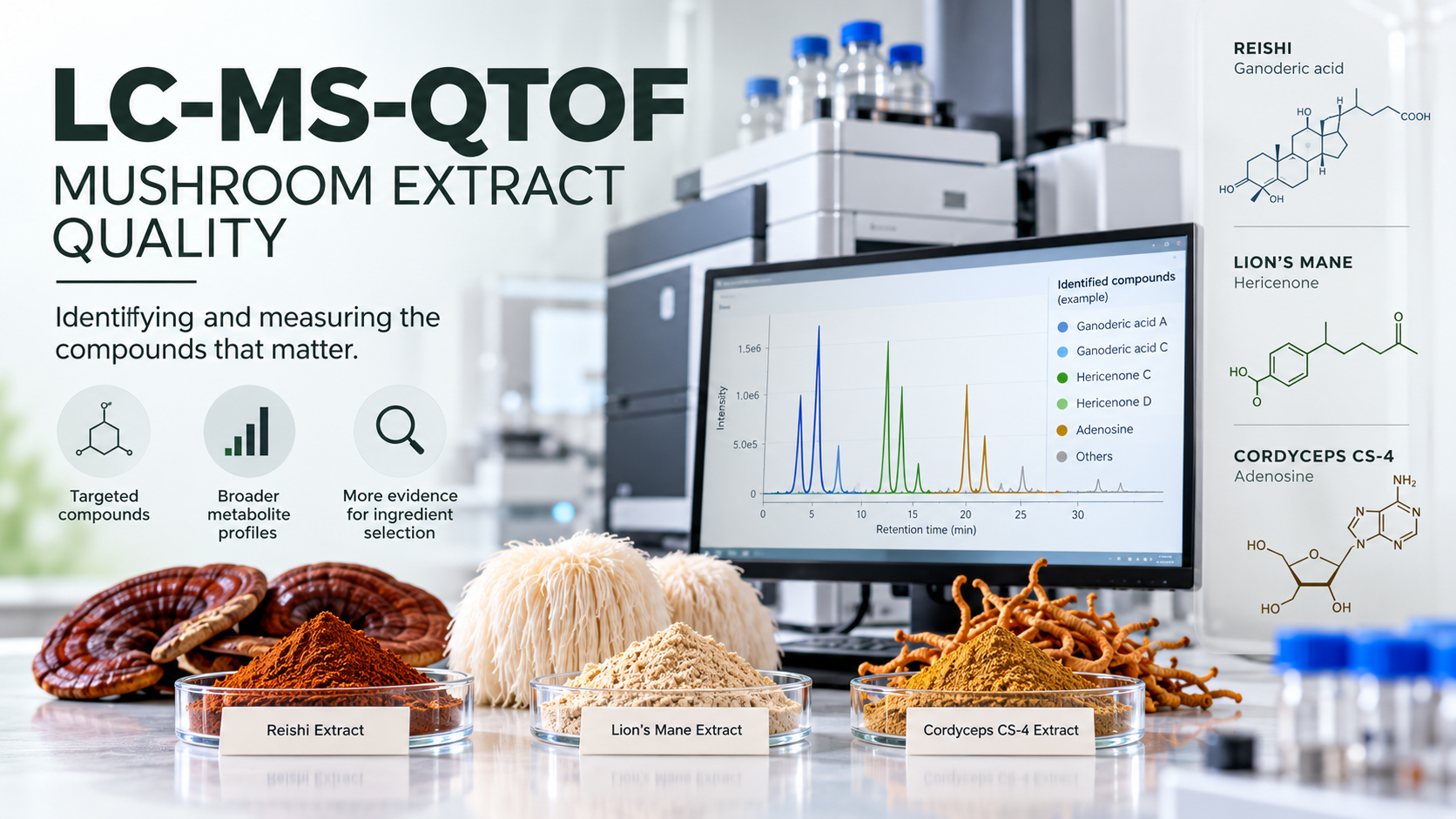
For selected ingredients, we use Liquid Chromatography Mass Spectrometry Quadrupole Time-of-Flight, usually abbreviated to LC-MS-QTOF, to investigate the metabolites present in the finished extract.
If Nuclear Magnetic Resonance is particularly useful to us for questions around identity and purity, LC-MS-QTOF gives us another perspective:
What compounds are actually present, and at what levels?
For MUSHEEZ®, that is an important part of understanding ingredient quality.
PURITY AND QUALITY ARE NOT THE SAME QUESTION
A mushroom extract can be genuine and relatively pure while still differing significantly in chemical quality from another extract of the same species.
For example, two samples may both be correctly identified as Reishi.
Nuclear Magnetic Resonance analysis may indicate that both are chemically consistent with Reishi and do not contain large amounts of unexpected material.
But that does not mean the two extracts contain the same concentrations or patterns of Reishi metabolites.
One may contain substantially different levels of ganoderic acids or other compounds.
Similarly, two Lion’s Mane extracts may both be authentic Hericium erinaceus, while differing considerably in their metabolite profiles.
This is where LC-MS-QTOF becomes particularly useful.
In simplified terms:
Nuclear Magnetic Resonance helps us assess identity and purity.
LC-MS-QTOF helps us investigate chemical quality through the metabolites present in the extract.
Neither method provides the entire answer, but together they tell us far more than an extraction ratio alone.
WHAT IS LC-MS-QTOF?
The name sounds complicated, but the principle can be understood fairly simply.
The technique combines two analytical technologies.
Liquid Chromatography separates compounds within a complex sample.
Mass Spectrometry Quadrupole Time-of-Flight then measures compounds according to their mass-to-charge characteristics with high accuracy.
This allows a laboratory to separate and detect a large number of chemical components within a mushroom extract.
The result is a much more detailed view of the chemical composition of the sample than can be obtained from broad measurements such as colour, extraction ratio or a non-selective total-compound assay.
Depending on the analytical method, LC-MS-QTOF can be used to investigate known compounds of interest as well as wider metabolite patterns.
WHY THIS MATTERS FOR MUSHROOM EXTRACTS
Functional mushrooms contain complex mixtures of compounds.
These can include:
• Triterpenoids
• Sterols
• Phenolic compounds
• Nucleosides
• Aromatic compounds
• Fatty acids
• Polysaccharide-related components
• Species-associated secondary metabolites
The composition depends on many factors.
These include:
• Species
• Fungal material used
• Cultivation conditions
• Raw-material quality
• Extraction method
• Solvent
• Temperature
• Extraction time
• Filtration
• Concentration
• Drying
This means two extracts carrying apparently similar specifications can have very different metabolite profiles.
LC-MS-QTOF allows us to investigate those differences.
REISHI IS A GOOD EXAMPLE
Reishi is frequently marketed using claims around triterpenoids or triterpenes.
But those terms describe broad groups of compounds.
For MUSHEEZ®, a more interesting question is whether specific Reishi-associated compounds can actually be identified and measured.
Our independent analytical work has detected individual ganoderic acids in Reishi extracts.
This is important because it moves the discussion beyond statements such as:
“15:1 extract”
or:
“high triterpenes”
and towards something more chemically meaningful:
Which Reishi metabolites are actually present?
We have also found that assumptions based solely on extraction method can be unreliable.
It is sometimes stated that water extraction cannot recover meaningful Reishi triterpenoids.
Our analytical results have shown measurable ganoderic acids in appropriately produced Reishi water extracts.
That does not mean that water and alcohol extraction produce identical profiles.
They do not.
It means that the finished ingredient should be tested rather than judged solely from assumptions about the manufacturing process.
WHY BROAD “TRITERPENE” PERCENTAGES CAN BE MISLEADING
This is also where analytical methodology becomes important.
A supplier may claim, for example, that a Reishi extract contains a very high percentage of “triterpenes”.
But the usefulness of that figure depends heavily on how it was measured.
Some broad Ultraviolet-based methods estimate groups of compounds according to their light absorption.
The difficulty is that Ultraviolet detection is not always sufficiently chemically selective to establish that everything contributing to the signal is actually the compound group being claimed.
At MUSHEEZ®, we have encountered supplier claims for extremely high Reishi triterpene levels that were not supported when the same type of ingredient was investigated using much more selective Liquid Chromatography Mass Spectrometry analysis.
This is why we increasingly ask not only:
“What is the result?”
but also:
“Which analytical method produced the result?”
A large number is not necessarily meaningful if the method cannot selectively measure what the number claims to represent.
LION’S MANE PROVIDES ANOTHER EXAMPLE
Lion’s Mane is often discussed in relation to compounds such as hericenones and erinacines.
These compounds are not distributed uniformly across every Lion’s Mane material.
The fungal material, cultivation process and extraction method matter.
At MUSHEEZ®, our analytical programme includes investigation of specific Lion’s Mane metabolites rather than assuming that every Hericium erinaceus extract contains equivalent levels simply because the species name is the same.
Our work with specialist analytical laboratories is also extending into more specific marker compounds, including individual hericenones.
This allows us to build a more detailed chemical picture of different Lion’s Mane ingredients.
Again, this is not about finding one molecule and declaring that it defines the quality of the entire extract.
It is about accumulating better evidence.
CORDYCEPS CS-4 IS DIFFERENT AGAIN
Cordyceps is a particularly good example of why compound profiling needs to be interpreted in the context of the actual fungal material.
The Cordyceps CS-4 supplied by MUSHEEZ® is fermented mycelium identified as Samsoniella hepiali.
It is not Cordyceps militaris and it is not wild Ophiocordyceps sinensis.
One compound we examine in CS-4 is adenosine.
Adenosine is relevant to the chemical characterisation of this material and can be measured using appropriate analytical methods.
By contrast, cordycepin is strongly associated with Cordyceps militaris and should not simply be expected at meaningful levels in CS-4 because both products happen to be sold commercially under the broad name “Cordyceps”.
This illustrates an important point.
Analytical results only make sense when interpreted alongside fungal identity.
Looking for the wrong marker in the wrong fungal material can be just as misleading as not testing at all.
METABOLITE PROFILING CAN ALSO HELP COMPARE SUPPLIERS
LC-MS-QTOF becomes particularly interesting when several candidate ingredients are compared.
Imagine that three suppliers offer organic Reishi 15:1 water extracts.
On paper they may look almost identical.
All three might provide:
• The same species
• The same extraction ratio
• Similar moisture specifications
• Acceptable microbiology
• Similar beta-glucan values
A conventional specification comparison may therefore give procurement teams little reason to distinguish between them.
But metabolite profiling may reveal substantial differences.
One sample might contain a broader or stronger profile of expected Reishi metabolites.
Another might show considerably lower levels.
A third might present a different chemical pattern again.
This does not automatically make one product universally “best”.
Different extracts can be appropriate for different purposes.
But it gives MUSHEEZ® and our clients more evidence on which to base an ingredient decision.
THE AMOUNT MATTERS, NOT JUST THE PRESENCE
Detecting a compound is useful, but presence alone can also be misleading.
Modern mass spectrometry is extremely sensitive.
A compound can sometimes be detected at a very low level.
That is not the same as demonstrating that it is present in a substantial or commercially meaningful amount.
For this reason, MUSHEEZ® is interested not only in whether relevant metabolites can be detected, but also in their measured or comparative abundance where the analytical method allows this.
This distinction is important when discussing mushroom ingredients.
“Contains compound X” can sound impressive.
But the more useful questions are:
How much is present?
How was it measured?
How does that compare with other batches or ingredients?
TARGETED ANALYSIS AND BROADER PROFILING
There are two related ways LC-MS-QTOF can contribute to mushroom ingredient evaluation.
One is targeted analysis.
Here, the laboratory looks specifically for selected known compounds.
Examples might include particular ganoderic acids in Reishi or selected hericenones in Lion’s Mane.
The second is broader metabolite profiling.
Rather than focusing exclusively on a small number of predetermined compounds, the analysis can provide a much wider chemical fingerprint of the extract.
This can be valuable for:
• Comparing suppliers
• Comparing extraction methods
• Monitoring batch consistency
• Investigating unexpected differences
• Developing future marker panels
• Building stronger reference data for individual mushroom ingredients
At MUSHEEZ®, we see considerable value in combining both approaches.
QUALITY CANNOT BE REDUCED TO ONE MARKER
There is also an important limitation.
Finding more of one metabolite does not automatically mean an extract is superior in every respect.
Mushrooms are chemically complex materials.
A high level of one compound does not establish:
• Species identity
• Purity
• Microbiological quality
• Heavy metals compliance
• Beta-glucan content
• Sensory suitability
• Performance in a food matrix
• Clinical efficacy
This is why we do not want LC-MS-QTOF to become another simplistic quality number.
The functional mushroom sector already relies too heavily on single figures such as extraction ratios.
Replacing “20:1” with a single metabolite number would repeat the same mistake.
The value of LC-MS-QTOF is that it adds another high-quality layer of evidence.
HOW NMR AND LC-MS-QTOF WORK TOGETHER
The easiest way to understand the MUSHEEZ® approach is to think of the two methods as answering different questions.
Nuclear Magnetic ResonancePrimarily helps us ask:
Is this ingredient chemically consistent with what it claims to be?
Is substantial unexpected material present?
Does its overall fingerprint resemble the appropriate reference material?
For MUSHEEZ®, this is strongly connected with identity and purity.
Liquid Chromatography Mass Spectrometry Quadrupole Time-of-FlightHelps us ask:
Which metabolites are present?
How much of selected compounds can be measured?
How does the metabolite pattern compare with other extracts or batches?
For MUSHEEZ®, this contributes strongly to understanding chemical quality.
The two methods complement each other.
A chemically authentic mushroom ingredient is the starting point.
Understanding what useful fungal metabolites are actually present takes us further.
THE REST OF THE QUALITY PICTURE STILL MATTERS
LC-MS-QTOF is therefore part of a broader MUSHEEZ® analytical programme.
Depending on the ingredient, this can also include:
• Nuclear Magnetic Resonance analysis
• Alpha-glucan and beta-glucan testing
• Microbiological testing
• Heavy metals testing
• Moisture analysis
• Physical performance testing
• Sensory evaluation
For food and beverage ingredients, we may additionally examine properties such as Water Solubility Index, Water-Holding Capacity, Oil-Holding Capacity and dispersion behaviour.
These are different dimensions of quality.
No single test replaces the others.
FROM SPECIFICATION CLAIMS TO MEASURED COMPOSITION
Functional mushroom ingredients are becoming increasingly sophisticated.
The way they are evaluated needs to develop with them.
Extraction ratios provide manufacturing information.
A Certificate of Analysis provides important specification information.
Nuclear Magnetic Resonance can add evidence around identity and purity.
Liquid Chromatography Mass Spectrometry Quadrupole Time-of-Flight allows us to go further into the chemical composition of the extract and investigate the metabolites that are actually present.
At MUSHEEZ®, the principle is straightforward:
First establish that the material is what it claims to be. Then investigate what is actually in it.
For us, Nuclear Magnetic Resonance helps answer the first question.
LC-MS-QTOF helps answer the second.
Together with appropriate compositional, safety and application testing, that gives procurement teams and product developers a much stronger basis for assessing mushroom ingredient quality than a headline extraction ratio alone.
Companies mentioned


Get more of our news on Google
Set Ingredients Network as a 'Preferred Source' to get quicker access to the news you value.
Related news
.jpg)
Nactarome: New possibilities in natural innovation
24 Sep 2026
As food innovation becomes increasingly multi-dimensional, Nactarome's expanding expertise reflects a growing industry focus on integrated natural ingredient solutions.
Read more
A new standard for omega-3 experience
13 Apr 2026
Omega-3 quality is no longer just about purity or concentration. Senses™ by Naturmega delivers ultra-pure, sensory-optimised omega-3 with no taste, no odour, and improved stability.
Read more
PharmaLinea’s iron supplement delivers improvements in hemoglobin comparable to ferrous sulfate with fewer side effects
23 Feb 2026
PharmaLinea, a Slovenian developer and manufacturer of private label food supplements, has announced the completion of a clinical study evaluating its finished formulation for iron deficiency.
Read more
LomaChelateX® – power in magnesium bisglycinate
12 Feb 2026
Gentle and effective: magnesium bisglycinate is setting a new standard. Through its LomaChelateX® brand, Dr. Paul Lohmann® delivers magnesium bisglycinate and a broad range of fully reacted mineral bisglycinates made in Germany.
Read more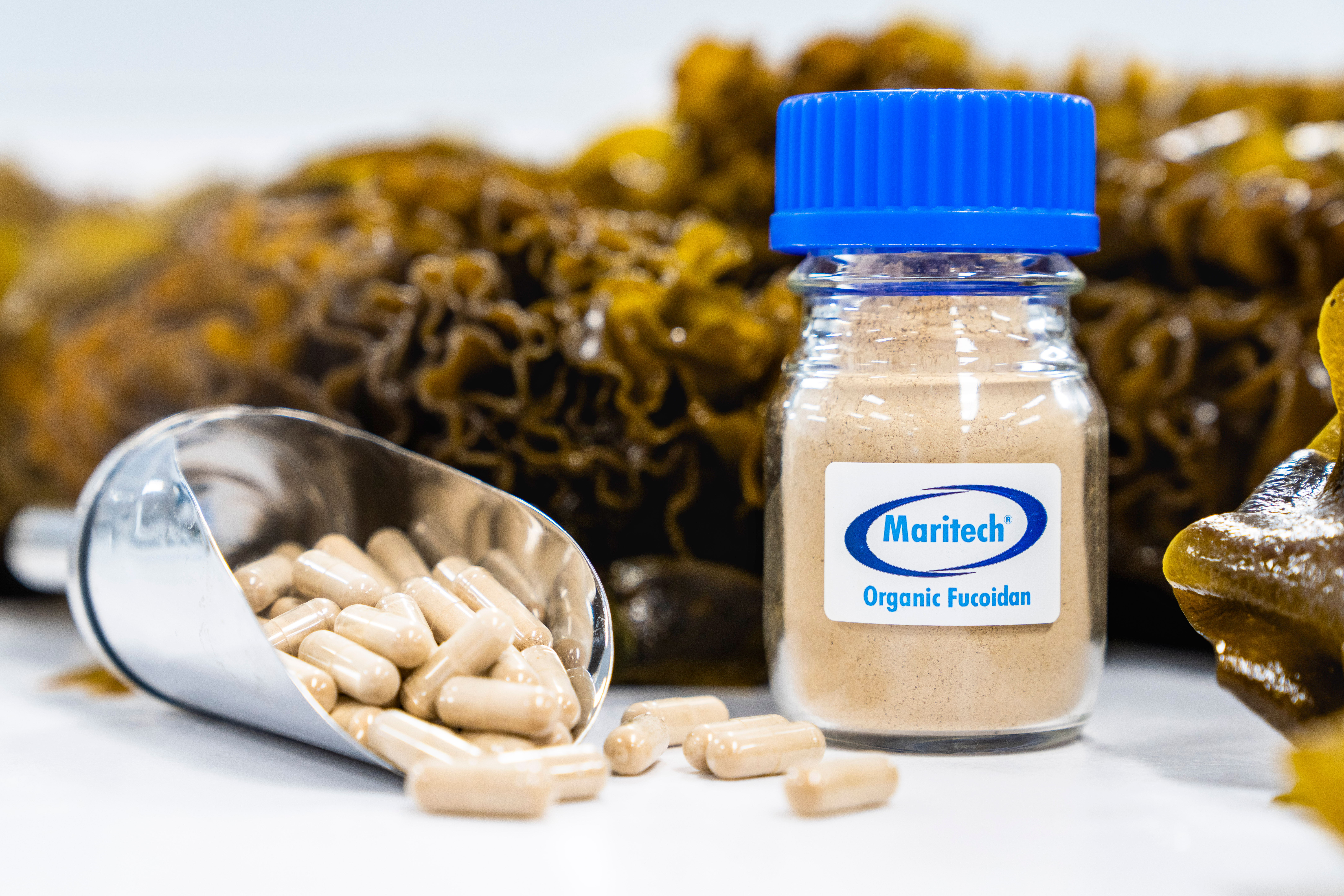
Fucoidan leader reports record production
22 Jan 2026
The global leader in fucoidan science, Marinova Pty Ltd, reported record annual fucoidan production for 2025. The company's total production volume has more than doubled over the past three years.
Read more
India Honours Ashwagandha with Commemorative Postal Stamp at WHO Global Summit
6 Jan 2026
HYDERABAD, December 20, 2025 – India’s Prime Minister Mr. Narendra Modi, alongside WHO Director-General Dr. Tedros Adhanom Ghebreyesus, released a commemorative postal stamp honoring ashwagandha at the recently concluded Second WHO Global Traditional...
Read more
PharmaLinea delivers actionable 2026 insights at the first ever NutraLoop™ Summit
22 Dec 2025
PharmaLinea held its first-ever NutraLoop™ Summit this December. The virtual event featured 12 speakers from companies such as IQVIA, NHCO, Radicle Science, and BeyondBrands, who provided comprehensive insights across the scientific and commercia...
Read more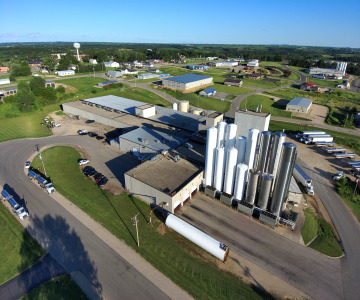
FrieslandCampina strengthens its global protein position with acquisition of Wisconsin Whey Protein
11 Dec 2025
Royal FrieslandCampina N.V. intends to acquire Wisconsin Whey Protein, a respected producer of whey protein isolates in the United States. Wisconsin Whey Protein will become part of FrieslandCampina Ingredients, a global leader in proteins and prebioti...
Read more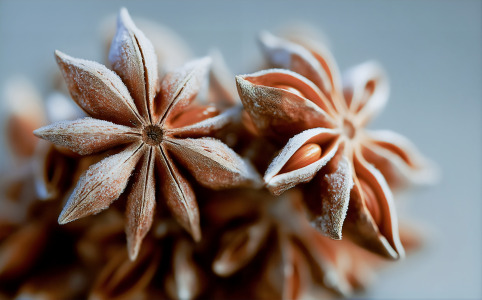
dsm-firmenich names ‘Frosted Star Anise’ as Flavor of the Year 2026, capturing a global desire for warmth and freshness
11 Dec 2025
Kaiseraugst (Switzerland), Maastricht (Netherlands), December 5, 2025 dsm-firmenich, innovators in nutrition, health, and beauty, announces ‘Frosted Star Anise’ as its Flavor of the Year for 2026. This...
Read more
Balchem Makes Strategic Investment in U.S. Food Ingredients Market with New Microencapsulation Manufacturing Facility
11 Dec 2025
Montvale, New Jersey, (10 December, 2025) – Balchem, a leading global manufacturer of specialty ingredients for human nutrition and health, is pleased to announce the development of a new, high-capacity man...
Read more