
Ingredients Categories
Finished Products
Finished Food Categories
- Bakery
- Beverages / Juices
- Cereal and grain products
- Confectionery
- Cooking Fats & Oils
- Dairy
- Egg products
- Fruits & Vegetables
- Infant & Baby food
- Meat, Poultry & Fish
- Nuts & Seeds products
- Other Finished Food Categories
- Pet Food
- Plant-based foods
- Prepared foods
- Sauces & Seasonings
- Sweet & Savoury Spreads
Specialised Finished Products
- Bee products
- Biotic products
- Dietary supplements
- Energy drinks
- Functional beverages
- Functional confectionery
- Functional food
- Functional powders
- Meal replacement products
- Nutricosmetics
- Other Specialised Finished Products
- Pet Dietary Supplements
- Pharma and OTC products
- Protein products
- Sugar replacers / Sweeteners
Health & Wellness Areas
Delivery Formats
Operations & Services
- 3D printing
- Analysis/ Testing
- Auditing & certifications
- Blending & mixing
- Bottling
- Certification
- Clinical trials
- Co-packing
- Coating
- Consulting
- Contract manufacturing
- Drying
- Electrospinning
- Encapsulating
- Enzymatic processing
- Extracting
- Extrusion
- Fat structuring
- Fermentation
- Filling
- Flavour development
- Freeze drying
- Granulating/ grinding/ milling / mixing
- High-pressure processing
- Labelling
- Other Operations & Services
- Packaging
- Packet filling
- Pasturising
- Quality assurance
- Saccharification
- Shear cell processing
- Spray drying
- Sterilisation
- Storage & Logistics
- Tabletting
- Toasting / roasting
- Ultra-high temperature processing
Sponsored Content
Why MUSHEEZ® Uses Nuclear Magnetic Resonance to Check Mushroom Identity
25 Sep 2026Specifications and Certificates of Analysis are important, but they do not independently confirm the identity and composition of a finished mushroom extract. This article explains why MUSHEEZ® uses Nuclear Magnetic Resonance, or NMR, as part of its quality-control approach for selected ingredients, and how chemical fingerprinting can help provide evidence beyond the specification sheet.
A bag arrives labelled Lion’s Mane extract.
The specification says Hericium erinaceus.
The Certificate of Analysis says Hericium erinaceus.
The supplier confirms that it is Hericium erinaceus.
That is useful documentation, but it is not the same as independently verifying the identity and composition of the finished ingredient.
For functional mushroom ingredients, especially processed extracts, identity can be more complicated than the name printed on the bag.
At MUSHEEZ®, this is why Nuclear Magnetic Resonance, usually abbreviated to NMR, has become an important part of our quality-control approach for selected mushroom powders and extracts.
NMR does not answer every quality question. No single analytical method does.
But it can provide a powerful additional layer of evidence about what is actually present in a finished mushroom ingredient.
WHY IDENTITY TESTING MATTERS
Mushroom ingredients can pass through several stages before they reach a brand or manufacturer.
The original fungal material may be:
• Cultivated
• Harvested
• Dried
• Milled
• Extracted
• Filtered
• Concentrated
• Spray dried
• Blended
• Packed
• Repacked
At each stage, the ingredient becomes further removed from the original visible mushroom.
A raw fruiting body can often be examined morphologically.
A fine brown extract powder cannot.
Once an ingredient has been processed into a homogeneous powder, visual inspection provides very little information about species identity, fungal material or composition.
This is one reason why independent analytical verification matters.
WHY NOT RELY ONLY ON SUPPLIER DOCUMENTATION?
Specifications and Certificates of Analysis are essential documents.
They provide information about the material supplied and define the parameters against which a batch is released.
But in most cases they originate within the supplier’s own quality system.
That means they are declarations about the product, not independent confirmation of every claim made about it.
This distinction matters particularly when ingredient identity is central to the value of the product.
A buyer may want to know:
• Is this really the stated mushroom species?
• Does the chemical profile match the expected ingredient?
• Is substantial non-mushroom material present?
• Does the finished powder resemble previous verified batches?
• Are there signs that the product contains unexpected carriers or other material?
These are not questions that can always be answered from a specification sheet alone.
DNA CAN BE VERY USEFUL, BUT PROCESSED EXTRACTS CREATE COMPLICATIONS
DNA analysis is an important tool for fungal identification.
For raw fungal material, it can be extremely valuable.
If intact biological material is available, DNA-based methods can help confirm taxonomic identity and can distinguish between closely related species.
But processed extracts create additional challenges.
Extraction commonly involves heat, water, alcohol, pressure, filtration, concentration and drying.
These processes can degrade or remove DNA.
As a result, the finished extract powder may contain little intact fungal DNA even when the starting mushroom was genuine.
A failed or weak DNA result therefore does not necessarily mean the material is not mushroom-derived.
It may simply reflect the degree of processing.
There is another limitation.
Even where fungal DNA is detected, that does not necessarily describe the chemical composition of the finished ingredient.
DNA can help answer:
“Which organism is represented?”
It does not necessarily answer:
“What is actually present in this processed powder, and in what approximate proportions?”
For a finished extract, those are different questions.
WHAT NUCLEAR MAGNETIC RESONANCE DOES
Nuclear Magnetic Resonance spectroscopy examines the magnetic behaviour of atomic nuclei within molecules.
In practical terms, it produces a characteristic chemical profile or fingerprint of the sample.
Different compounds contribute signals at different positions in the spectrum.
The result is not a photograph of the mushroom and it is not a DNA sequence.
It is a chemical representation of the material being analysed.
For a complex natural product such as a mushroom extract, the spectrum contains information from many compounds at the same time.
That makes NMR particularly useful for pattern comparison.
A sample can be compared with:
• Verified reference materials
• Previously authenticated batches
• Known mushroom profiles
• Known carrier materials
• Other extract types
The objective is not necessarily to identify every individual molecule in the sample.
Often the more useful question is whether the overall chemical profile is consistent with what the ingredient claims to be.
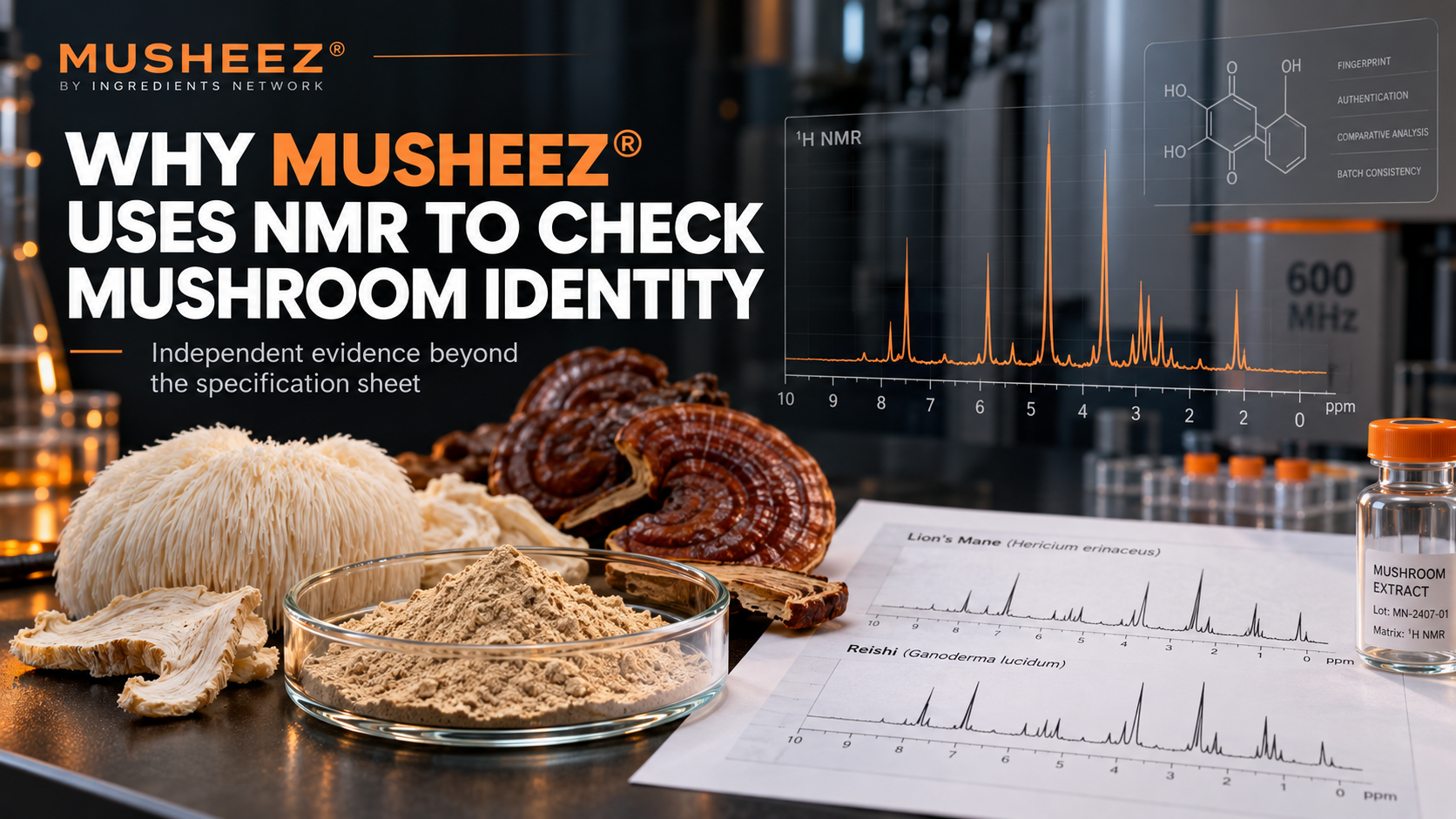
A CHEMICAL FINGERPRINT CAN REVEAL MORE THAN A SPECIES NAMESuppose two powders are both sold as Lion’s Mane water extract.
Both may carry the same Latin name.
Both may have similar colour.
Both may meet microbiological specifications.
But their NMR fingerprints may differ substantially.
That difference could reflect:
• Different fungal material
• Different production processes
• Different extraction intensity
• Different carrier levels
• Different proportions of carbohydrates
• Different non-mushroom components
• Batch inconsistency
NMR therefore provides information at a level that a species name alone cannot.
This is particularly useful for processed ingredients where the original morphology has disappeared.
NMR CAN ALSO HELP IDENTIFY CARRIERSOne practical advantage is that common carrier materials can also have recognisable NMR profiles.
Purity-IQ, the laboratory used by MUSHEEZ® for this work, holds reference profiles for materials including maltodextrin and polydextrose.
This means the analysis can potentially provide evidence that an extract contains a significant proportion of one of these materials.
That can be highly relevant.
Carriers are not inherently problematic.
Maltodextrin, for example, can be useful as a spray-drying aid and can improve powder handling, dispersion or stability.
The issue is transparency.
A buyer needs to know whether a powder is predominantly mushroom-derived material or whether a significant proportion consists of another carbohydrate.
An extraction ratio alone does not tell you that.
An NMR profile can contribute useful evidence.
WHY THIS MATTERS FOR “PURE” MUSHROOM EXTRACTSTerms such as “pure”, “100% mushroom” and “fruiting body extract” are common in the market.
These can be commercially important claims.
But they should ideally be supported by more than supplier declaration.
At MUSHEEZ®, the PureMushroom™ range was developed specifically around stronger verification.
NMR forms one part of that system.
The analysis can help assess whether a sample is chemically consistent with the claimed mushroom material and whether substantial unexpected components are visible.
It does not, by itself, prove every aspect of purity.
That is why MUSHEEZ® combines NMR with other analytical methods.
NMR IS NOT A REPLACEMENT FOR OTHER TESTINGThis point is important.
NMR does not replace:
• Liquid Chromatography Mass Spectrometry
• Glucan analysis
• Microbiological testing
• Heavy metals testing
• Pesticide testing
• Moisture testing
• Sensory evaluation
• Physical performance testing
Each method answers a different question.
For example:
Nuclear Magnetic Resonance can support identity and overall composition assessment.
Liquid Chromatography Mass Spectrometry Quadrupole Time-of-Flight can provide detailed metabolite profiling and help detect compounds of interest.
Enzymatic glucan analysis can quantify alpha-glucans and beta-glucans.
Microbiological testing assesses microbial safety and compliance.
Heavy metals testing checks for elemental contaminants.
The strength comes from combining methods rather than expecting one test to provide a complete answer.
WHY ULTRAVIOLET-BASED METHODS HAVE LIMITATIONSSome mushroom ingredients are marketed using compound percentages generated by Ultraviolet-based analytical methods.
These methods can be useful in some contexts, but they are not always chemically selective enough for the claims being made.
If several unrelated compounds absorb light at similar wavelengths, a broad Ultraviolet measurement may not distinguish between them.
This can lead to inflated or poorly defined results.
At MUSHEEZ®, we are therefore cautious about accepting high compound claims without understanding the method used.
For targeted metabolite work, we prefer more selective approaches such as Liquid Chromatography Mass Spectrometry.
NMR answers a different question again, by looking at the broader chemical fingerprint.
IDENTITY IS DIFFERENT FROM POTENCYAnother important distinction is that identity testing does not automatically establish potency.
A sample can be correctly identified as Reishi and still vary significantly in:
• Ganoderic acid profile
• Beta-glucan content
• Extraction intensity
• Sensory properties
• Moisture
• Physical behaviour
Likewise, a Lion’s Mane sample can be correctly identified while differing substantially from another Lion’s Mane extract in composition.
This is why MUSHEEZ® separates the questions.
First:
Is the material what it claims to be?
Then:
What is in it?
Then:
Does it meet the specification required for the intended application?
Those are related questions, but they are not the same question.
BATCH COMPARISON IS ALSO VALUABLEOnce a verified reference profile has been established, future batches can be compared against it.
This is valuable for consistency monitoring.
Natural ingredients inevitably show some biological variation.
That is normal.
But major deviations in the chemical fingerprint can indicate something that deserves further investigation.
Possible explanations may include:
• Different raw material
• Process change
• Carrier variation
• Extraction change
• Supplier change
• Batch inconsistency
NMR therefore has value not only for initial supplier qualification but also for ongoing quality control.
WHY THIS MATTERS FOR PROCUREMENT TEAMSFor procurement teams, mushroom ingredients can be difficult to compare.
Several suppliers may offer products with apparently similar specifications:
Lion’s Mane 8:1.
Reishi 15:1.
Chaga dual extract.
All may claim fruiting body.
All may present compliant Certificates of Analysis.
At that point, the challenge becomes distinguishing documentation from evidence.
Questions worth asking include:
• Has species identity been independently verified?
• What analytical method was used?
• Is the finished extract chemically consistent with the claimed mushroom?
• Are carriers present?
• Is there independent composition data?
• Is batch-to-batch comparison available?
• Can the supplier show the underlying analytical evidence?
The objective is not to make procurement unnecessarily complicated.
It is to reduce reliance on unverified claims.
NMR WITHIN THE MUSHEEZ® QUALITY SYSTEMMUSHEEZ® uses Nuclear Magnetic Resonance as one part of the verification programme for selected PureMushroom™ ingredients.
Testing is carried out independently by Purity-IQ using 400 MHz NMR analysis.
Depending on the ingredient, this may be combined with:
• Liquid Chromatography Mass Spectrometry Quadrupole Time-of-Flight analysis
• Alpha-glucan and beta-glucan testing
• Microbiological analysis
• Heavy metals testing
• Moisture analysis
• Physical performance testing
• Sensory evaluation
The results are used to build a stronger evidence base around each ingredient.
Selected batch-level information is then made available through PureData™.
FROM LABEL CLAIM TO EVIDENCEA mushroom ingredient can look convincing on paper.
The Latin name may be correct.
The extraction ratio may sound impressive.
The specification may be professionally presented.
But none of those things independently confirms the chemical identity of the finished powder.
For processed mushroom extracts, NMR provides one way to move beyond the label and examine the material itself.
It is not a complete answer.
But it is a very useful part of the answer.
At MUSHEEZ®, that is why we increasingly ask suppliers and ourselves a simple question:
What evidence do we have that this ingredient is actually what we say it is?
Companies mentioned


Get more of our news on Google
Set Ingredients Network as a 'Preferred Source' to get quicker access to the news you value.
Related news
.jpg)
Nactarome: New possibilities in natural innovation
24 Sep 2026
As food innovation becomes increasingly multi-dimensional, Nactarome's expanding expertise reflects a growing industry focus on integrated natural ingredient solutions.
Read more
A new standard for omega-3 experience
13 Apr 2026
Omega-3 quality is no longer just about purity or concentration. Senses™ by Naturmega delivers ultra-pure, sensory-optimised omega-3 with no taste, no odour, and improved stability.
Read more
PharmaLinea’s iron supplement delivers improvements in hemoglobin comparable to ferrous sulfate with fewer side effects
23 Feb 2026
PharmaLinea, a Slovenian developer and manufacturer of private label food supplements, has announced the completion of a clinical study evaluating its finished formulation for iron deficiency.
Read more
LomaChelateX® – power in magnesium bisglycinate
12 Feb 2026
Gentle and effective: magnesium bisglycinate is setting a new standard. Through its LomaChelateX® brand, Dr. Paul Lohmann® delivers magnesium bisglycinate and a broad range of fully reacted mineral bisglycinates made in Germany.
Read more
Fucoidan leader reports record production
22 Jan 2026
The global leader in fucoidan science, Marinova Pty Ltd, reported record annual fucoidan production for 2025. The company's total production volume has more than doubled over the past three years.
Read more
India Honours Ashwagandha with Commemorative Postal Stamp at WHO Global Summit
6 Jan 2026
HYDERABAD, December 20, 2025 – India’s Prime Minister Mr. Narendra Modi, alongside WHO Director-General Dr. Tedros Adhanom Ghebreyesus, released a commemorative postal stamp honoring ashwagandha at the recently concluded Second WHO Global Traditional...
Read more
PharmaLinea delivers actionable 2026 insights at the first ever NutraLoop™ Summit
22 Dec 2025
PharmaLinea held its first-ever NutraLoop™ Summit this December. The virtual event featured 12 speakers from companies such as IQVIA, NHCO, Radicle Science, and BeyondBrands, who provided comprehensive insights across the scientific and commercia...
Read more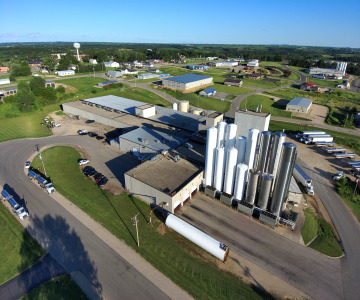
FrieslandCampina strengthens its global protein position with acquisition of Wisconsin Whey Protein
11 Dec 2025
Royal FrieslandCampina N.V. intends to acquire Wisconsin Whey Protein, a respected producer of whey protein isolates in the United States. Wisconsin Whey Protein will become part of FrieslandCampina Ingredients, a global leader in proteins and prebioti...
Read more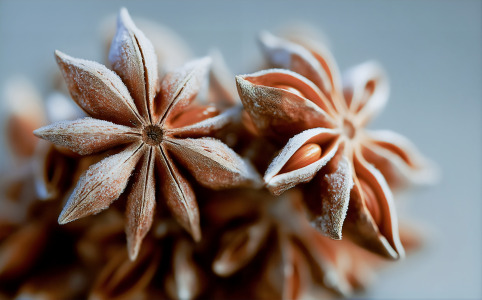
dsm-firmenich names ‘Frosted Star Anise’ as Flavor of the Year 2026, capturing a global desire for warmth and freshness
11 Dec 2025
Kaiseraugst (Switzerland), Maastricht (Netherlands), December 5, 2025 dsm-firmenich, innovators in nutrition, health, and beauty, announces ‘Frosted Star Anise’ as its Flavor of the Year for 2026. This...
Read more
Balchem Makes Strategic Investment in U.S. Food Ingredients Market with New Microencapsulation Manufacturing Facility
11 Dec 2025
Montvale, New Jersey, (10 December, 2025) – Balchem, a leading global manufacturer of specialty ingredients for human nutrition and health, is pleased to announce the development of a new, high-capacity man...
Read more