
Ingredients Categories
Finished Products
Finished Food Categories
- Bakery
- Beverages / Juices
- Cereal and grain products
- Confectionery
- Cooking Fats & Oils
- Dairy
- Egg products
- Fruits & Vegetables
- Infant & Baby food
- Meat, Poultry & Fish
- Nuts & Seeds products
- Other Finished Food Categories
- Pet Food
- Plant-based foods
- Prepared foods
- Sauces & Seasonings
- Sweet & Savoury Spreads
Specialised Finished Products
- Bee products
- Biotic products
- Dietary supplements
- Energy drinks
- Functional beverages
- Functional confectionery
- Functional food
- Functional powders
- Meal replacement products
- Nutricosmetics
- Other Specialised Finished Products
- Pet Dietary Supplements
- Pharma and OTC products
- Protein products
- Sugar replacers / Sweeteners
Health & Wellness Areas
Delivery Formats
Operations & Services
- 3D printing
- Analysis/ Testing
- Auditing & certifications
- Blending & mixing
- Bottling
- Certification
- Clinical trials
- Co-packing
- Coating
- Consulting
- Contract manufacturing
- Drying
- Electrospinning
- Encapsulating
- Enzymatic processing
- Extracting
- Extrusion
- Fat structuring
- Fermentation
- Filling
- Flavour development
- Freeze drying
- Granulating/ grinding/ milling / mixing
- High-pressure processing
- Labelling
- Other Operations & Services
- Packaging
- Packet filling
- Pasturising
- Quality assurance
- Saccharification
- Shear cell processing
- Spray drying
- Sterilisation
- Storage & Logistics
- Tabletting
- Toasting / roasting
- Ultra-high temperature processing
Sponsored Content
Beyond Meat’s Mushroom Problem: Why Phytosphere May Hit a Wall in Europe
2 Nov 2026Beyond Meat’s new US platform is a welcome push into functional mushrooms and mycelium. It also shows why brands with global ambitions should think about Europe before they lock the recipe.

Beyond Meat’s new Phytosphere™ platform is exactly the kind of innovation that is welcome in the functional mushroom sector.
The new US range takes Beyond well beyond its traditional meat-alternative territory, bringing functional mushrooms and fungal ingredients into protein powders, savoury snacks and centre-of-plate foods.
At MUSHEEZ, we work with functional mushroom ingredients for European food and food supplement businesses, so one part of the launch immediately caught our attention.
Several of the fungal materials used in their US formulations would have a very different regulatory position in Europe.
That does not make Phytosphere a bad idea. Quite the opposite. A company of Beyond Meat’s scale putting functional mushrooms and mycelium into genuinely new formats is good news for the sector.
But it illustrates an important lesson for any brand with global ambitions.
A mushroom formulation developed for the US market cannot necessarily be transferred unchanged to Europe.
And with fungi, surprisingly small details can make the difference.
What Beyond actually puts in Starmatter
Beyond Starmatter™ is a nutrient-boosted plant protein powder containing a 1,000 mg adaptogen blend.
The interesting part is the detail on Beyond’s own US back label.
All six fungi include mycelial biomass.
Reishi, King Trumpet and Lion’s Mane are listed as containing mycelial biomass together with the fruit body. Shiitake and Turkey Tail contain mycelial biomass and primordia. Cordyceps militaris is described as containing mycelial biomass, stroma and fruit body.
Those terms matter.
Primordia are early developing fruiting structures rather than mature fruiting bodies. Stroma is fungal tissue associated with development of the reproductive structure and, particularly with C. militaris, the terminology can overlap with what is commonly called the fruiting body.
Exactly what Beyond’s ingredient supplier intended by each of those terms would require more detailed specifications.
But one thing is unambiguous: Beyond explicitly declares mycelial biomass in all six fungal ingredients.
That creates an immediate European question.
Fruiting body and mycelium are not interchangeable in EU regulation
Under EU Novel Food rules, a history of consumption of the mushroom fruiting body does not automatically establish a history of consumption of its mycelium.
This is not simply regulatory wordplay.
In a series of consultations involving species including Shiitake, Lion’s Mane, Reishi, Maitake and King Trumpet, Spanish authorities concluded that equivalence between the reproductive and vegetative parts of fungi could not simply be assumed in terms of nutritional composition, metabolites and active substances.
The European Commission’s consultation database consequently records dehydrated mycelium powders of Lion’s Mane, Reishi, Shiitake and King Trumpet as Novel Foods.
So saying that an ingredient is “Lion’s Mane” or “Reishi” is only the beginning.
For European market access, we may also need to know which fungal part was used, the production process, whether it has been extracted, and sometimes even the exact strain.
Much of the Starmatter problem has practical solutions
The position of established mushroom fruiting bodies is very different.
In 2025, European Commission consultations determined specified fruiting-body extract powders of Lion’s Mane, Reishi, Shiitake and Maitake to be not Novel Food.
The Reishi decision is particularly useful because it states the underlying principle clearly. The Member States agreed that, in general, non-concentrated water extracts of non-novel foods retain the same non-novel status, provided processing has not produced significant compositional changes.
That does not mean every mushroom extract is automatically acceptable. Concentration, starting material and process still matter.
But it does mean conventional fruiting-body water extraction has a considerably clearer European regulatory pathway for established food mushrooms than novel mycelial biomass.
For Lion’s Mane, Reishi and Shiitake, the possible direction for an EU-oriented formulation is therefore relatively straightforward: use properly documented fruiting-body material or an appropriate water extract rather than the novel mycelial component.
King Trumpet, Pleurotus eryngii, is another useful example.
The Commission’s Novel Food determination concerns dehydrated P. eryngii mycelium powder. It does not say that the King Trumpet mushroom itself is novel. In fact, P. eryngii appears on official French lists of edible mushrooms and on Italian Ministry of Health lists of mushroom species permitted for commercial sale and preparation.
So conventional King Trumpet fruiting-body material starts from a very different regulatory position from King Trumpet mycelium.
Cordyceps needs a different solution
Cordyceps militaris is harder.
Simply changing the ingredient from C. militaris mycelium to C. militaris fruiting body does not solve the problem. Both remain Novel Food without an applicable authorisation for general EU market use.
There is, however, another Cordyceps route for food supplements.
Samsoniella hepiali is the organism associated with material widely known and marketed as Cordyceps sinensis Cs-4, or simply Cs-4. The EU Novel Food Catalogue was updated in 2025 to recognise S. hepiali as not novel for food supplement use.
Cs-4 is a fermented mycelium material. It is produced through liquid fermentation, after which the mycelium is harvested and dried to powder. That powder can also undergo further extraction.
There is no Cs-4 fruiting-body route involved.
For a European food supplement, an appropriately identified and documented Cs-4 fermented mycelium powder or extract could therefore potentially replace C. militaris while retaining a Cordyceps component.
The food supplement distinction is important. This route should not automatically be extended to conventional foods or drinks.
Turkey Tail is the harder one
Turkey Tail, Trametes versicolor, presents a less obvious solution.
Unlike Lion’s Mane, Reishi or Shiitake, changing from mycelium to fruiting body does not currently provide the same established European pathway.
Turkey Tail continues to appear in European Commission reporting among ingredients identified as not authorised in EU food supplements.
For a formulation intended for the EU today, the practical option may therefore simply be to leave Turkey Tail out unless an authorised route can be established.
That still leaves plenty of scope for a sophisticated multi-mushroom formulation.
The bigger lesson is not really about Beyond Meat
We are not suggesting Beyond Meat should now reformulate a product it has just launched for the US market.
That misses the point.
The more useful lesson is for the next company developing a functional mushroom product with international ambitions.
If a brand develops first for the relatively flexible US market and considers Europe only afterwards, it may discover that key fungal ingredients need to be replaced before the product can cross the Atlantic.
There is another approach.
Formulate with Europe in mind from the beginning.
Choose established food mushroom species where possible. Know whether you are using fruiting body or mycelium. Use appropriately documented water extracts where they offer the clearest route. Check food-specific and supplement-specific restrictions before the formulation is locked.
Those ingredients can still be used in US products, subject to the relevant US requirements.
In other words:
Formulate for Europe, and you may have a product for the world.
For brands with global ambitions, it makes far more sense to answer these questions at the development stage than to discover after a successful launch that a substantial part of the mushroom formula has to change for Europe.
Beyond’s other mycelium foods raise another question
Starmatter is not the only interesting fungal element in Phytosphere.
Beyond Starcut™ uses mycelium in a new savoury protein format, while Beyond Steak® Filet lists mycelium among its ingredients.
Here the European question is different.
It would be wrong to say that mycelium as a category is prohibited in Europe.
The real question is much more specific:
Which mycelium?
About the author
Robin Gurney is the founder of MUSHEEZ®, the functional mushroom brand of Estonia’s Natural Chaga OÜ. Through SOLVIQA™, MUSHEEZ® helps food and drink developers choose premium functional mushroom extract powders and liquid extracts for their recipes.
Read the whole story on the MUSHEEZ® blog
Companies mentioned


Get more of our news on Google
Set Ingredients Network as a 'Preferred Source' to get quicker access to the news you value.
Related news
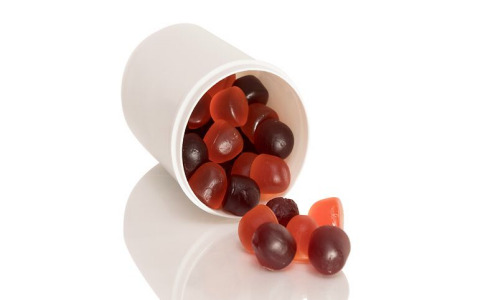
High load protein gummies by using H&F Citrus Pectin
21 Oct 2026
Dietary supplements are a rapidly growing market of which protein products, in particular, arecurrently very popular. Gummies are an attractive format for consuming dietary supplements.Consequently, protein gummies have become a common product developm...
Read more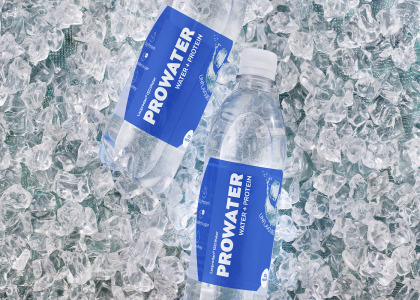
Clear water with a protein secret
19 Oct 2026
Crystal-clear protein water concept with 10g high-quality whey protein isolate in every 500ml serving. Powered by Lacprodan® ISO.Water, it combines the neutral taste of water with lasting clarity. A refreshing way to support hydration and muscle recove...
Read more
Unlock New Formulation Possibilities with One of the Industry's Broadest Lecithin and Protein Portfolios
16 Oct 2026
Food manufacturers today face a difficult balancing act: improving functionality, simplifying formulations, increasing protein content, all while maintaining the taste, texture, and quality consumers expect. At Fi Europe, discover how Bunge can ...
Read more
Fucoidan research surpasses 5000 studies
11 Oct 2026
Global
research interest in the marine extract fucoidan continues to surge, with the
number of published, peer-reviewed papers recently surpassing 5000.

Fi Europe 2026: See you in Frankfurt!
9 Oct 2026
Faravelli continues its centenary celebrations at Fi Europe 2026, looking ahead to what’s next. Meet the team at stand 41K45 and discover the right ingredients to make your products stand out.

HORIZONS, the New Foresight Platform for the Food Industry
6 Oct 2026
Roquette Launches HORIZONS, a new platform created to help food and nutrition businesses anticipate change, explore possible futures, and transform uncertainty into actionable strategies.
Read more
Launch of Breakthrough Clean-Tasting Pea Protein Isolate
6 Oct 2026
NUTRALYS® Pea 850F is Roquette’s latest pea protein isolate, representing a breakthrough in delivering a clean, neutral taste for plant-based product formulations.
Read more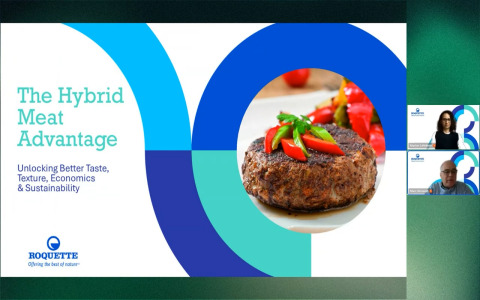
The Hybrid Meat Advantage
6 Oct 2026
Hybrid meat is quickly gaining recognition across Europe as a powerful way to meet modern food trends and consumer needs. At Roquette, we help food producers create hybrid meat products that deliver on taste, texture, affordability, and sustainability.
Read more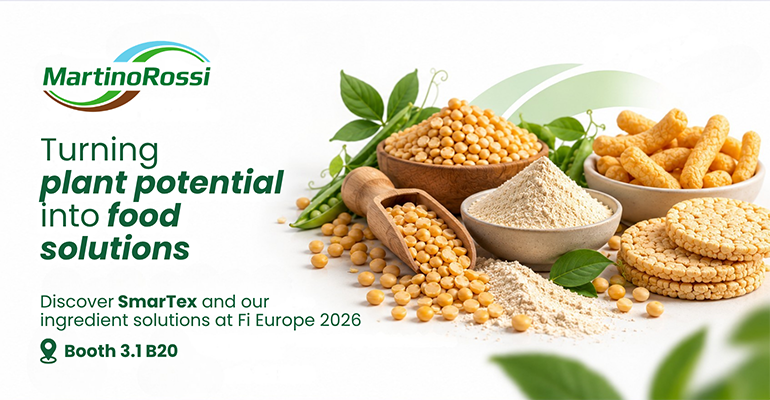
Turning plant potential into food solutions
1 Oct 2026
Today, plant-based and free-from ingredients must do more than replace. MartinoRossi combines nutrition, functionality, and processing performance to address new formulation challenges.
Read more
Hügli Food Industry: Innovations at Fi Europe 2026
1 Oct 2026
Taste 90 years of culinary mastery at Fi Europe (Booth 41G44), where Hügli will feature chilled Bresc Umami compounds alongside Sauce Culture, its newest snack seasoning concept.
Read more