
Ingredients Categories
Finished Products
Finished Food Categories
- Bakery
- Beverages / Juices
- Cereal and grain products
- Confectionery
- Cooking Fats & Oils
- Dairy
- Egg products
- Fruits & Vegetables
- Infant & Baby food
- Meat, Poultry & Fish
- Nuts & Seeds products
- Other Finished Food Categories
- Pet Food
- Plant-based foods
- Prepared foods
- Sauces & Seasonings
- Sweet & Savoury Spreads
Health & Wellness Areas
Delivery Formats
Operations & Services
- 3D printing
- Analysis/ Testing
- Auditing & certifications
- Blending & mixing
- Bottling
- Certification
- Clinical Trials
- Co-packing
- Coating
- Consulting
- Contract manufacturing
- Drying
- Electrospinning
- Encapsulating
- Enzymatic processing
- Extracting
- Extrusion
- Fat structuring
- Fermentation
- Filling
- Flavour development
- Freeze Drying
- Granulating/ grinding/ milling / mixing
- High pressure processing
- Labelling
- Other Operations & Services
- Packaging
- Packet filling
- Pasturising
- Quality assurance
- Saccharification
- Sheer cell processing
- Spray drying
- Sterilisation
- Storage & Logistics
- Tabletting
- Toasting / roasting
- Ultra-high temperature processing
Certification
News
Animal welfare claims on meat ‘have no agreed meaning’
17 Aug 2026Animal welfare claims on meat have no agreed meaning, meaning shoppers cannot make comparisons between products – and labels on processed foods tell them even less, a report has found.
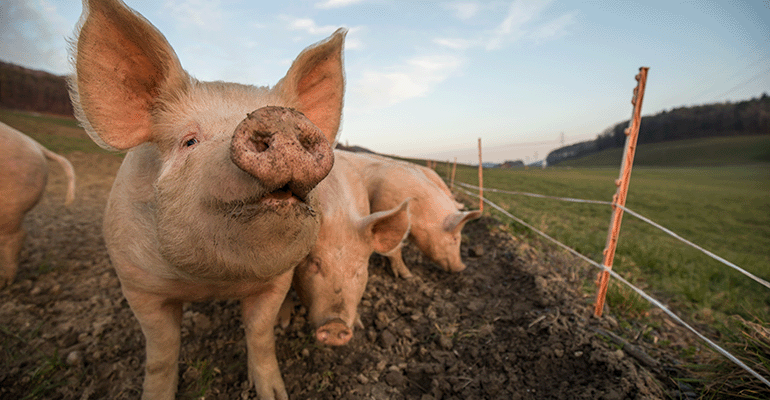
Lamb “reared with care by farmers who share our values”, pork from “trusted farmers, welfare assured”, and ducks “reared in small flocks in airy straw barns with multigrain diet and space to roam”: these are just a few of the welfare claims on meat products sitting on UK supermarket shelves today.
At a glance:
- A report has called out the meat industry for “welfare washing” – vague, misleading claims that fail to accurately reflect standards.
- The authors are now calling for a mandatory welfare label to be introduced.
- A five-tier label proposed in 2024 by the UK government would cover pork, chicken, and eggs, but not ready meals, dairy, beef, or food service.
None, however, contains a fixed definition of housing conditions, stocking density, or access to the outdoors, according to a report commissioned by the animal charity Four Paws UK entitled What’s behind the label?
“Terms such as ‘higher welfare’, ‘outdoor bred’, ‘responsibly sourced’, and ‘farm assured’ often appear without clear definition or explanation of how they relate to legal minimum standards, or to one another,” the authors wrote.
They called this “welfare washing”, which they likened to greenwashing: vague and misleading claims that imply higher welfare standards.
No plans to introduce method-of-production labelling
Four Paws UK is now calling for a mandatory welfare label showing how the animal was kept, and wants it applied across the market, for whole meat and processed products alike.
However, getting any welfare label on meat products may be the harder task. The UK’s Department for Environment, Food, and Rural Affairs (DEFRA) consulted on one in 2024, receiving 31,011 responses as part of the process.
Two years on, the government is yet to commit to any such label.
As part of a statement to Ingredients Network, John Powell, CEO of the British Meat Processors Association (BMPA), said: “We understand that the government has no current plans to introduce method-of-production labelling.”
Why welfare claims on pack cannot be compared like for like
Animal welfare claims have been challenged in recent years.
In October 2025, the UK’s Advertising Standards Association (ASA) upheld a complaint against Assured Food Standards' Red Tractor Scheme, in which a voiceover said “farmed with care”, and “from field to store, all our standards are met”.
The ASA ruled that the ad was “likely to exaggerate the benefits of Red Tractor endorsement” after reports from the Environment Agency alleged that “some environmental standards relating to pollution on Red Tractor Assured farms were not met”.
The report authors also assessed voluntary assurance schemes, and while they acknowledged that these are widely seen as valuable for setting auditable standards, they found “they have limited capacity to signal meaningful differences in animal welfare”.
Welfare information largely absent from processed foods
Those interviewed for the report repeatedly described processed food as a loophole.
One retailer explained that welfare information becomes diluted and consumers “less likely to scrutinise claims” as a product grows in complexity.
“Consequently, lower-welfare ingredients may become concentrated in processed or composite products for which welfare information is absent or less visible,” the report authors wrote.
The British Egg Industry Council made the same point regarding ingredients. Without country-of-origin and production system labelling of ingredients, its representatives told the report authors that consumers cannot determine the welfare status of animal products in processed foods.
When asked how a welfare label would work on a processed food, Emily Wilson, head of programmes at Four Paws UK, told Ingredients Network that “it is more complex, but it's certainly achievable”.
She added: “The key is ensuring that the animal-derived ingredients within a product carry the same method-of-production information as they would if sold on their own.
“Consumers shouldn't lose transparency simply because meat has become part of a lasagne, sandwich, or pie.”
What would the UK’s proposed method-of-production label cover?
In its 2024 consultation report, DEFRA’s proposed label “would apply to all unprocessed pork, chicken and eggs and certain prepacked and loose minimally processed products with pork, chicken or egg”.
The label would include five tiers “differentiating between products that fall below, meet and exceed relevant baseline UK welfare regulations”. It would apply to both domestic and imported goods.
For Wilson, the scope of the label is the problem.
“It's a positive first step, but it shouldn't be the final destination,” she said. “Covering pork, chicken, and eggs would improve transparency for millions of products and help consumers better understand how those animals were raised.
“However, for the system to be truly effective, it should be expanded over time to include all major animal products, processed foods, imported products, and the food service sector.
“Consumers shouldn't have access to clear welfare information in one aisle of the supermarket, but lose it as soon as they buy a ready meal or eat out.”
Why meat processors have doubts about what a label can carry
The companies that would be responsible for applying these labels – if any such proposal comes to fruition – are, however, not convinced it can carry that much.
Powell said that the BMPA “support clear labelling for consumers to enable them to make informed decisions about the products they buy”.
He added: “Many production methods are different but equally good for animals. Given the complexities surrounding different production systems, simplistic food labelling cannot easily convey enough information to allow properly informed choices.”
He did not say whether members could carry method-of-production data through to a ready meal.
In December 2025, the UK’s National Farmers’ Union (NFU), responding to DEFRA’s animal welfare strategy, said: “The NFU has made clear that while improved food labelling can help transparency, mandatory method-of-production labelling is not an effective or reliable way to communicate animal welfare outcomes.”
Asked about the industry’s argument that a label about housing is too simple and doesn’t really tell you how an animal has been treated, Wilson said: “They’re right that no single label can capture every aspect of an animal's welfare.
“Welfare is influenced by many factors throughout an animal's life. However, housing and production systems are among the biggest determinants of welfare and are relatively straightforward for consumers to understand.”

Get more of our news on Google
Set Ingredients Network as a 'Preferred Source' to get quicker access to the news you value.