
Ingredients Categories
Finished Products
Finished Food Categories
- Bakery
- Beverages / Juices
- Cereal and grain products
- Confectionery
- Cooking Fats & Oils
- Dairy
- Egg products
- Fruits & Vegetables
- Infant & Baby food
- Meat, Poultry & Fish
- Nuts & Seeds products
- Other Finished Food Categories
- Pet Food
- Plant-based foods
- Prepared foods
- Sauces & Seasonings
- Sweet & Savoury Spreads
Specialised Finished Products
- Bee products
- Biotic products
- Dietary supplements
- Energy drinks
- Functional beverages
- Functional confectionery
- Functional food
- Functional powders
- Meal replacement products
- Nutricosmetics
- Other Specialised Finished Products
- Pet Dietary Supplements
- Pharma and OTC products
- Protein products
- Sugar replacers / Sweeteners
Health & Wellness Areas
Delivery Formats
Operations & Services
- 3D printing
- Analysis/ Testing
- Auditing & certifications
- Blending & mixing
- Bottling
- Certification
- Clinical trials
- Co-packing
- Coating
- Consulting
- Contract manufacturing
- Drying
- Electrospinning
- Encapsulating
- Enzymatic processing
- Extracting
- Extrusion
- Fat structuring
- Fermentation
- Filling
- Flavour development
- Freeze drying
- Granulating/ grinding/ milling / mixing
- High-pressure processing
- Labelling
- Other Operations & Services
- Packaging
- Packet filling
- Pasturising
- Quality assurance
- Saccharification
- Shear cell processing
- Spray drying
- Sterilisation
- Storage & Logistics
- Tabletting
- Toasting / roasting
- Ultra-high temperature processing
News
Innovation in the cell-cultured meat sector
28 Oct 2022
As the number of animal-free meat consumers continues to grow, manufacturers are on the lookout for new, innovative, and sustainable ways to produce tasty alternatives to traditional meat. Eat Just and SuperMeat are just two companies disrupting the alternative industry with their cell-cultured meat products.
With almost half (47%) of global consumers currently following a diet based around the avoidance or moderation of animal produce, flexitarianism, or so-called ‘casual vegetarianism’, is quickly gaining ground as the modern diet of choice.
This, along with a host of factors including shortages resulting from supply chain challenges and the rising cost of animal-based diets, is driving a global plant-based market boom. In Europe alone, the plant-based meat sector was valued at €1.4 billion in 2020. And in the years since, it has only continued to balloon with sales values rising at a rate of 68%.
Over recent years, an influx of innovative plant-based ingredients, processing techniques, and products have entered and revolutionised the plant-based space. A recent report from flavour giant, Givaudan, exploring the most promising processing techniques on offer shows that while innovation is well underway, there remains a relatively untapped market for plant-based manufacturers to discover.
A sustainable alternative to traditional meat
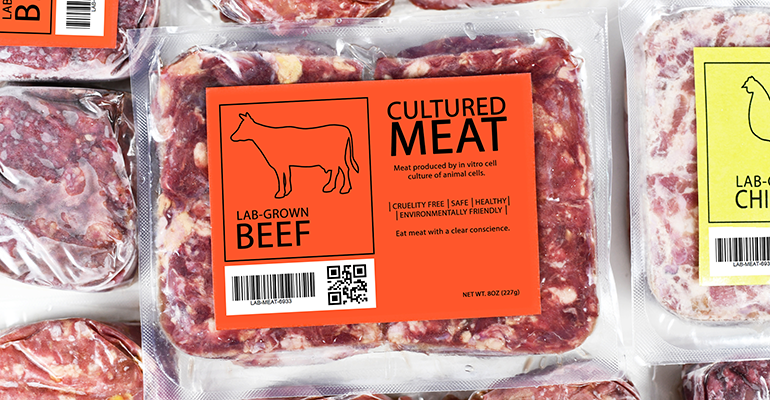
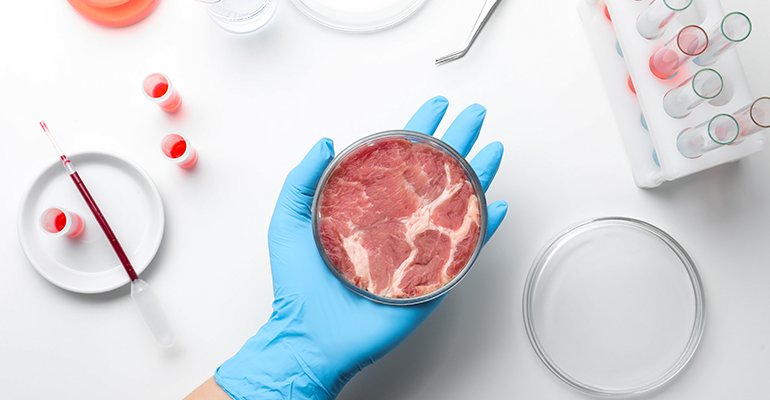
One promising processing technology that is increasingly being used by forward-thinking food manufacturers is cell-cultured, or cultivated, meat. This method produces meat alternatives by cultivating real animal cells in bioreactors in labs and arranging them in identical or similar structures as animal tissue, rather than formulating alternatives with plant-based ingredients. Since the creation of the first cultivated meat burger in 2013, the sector has gained investment of over $450 million across more than 60 companies globally.
Replicating the nutritional and sensory profiles of traditional meat, cultivated meat eliminates the need for animal agriculture, a top contributor to global greenhouse gas emissions, and allows consumers to enjoy the same taste and texture as the meat they’re used to eating. Given that cells from one animal could cultivate the same amount of product as countless animals, cell-cultured meat offers a sustainable alternative to the carnivorous diet. One estimate suggests that cell cultured meat could reduce land use by up to 95% and require 77% less water than its traditional counterparts. While consulting firm Kearney suggest that by 2040, 35% of all meat will be lab-grown.
 © AdobeStock/New Africa
Creating chicken nuggets via cultivation
Nevertheless, due to the specialist equipment required to carry out the process, capital and operating costs are high, and more innovation is needed to scale the technology and decrease the cost of end products. Question marks around whether cultivated meat alternatives classify as vegan or vegetarian, are also an obstacle to widescale consumer adoption.
In 2020, California-based startup Eat Just launched their cultivated meat chicken nuggets in Singapore, a world first on the back of a landmark approval of the meat alternative product for human consumption. The chicken nuggets were created when cells extracted from a chicken feather were added to 1,200-liter bioreactors. After around two weeks in the climate and pressure-controlled bioreactor, the cells multiplied and became edible animal tissue in the form of raw minced meat which were then moulded into the classic chicken nugget form. Eat Just’s chicken bites sold for $17 per portion at 1880 restaurant in Singapore.
Since then, the cultivated meat sector has seen further innovation including 100% cultured chicken products without the use of plant-based carrier or scaffolding, developed by SuperMeat in 2022, and Mosa Meat’s non-GMO and full tissue burgers which produced 80,000 patties from a sesame-seed size sample of cells in 2022, the report highlights.

Get more of our news on Google
Set Ingredients Network as a 'Preferred Source' to get quicker access to the news you value.
Related news

Kellogg accelerates work to remove artificial colours from all US cereals
3 Sep 2026
WK Kellogg has announced an accelerated timeline to eliminate all artificial colours and the chemical preservative, BHT, across its full US portfolio of cereals and cereal packaging.
Read more
Skimpflation: An ‘unfair’ and risky approach to keeping prices low
2 Sep 2026
Consumers see skimpflation – reducing the quality of ingredients due to rising costs – as more unfair than shrinkflation, making it a risky strategy according to recent research.
Read more
‘Urgent gaps’ in achieving 2030 food system goals
27 Aug 2026
Global food systems are failing to meet 2030 targets across indicators including health, environment, and resilience, according to a report co-authored by the Food and Agriculture Organisation (FAO).
Read more
Seven-Eleven uses microbial testing tech to extend katsudon shelf life
26 Aug 2026
Japanese retail company Seven-Eleven has improved its factory’s microbial environment to keep comfort-food staple, katsudon, fresher for longer.
Read more
Chimac’s fusion sauces bring Korean flavours to Europe
25 Aug 2026
Irish sauce brand Chimac is tapping into Korea’s culinary traditions, bringing its flavours and products to European consumers who want a taste of K-food.
Read more
Global demand for instant noodles continues to rise
24 Aug 2026
Global demand for instant noodles reached 124.21 billion servings last year, representing a 0.7% year-on-year increase – or 900 million extra servings.
Read more
China beverages: Is herbal innovation the future?
20 Aug 2026
Herbal and botanical innovation in China's drinks market continues to grow, with ingredients like astragalus root, ginger, and ginseng in the spotlight – and focus shifting far beyond refreshment.
Read more
Popular barbecue staples experience sharp price increases
19 Aug 2026
The typical cost of US shoppers’ barbecue baskets has risen by 12% over the past year – the fastest annual rise in a decade, figures from The Economist show.
Read more
Hot NPD: Nissin launches first cold-water Cup Noodles
18 Aug 2026
Nissin is taking one of Japan’s most iconic instant meals in a completely new direction with the launch of the first cold water-only Cup Noodles in the brand’s 55-year history.
Read more
Beyond 'nice to have': A spotlight on US functional beverages
12 Aug 2026
Functional beverage interest in the US is gaining important ground as consumers now expect function rather than see it as "nice to have", and there are clear market gaps for growth, according to Spate.
Read more