
Ingredients Categories
Finished Products
Finished Food Categories
- Bakery
- Beverages / Juices
- Cereal and grain products
- Confectionery
- Cooking Fats & Oils
- Dairy
- Egg products
- Fruits & Vegetables
- Infant & Baby food
- Meat, Poultry & Fish
- Nuts & Seeds products
- Other Finished Food Categories
- Pet Food
- Plant-based foods
- Prepared foods
- Sauces & Seasonings
- Sweet & Savoury Spreads
Specialised Finished Products
- Bee products
- Biotic products
- Dietary supplements
- Energy drinks
- Functional beverages
- Functional confectionery
- Functional food
- Functional powders
- Meal replacement products
- Nutricosmetics
- Other Specialised Finished Products
- Pet Dietary Supplements
- Pharma and OTC products
- Protein products
- Sugar replacers / Sweeteners
Health & Wellness Areas
Delivery Formats
Operations & Services
- 3D printing
- Analysis/ Testing
- Auditing & certifications
- Blending & mixing
- Bottling
- Certification
- Clinical trials
- Co-packing
- Coating
- Consulting
- Contract manufacturing
- Drying
- Electrospinning
- Encapsulating
- Enzymatic processing
- Extracting
- Extrusion
- Fat structuring
- Fermentation
- Filling
- Flavour development
- Freeze drying
- Granulating/ grinding/ milling / mixing
- High-pressure processing
- Labelling
- Other Operations & Services
- Packaging
- Packet filling
- Pasturising
- Quality assurance
- Saccharification
- Shear cell processing
- Spray drying
- Sterilisation
- Storage & Logistics
- Tabletting
- Toasting / roasting
- Ultra-high temperature processing
News
Mars launches animal-free chocolate with Perfect Day’s whey protein
21 Jun 2022
Mars has launched a vegan chocolate bar made with biotech unicorn Perfect Day’s animal-free whey protein made via precision fermentation.
The chocolate bar, called CO2COA in a reference to the reduced greenhouse gas emissions associated with its ingredient sourcing, is vegan, free from lactose and cholesterol, and wrapped in paper-based packaging. It bears a front-of-pack claim saying: ‘Made with animal-free dairy’.
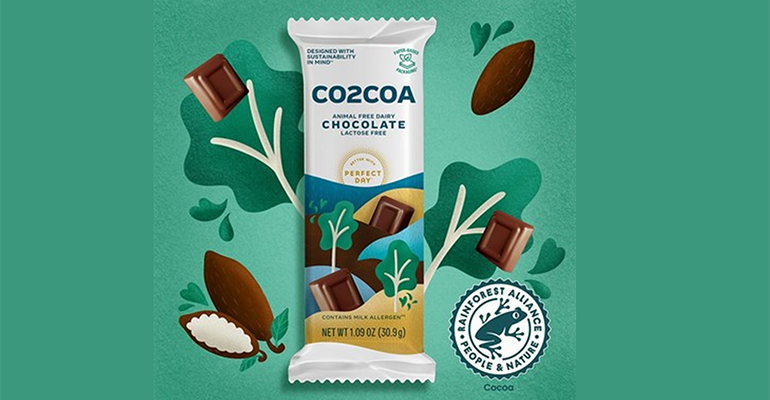
The chocolate bar, called CO2COA in a reference to the reduced greenhouse gas emissions associated with its ingredient sourcing, is vegan, free from lactose and cholesterol, and wrapped in paper-based packaging. It bears a front-of-pack claim saying: ‘Made with animal-free dairy’.
The bar, available online as of 16 June until stocks last, is also made with Rainforest Alliance-certified cocoa.
Chris Rowe, global vice president of research & development at Mars Wrigley, said the chocolate bar was “an inventive example” of how Mars partners with technology innovators to bring new offerings to consumers and explore the potential of alternative proteins.
Alastair Child, chief sustainability officer at Mars Wrigley added that it was “thoughtfully designed” to achieve Mars’ goal of net zero greenhouse gas (GHG) emissions across its full value chain by 2050.
Last year, Perfect Day released the results of a life-cycle assessment (LCA) of its production process, which found it reduces blue water consumption by at least 96% and non-renewable energy use by at least 29%, compared with conventional whey production methods. The company also says its production methods cut greenhouse gas emissions by up to 97%.
What is Perfect Day’s ingredient?
Precision fermentation uses microbial hosts (such as yeast, bacteria and microalgae) as ‘cell factories’ for producing specific functional ingredients. Perfect Day says its process involves giving microorganisms the precise DNA sequence that serves as a blueprint for how to make cow whey protein – “the thing that makes milk taste, whip, and swirl like milk”. Genetic engineering is involved in the process but GM ingredients are not present in the final whey product.
The ingredient launched in 2020 and is approved for use in the US, Hong Kong and Singapore where manufacturers are using it in ice creams, cream cheese, baked goods, and sports nutrition products.
Ryan Pandya, Perfect Day cofounder and CEO, said: "Partnering with a forward-looking leader like Mars to accelerate their innovation and sustainability initiatives is a hallmark example of how we're extending our impact.”
In 2021, Starbucks began to trial Perfect Day milk in select locations, for instance.
From dairy to palm oil: Big Food embraces biotech
A growing number of consumer-facing multinational manufacturers are partnering with biotech startups to source sustainable, lower-impact ingredients for their products.
Mars’ partnership with Perfect Day comes as Unilever announced a $120 million joint investment with San Diego startup Geno to produce alternatives to palm kernel oil-derived surfactants via precision fermentation for its home care and personal care portfolio.
On the supply side, Kerry recently acquired two biotech companies: C-LEcta , a German precision fermentation firm and Mexican enzyme manufacturer, Enmex, saying the dual acquisition would accelerate its capabilities in enzyme engineering, fermentation and bio-process development.
According to animal-free advocacy organisation, the Good Food Institute (GFI), precision fermentation, which is being used to produce enzymes, flavours, proteins, vitamins, natural pigments, and fats, is well suited to creating high-value ingredients for plant-based foods.
“These ingredients typically require greater purity than the primary protein ingredients and are incorporated at much lower levels in finished products,” GFI wrote in a 2021 State of the Industry report on fermentation. “These ingredients are powerful enablers of improved sensory characteristics and functional attributes of plant-based products or cultivated meat.”

Get more of our news on Google
Set Ingredients Network as a 'Preferred Source' to get quicker access to the news you value.
Related news

Kellogg accelerates work to remove artificial colours from all US cereals
3 Sep 2026
WK Kellogg has announced an accelerated timeline to eliminate all artificial colours and the chemical preservative, BHT, across its full US portfolio of cereals and cereal packaging.
Read more
Skimpflation: An ‘unfair’ and risky approach to keeping prices low
2 Sep 2026
Consumers see skimpflation – reducing the quality of ingredients due to rising costs – as more unfair than shrinkflation, making it a risky strategy according to recent research.
Read more
‘Urgent gaps’ in achieving 2030 food system goals
27 Aug 2026
Global food systems are failing to meet 2030 targets across indicators including health, environment, and resilience, according to a report co-authored by the Food and Agriculture Organisation (FAO).
Read more
Seven-Eleven uses microbial testing tech to extend katsudon shelf life
26 Aug 2026
Japanese retail company Seven-Eleven has improved its factory’s microbial environment to keep comfort-food staple, katsudon, fresher for longer.
Read more
Chimac’s fusion sauces bring Korean flavours to Europe
25 Aug 2026
Irish sauce brand Chimac is tapping into Korea’s culinary traditions, bringing its flavours and products to European consumers who want a taste of K-food.
Read more
Global demand for instant noodles continues to rise
24 Aug 2026
Global demand for instant noodles reached 124.21 billion servings last year, representing a 0.7% year-on-year increase – or 900 million extra servings.
Read more
China beverages: Is herbal innovation the future?
20 Aug 2026
Herbal and botanical innovation in China's drinks market continues to grow, with ingredients like astragalus root, ginger, and ginseng in the spotlight – and focus shifting far beyond refreshment.
Read more
Popular barbecue staples experience sharp price increases
19 Aug 2026
The typical cost of US shoppers’ barbecue baskets has risen by 12% over the past year – the fastest annual rise in a decade, figures from The Economist show.
Read more
Hot NPD: Nissin launches first cold-water Cup Noodles
18 Aug 2026
Nissin is taking one of Japan’s most iconic instant meals in a completely new direction with the launch of the first cold water-only Cup Noodles in the brand’s 55-year history.
Read more
Beyond 'nice to have': A spotlight on US functional beverages
12 Aug 2026
Functional beverage interest in the US is gaining important ground as consumers now expect function rather than see it as "nice to have", and there are clear market gaps for growth, according to Spate.
Read more