
Ingredients Categories
Finished Products
Finished Food Categories
- Bakery
- Beverages / Juices
- Cereal and grain products
- Confectionery
- Cooking Fats & Oils
- Dairy
- Egg products
- Fruits & Vegetables
- Infant & Baby food
- Meat, Poultry & Fish
- Nuts & Seeds products
- Other Finished Food Categories
- Pet Food
- Plant-based foods
- Prepared foods
- Sauces & Seasonings
- Sweet & Savoury Spreads
Specialised Finished Products
- Bee products
- Biotic products
- Dietary supplements
- Energy drinks
- Functional beverages
- Functional confectionery
- Functional food
- Functional powders
- Meal replacement products
- Nutricosmetics
- Other Specialised Finished Products
- Pet Dietary Supplements
- Pharma and OTC products
- Protein products
- Sugar replacers / Sweeteners
Health & Wellness Areas
Delivery Formats
Operations & Services
- 3D printing
- Analysis/ Testing
- Auditing & certifications
- Blending & mixing
- Bottling
- Certification
- Clinical trials
- Co-packing
- Coating
- Consulting
- Contract manufacturing
- Drying
- Electrospinning
- Encapsulating
- Enzymatic processing
- Extracting
- Extrusion
- Fat structuring
- Fermentation
- Filling
- Flavour development
- Freeze drying
- Granulating/ grinding/ milling / mixing
- High-pressure processing
- Labelling
- Other Operations & Services
- Packaging
- Packet filling
- Pasturising
- Quality assurance
- Saccharification
- Shear cell processing
- Spray drying
- Sterilisation
- Storage & Logistics
- Tabletting
- Toasting / roasting
- Ultra-high temperature processing
News
US consumers make a beeline for honey-sweetened products
4 Oct 2022
Honey-sweetened products are enjoying rising demand amongst US consumers, perceived as an all-natural product, according to recent USDA figures.
Recent figures released by the United States Department of Agriculture (USDA) suggest honey demand has reached an all-time high in the US, with consumption along with ‘made-with-honey’ products totalling 618 million pounds (lb) in 2021. The previous record was 596 million pounds in 2017.

“We are thrilled to see the results of this study,” says Margaret Lombard, chief executive officer of the National Honey Board.
“It means that consumers are beginning to understand when you choose honey you are not only getting a perfect all-natural sweetener, but you are supporting honeybees and beekeepers who help to feed the world."
Product launches with honey: Ice cream, ketchup, and energy bars
Recent years have seen a spate of product innovation using honey as a sweetener or for added flavour. In 2018, Unilever-owned Hellmann launched a honey-sweetened ketchup made with only six ingredients. Meanwhile, Kellogg-owned brand RX, has offered an ‘on-the-go’ solution with the release of ‘RXBar A.M,’ its range of clean-label energy bar that uses honey and coconut sugar to provide the sweet taste.
US ice cream brand Häagen‐Dazs continues to carry the Xerces Society's Bee Better Certified Seal on its products containing almonds, reassuring consumers the nut was grown and harvested in a 'bee-friendly' manner.
US consumers eat honey for health and sustainability
The plight of bees and its role in the honey making process was cited as a key purchasing factor in the National Honey Board’s 2021 Attitudes and Usage study.
Surveying 2,000 US consumers, the study found the most popular reasons for increased honey consumption were split between antioxidants and bee health. Despite its high sugar content, honey has been described as an immune system booster, thanks to its antimicrobial, anti-inflammatory, and antioxidant properties. Research has also pointed to its antiviral effects that may offer protection from flu.
However, domestic production is not enough to meet demand in the US. Since 1991, imports of honey grew by an average 7.5% per year, or 17 million pounds, to fill the supply deficit from the declining domestic honey production.
“Imports have exceeded domestic honey production since 2005 and accounted for 74% of total US honey supplies in 2021, up from 27% in 1991,” the USDA report states.
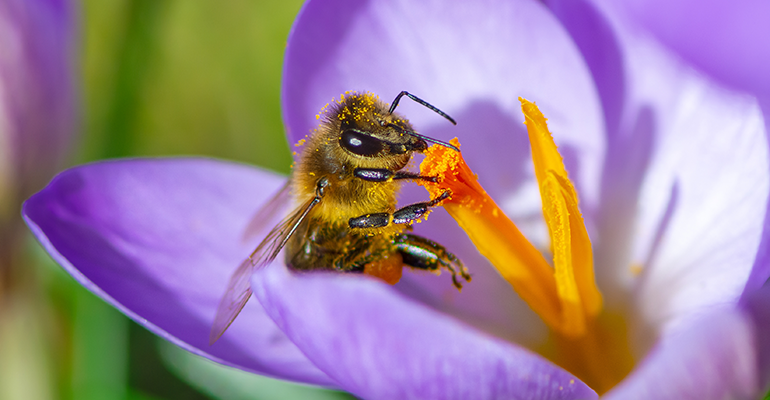 © AdobeStock/manfredxy
Startups are making bee-free honey
Thus, environmental concerns have given way to alternative solutions to meet demand. Startups, such as Bee-io Honey, are now touting innovative ways to produce honey in the lab setting.
The food tech firm has begun scaling up development of its cultured honey production system, which uses a fermentation process and bioreactors, to produce in microorganisms, proteins normally produced by bees. The proteins are then blended with plant-derived natural nectar components to make honey.
Another startup in this space is MeliBio, a San Francisco-based firm that has just raised $5.7 million in funding to scale and commercialise its bee-free honey.
The process, which was previously named TIME’s Best Inventions in 2021, also uses a fermentation-based approach to produce honey that the firm says is molecularly identical to traditional honey.
“We know that science can produce delicious and nutritious honey at no cost to our precious bees,” says Darko Mandich, CEO & Co-Founder of MeliBio.
“At MeliBio, we are here to introduce certainty in the supply chain and help companies simplify their honey sourcing, while making their honey-based formulations sustainable and delicious.
“Together with our clients, we can make the future of honey better, for both humans and for bees.”

Get more of our news on Google
Set Ingredients Network as a 'Preferred Source' to get quicker access to the news you value.
Related news
Kellogg accelerates work to remove artificial colours from all US cereals
3 Sep 2026
WK Kellogg has announced an accelerated timeline to eliminate all artificial colours and the chemical preservative, BHT, across its full US portfolio of cereals and cereal packaging.
Read more
Skimpflation: An ‘unfair’ and risky approach to keeping prices low
2 Sep 2026
Consumers see skimpflation – reducing the quality of ingredients due to rising costs – as more unfair than shrinkflation, making it a risky strategy according to recent research.
Read more
‘Urgent gaps’ in achieving 2030 food system goals
27 Aug 2026
Global food systems are failing to meet 2030 targets across indicators including health, environment, and resilience, according to a report co-authored by the Food and Agriculture Organisation (FAO).
Read more
Seven-Eleven uses microbial testing tech to extend katsudon shelf life
26 Aug 2026
Japanese retail company Seven-Eleven has improved its factory’s microbial environment to keep comfort-food staple, katsudon, fresher for longer.
Read more
Chimac’s fusion sauces bring Korean flavours to Europe
25 Aug 2026
Irish sauce brand Chimac is tapping into Korea’s culinary traditions, bringing its flavours and products to European consumers who want a taste of K-food.
Read more
Global demand for instant noodles continues to rise
24 Aug 2026
Global demand for instant noodles reached 124.21 billion servings last year, representing a 0.7% year-on-year increase – or 900 million extra servings.
Read more
China beverages: Is herbal innovation the future?
20 Aug 2026
Herbal and botanical innovation in China's drinks market continues to grow, with ingredients like astragalus root, ginger, and ginseng in the spotlight – and focus shifting far beyond refreshment.
Read more
Popular barbecue staples experience sharp price increases
19 Aug 2026
The typical cost of US shoppers’ barbecue baskets has risen by 12% over the past year – the fastest annual rise in a decade, figures from The Economist show.
Read more
Hot NPD: Nissin launches first cold-water Cup Noodles
18 Aug 2026
Nissin is taking one of Japan’s most iconic instant meals in a completely new direction with the launch of the first cold water-only Cup Noodles in the brand’s 55-year history.
Read more
Beyond 'nice to have': A spotlight on US functional beverages
12 Aug 2026
Functional beverage interest in the US is gaining important ground as consumers now expect function rather than see it as "nice to have", and there are clear market gaps for growth, according to Spate.
Read more