
Ingredients Categories
Finished Products
Finished Food Categories
- Bakery
- Beverages / Juices
- Cereal and grain products
- Confectionery
- Cooking Fats & Oils
- Dairy
- Egg products
- Fruits & Vegetables
- Infant & Baby food
- Meat, Poultry & Fish
- Nuts & Seeds products
- Other Finished Food Categories
- Pet Food
- Plant-based foods
- Prepared foods
- Sauces & Seasonings
- Sweet & Savoury Spreads
Specialised Finished Products
- Bee products
- Biotic products
- Dietary supplements
- Energy drinks
- Functional beverages
- Functional confectionery
- Functional food
- Functional powders
- Meal replacement products
- Nutricosmetics
- Other Specialised Finished Products
- Pet Dietary Supplements
- Pharma and OTC products
- Protein products
- Sugar replacers / Sweeteners
Health & Wellness Areas
Delivery Formats
Operations & Services
- 3D printing
- Analysis/ Testing
- Auditing & certifications
- Blending & mixing
- Bottling
- Certification
- Clinical trials
- Co-packing
- Coating
- Consulting
- Contract manufacturing
- Drying
- Electrospinning
- Encapsulating
- Enzymatic processing
- Extracting
- Extrusion
- Fat structuring
- Fermentation
- Filling
- Flavour development
- Freeze drying
- Granulating/ grinding/ milling / mixing
- High-pressure processing
- Labelling
- Other Operations & Services
- Packaging
- Packet filling
- Pasturising
- Quality assurance
- Saccharification
- Shear cell processing
- Spray drying
- Sterilisation
- Storage & Logistics
- Tabletting
- Toasting / roasting
- Ultra-high temperature processing
News
Clutch Cognition creates functional drinks with brain health botanicals
7 Jun 2022
Danish startup, Clutch Cognition, has entered the functional drinks space targeting cognitive health with a blend of botanicals and plant-based ingredients such as sage, green oat, green tea, and guar beans.
Clutch Cognition says it uses the intersection between science, via clinical evidence, and plant-derived nutrition to create the “most relevant ‘smartdrink’.” Its plant-based beverage is targeted at the modern-day consumer, who lives “a sedentary, yet mentally challenging and exhausting lifestyle,” says Rune Rønhave Laursen, founder of Clutch Cognition, and the main inventor of the drink.
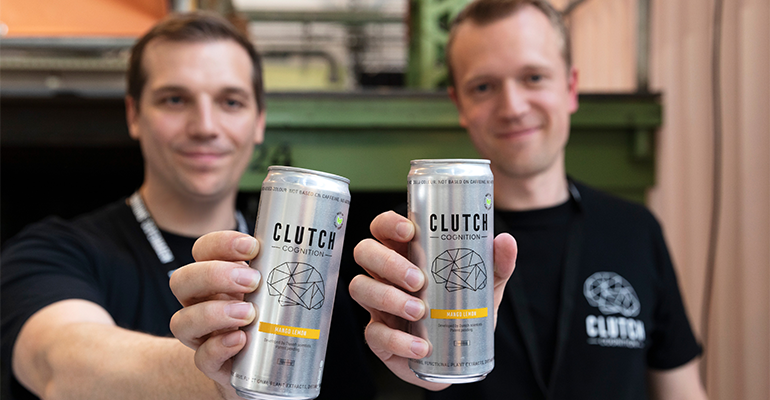
The brand believes the highest possible value-add for the general consumer comes from phytonutrients, or plant nutrients. “But only the right ones of course,” says Rønhave Laursen. Clutch Cognition has formulated its drink using ingredients it recognises for their beneficial properties, including the herb sage, green oat, green tea, guar beans and vitamins B5 and C.
The brand states that its concept is unique in the beverage market as it combines two overall product-specific purposes. Namely, its first purpose is to provide health for the body, specifically good macronutrition. As a result, it can help people manage their weight and have stable blood sugar, Clutch Cognition says. Also, the brand says it offers cognitive benefits in mental wellbeing to help people be as productive as possible while not suffering from stress, conversely to other drinks products such as caffeine.
Producing a plant-powered drink “for brains”
The inspiration for Clutch Cognition’s formulation came from the brand’s observation that functional beverages are ubiquitous. The brand noted that as consumers, we see other drinks products such as coffee and energy drinks as easily accessible and promoted products.
“In large part, they are being used with the intent of increasing productivity, but the irony of it is that for the most part, the common options, which are all based on caffeine, will eventually lead to a net decrease in productivity,” says Rønhave Laursen.
Clutch Cognition wanted to respond by creating a product that offers the benefits people seek. The Danish plant-based drinks brand saw that consumers wanted a product that enabled them “to be their best and most productive selves, without sacrificing health and productivity in the mid to long-term,” Rønhave Laursen adds.
The plant-powered formulator also wanted its product to be macronutritionally healthy by providing good nutrition for the body, as this is something Clutch Cognition believes beverages, in general, fail to do. “At least when you compare the nutritional profiles of a product to the typical sedentary lifestyle,” says Rønhave Laursen. the lack of good macronutrients in beverages was an important inspiration for Clutch Cognition to create its plant-based drink.
The R&D process
Clutch Cognition set out conceptualising its drink “for the brain” by deploying its team of three. Its trio consisted of a molecular biologist, a medical doctor and a nutrition expert and author. The brand already had a good idea of what it wanted the product to achieve: stabilising blood sugar, high in fibre, improving concentration and reducing stress.
The team also had a clear notion of where to start its research and product development (R&D), namely by finding the most potent phytonutrients, according to existing clinical evidence. “There was a significant amount of hands-on kitchen experiments involved developing the taste of the product and making sure that it was stable,” says Rønhave Laursen.
During the latter stages of this product development process, Clutch Cognition teamed up with co-founder and co-owner of the brand, Martin Kilic, who has since been developing the company and product’s narrative and brand strategy. “We worked intensely on conveying the right message in the most convenient way, e.g., asking ourselves how do you promote and describe a multifaceted ‘science-backed nootropic health drink’ to ordinary consumers?” says Kilic.
The team decided to go with the term ‘smartdrink’. “The beauty of it is that once people try Clutch and understand its effect, the message tends to spread by word of mouth,” Kilic adds. Therefore, even though the brand is a startup, it believes it has a solid business case for commercialisation which it is now trying to magnify by opening for investments.
Between the finalisation of the product prototype and commercialisation of it, Clutch Cognition also faced a hurdle in that the product ended up so different from the composition of other beverages that most co-manufacturers were unable to make it. “This was initially a tough nut to crack, but there are a lot of beverage co-manufacturers out there, and we eventually found the right partner for both short and long term and even a few other options in reserve,” says Rønhave Laursen.
Nootropics, cognitive health and emotional wellbeing
Clutch Cognition recognises that the brain is a complex organ and cognition is a broad term. The cognitive benefits that it believes are most relevant to most consumers generally relate to stability and mental wellbeing. “Hence, we have opted not to go the classical stimulant-based route, where people get a brief ‘kick’, but maybe incur side effects shortly after, as this is in principle the opposite of stability and wellbeing,” says Rønhave Laursen.
Instead, to promote cognitive stability, Clutch Cognition chose to home in on ingredients that have been proven to increase concentration and reduce stress. The brand believes that this fosters better wellbeing and productivity both on a day-to-day basis and longer term.
Commenting on how this aligns with consumer interest in nootropics, cognitive health, and emotional wellbeing, Rønhave Laursen says: “Extremely well!” When Clutch Cognition began the development process approximately five years ago, it didn’t know that these topics would be on-trend when launching Clutch. “We simply developed the product this way because we are absolutely convinced that this is what people need,” says Rønhave Laursen.
“It’s getting more and more evident post-covid – there is a global rise in demand for healthy, plant-based and clean label products for sure but also mental wellbeing products; we just happen to combine several interests in one product,” says Kilic.
Impact on the drinks segment
The vision behind the company is to make the world healthier and smarter. The brand states it never saw itself owning a company that makes beverages. Still, it figured that its best chance of increasing health on a societal level would come from a successful attempt at challenging the status quo of the beverage sector.
Clutch Cognition saw that the drinks industry “seems to consist almost entirely of products that range from extremely unhealthy to possibly not unhealthy but also not healthy,” says Rønhave Laursen. While there may be a few exceptions, it states that those would be niche products.
“We have made Clutch the way it is for it to become mainstream in the future,” says Rønhave Laursen. “Our mission is to offer smart nutritional choices that are both healthy, convenient, and beneficial for the average consumer worldwide.”

Get more of our news on Google
Set Ingredients Network as a 'Preferred Source' to get quicker access to the news you value.
Related news

Kellogg accelerates work to remove artificial colours from all US cereals
3 Sep 2026
WK Kellogg has announced an accelerated timeline to eliminate all artificial colours and the chemical preservative, BHT, across its full US portfolio of cereals and cereal packaging.
Read more
Skimpflation: An ‘unfair’ and risky approach to keeping prices low
2 Sep 2026
Consumers see skimpflation – reducing the quality of ingredients due to rising costs – as more unfair than shrinkflation, making it a risky strategy according to recent research.
Read more
‘Urgent gaps’ in achieving 2030 food system goals
27 Aug 2026
Global food systems are failing to meet 2030 targets across indicators including health, environment, and resilience, according to a report co-authored by the Food and Agriculture Organisation (FAO).
Read more
Seven-Eleven uses microbial testing tech to extend katsudon shelf life
26 Aug 2026
Japanese retail company Seven-Eleven has improved its factory’s microbial environment to keep comfort-food staple, katsudon, fresher for longer.
Read more
Chimac’s fusion sauces bring Korean flavours to Europe
25 Aug 2026
Irish sauce brand Chimac is tapping into Korea’s culinary traditions, bringing its flavours and products to European consumers who want a taste of K-food.
Read more
Global demand for instant noodles continues to rise
24 Aug 2026
Global demand for instant noodles reached 124.21 billion servings last year, representing a 0.7% year-on-year increase – or 900 million extra servings.
Read more
China beverages: Is herbal innovation the future?
20 Aug 2026
Herbal and botanical innovation in China's drinks market continues to grow, with ingredients like astragalus root, ginger, and ginseng in the spotlight – and focus shifting far beyond refreshment.
Read more
Popular barbecue staples experience sharp price increases
19 Aug 2026
The typical cost of US shoppers’ barbecue baskets has risen by 12% over the past year – the fastest annual rise in a decade, figures from The Economist show.
Read more
Hot NPD: Nissin launches first cold-water Cup Noodles
18 Aug 2026
Nissin is taking one of Japan’s most iconic instant meals in a completely new direction with the launch of the first cold water-only Cup Noodles in the brand’s 55-year history.
Read more
Beyond 'nice to have': A spotlight on US functional beverages
12 Aug 2026
Functional beverage interest in the US is gaining important ground as consumers now expect function rather than see it as "nice to have", and there are clear market gaps for growth, according to Spate.
Read more