
Ingredients Categories
Finished Products
Finished Food Categories
- Bakery
- Beverages / Juices
- Cereal and grain products
- Confectionery
- Cooking Fats & Oils
- Dairy
- Egg products
- Fruits & Vegetables
- Infant & Baby food
- Meat, Poultry & Fish
- Nuts & Seeds products
- Other Finished Food Categories
- Pet Food
- Plant-based foods
- Prepared foods
- Sauces & Seasonings
- Sweet & Savoury Spreads
Specialised Finished Products
- Bee products
- Biotic products
- Dietary supplements
- Energy drinks
- Functional beverages
- Functional confectionery
- Functional food
- Functional powders
- Meal replacement products
- Nutricosmetics
- Other Specialised Finished Products
- Pet Dietary Supplements
- Pharma and OTC products
- Protein products
- Sugar replacers / Sweeteners
Health & Wellness Areas
Delivery Formats
Operations & Services
- 3D printing
- Analysis/ Testing
- Auditing & certifications
- Blending & mixing
- Bottling
- Certification
- Clinical trials
- Co-packing
- Coating
- Consulting
- Contract manufacturing
- Drying
- Electrospinning
- Encapsulating
- Enzymatic processing
- Extracting
- Extrusion
- Fat structuring
- Fermentation
- Filling
- Flavour development
- Freeze drying
- Granulating/ grinding/ milling / mixing
- High-pressure processing
- Labelling
- Other Operations & Services
- Packaging
- Packet filling
- Pasturising
- Quality assurance
- Saccharification
- Shear cell processing
- Spray drying
- Sterilisation
- Storage & Logistics
- Tabletting
- Toasting / roasting
- Ultra-high temperature processing
Sponsored Content
Shorter drying time, sweeter success!
30 Oct 2025Curious about cost-effective, sustainable and delicious candy making? Stefan Wessel reveals how Avebe’s solutions reduce drying time and energy use by up to 50%.
Anyone who thinks making candy is child’s play is mistaken. Behind a classic wine gum lies a complex process of mixing, molding, and especially waiting. The candy dries for as long as two days at a specific humidity and a temperature of 50°C.
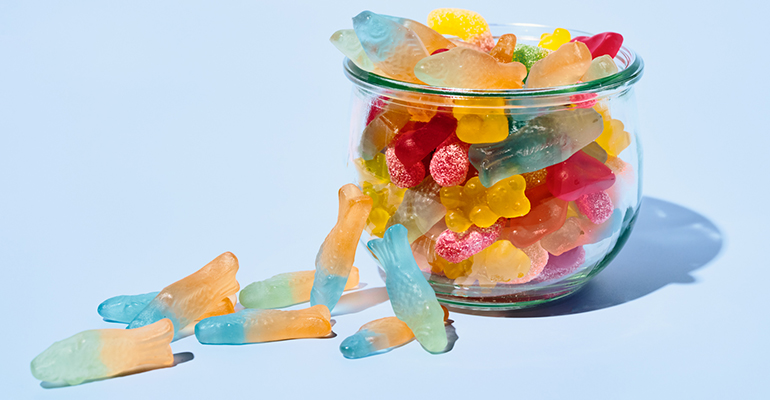
“Cost issues, changing consumer preferences, misconceptions about alternative solutions. The confectionery industry is facing several challenges right now, and many producers are struggling to adapt without compromising product quality,” said Stefan Wessel, Customer Application Specialist at Avebe. “Time, space, and energy are scarce resources. The production capacity of manufacturers often depends on the size of the drying rooms. That’s why our customers regularly ask for a shorter drying time. We are always happy to think along with them and look for a solution.”

Customer needs at the centre
"In Avebe’s laboratory, we test on a small scale what the manufacturer produces on a large scale", Stefan explained. “To make a starch-based vegan wine gum, for example, you have to heat sugar and also starch. Within Avebe’s portfolio, you can choose between 10 to 15 types of starch for confectionery. Depending on the customer’s wishes, we select a starch that matches the required structure and elasticity. We also experiment with high or low concentrations – and now, with long or short drying times. We keep testing with different variables until it meets the customer’s needs.”
Shorter drying time for gummy candy
Based on the customer’s wish to increase efficiency in the production process, the product development department started working with different types of starch to shorten the drying time. The choice fell on a starch branded as PerfectaGEL®. Stefan advised: “When it comes to creating cost-effective (vegan) sugar confectionery without compromising on taste and texture, PerfectaGEL® starches are the ultimate solution.” This product was introduced earlier this year at ISM Prosweets in Cologne and at IFT in the USA, where it was very well received.
Liquid
Stefan explained that this specific starch not only ensures a shorter drying time, but also keeps the product liquid for longer, making it easier to pour into a starch mold. “After the drying process, the gummies are removed from the mold.”
Texture and airiness of candy
“Other customer questions often relate to texture,” said Stefan. “In jargon, we call this a long or short structure. With a long structure, the candy can be stretched. With a short structure, the chewy candies are a bit firmer, like classic wine gums. Additionally, candy manufacturers want to control density, and for that, we have our proteins. The lower the density, the airier the foam candy,” he explained.
Reduce drying time up to 50%
PerfectaGEL® starches offer great taste and texture as can be a cost-effective cheaper alternative to gelatin and pectin, depending on current market prices. In addition, some PerfectaGEL® starches have fast-setting properties and low viscosity, allowing producers to reduce energy costs or increase factory output by up to 50%. Safe to say that a boost in efficiency like this will inevitably facilitate much more competitive product pricing.
Always at home
The candy most popular in Stefan’s family consists of two parts. One part is a wine gum with liquorice flavour, where potato starch provides firmness. The other part is a foam candy with banana flavour, where potato protein provides airiness. “That candy is always the first to go at our house. It’s a light, chewy candy. Especially the combination of liquorice and banana is very popular.”
Further reducing drying time?
“We continue to innovate. In the future, we want to reduce the drying time even further. It will then be possible to use solid molds made of plastic or metal, which are reusable,” says Stefan. He explains that the modified starch is also a vegan alternative to gelatin. And the shorter drying time also saves customers energy, time, and space.
Ready to Innovate?
Avebe invites ingredient buyers and suppliers to explore how its potato-based solutions can transform your confectionery portfolio. Whether you're looking to reduce drying time, improve texture, or meet clean-label demands, Avebe’s team is ready to collaborate.
Visit our booth at Fi Europe 2025 stand 40H110 or contact us today via avebe.com to learn more or request a sample.
This piece of content is provided by an advertiser or created on behalf of an advertiser. The views or opinions expressed in this piece of content do not reflect those of Informa.
Companies mentioned


Get more of our news on Google
Set Ingredients Network as a 'Preferred Source' to get quicker access to the news you value.
Related news

Kellogg accelerates work to remove artificial colours from all US cereals
3 Sep 2026
WK Kellogg has announced an accelerated timeline to eliminate all artificial colours and the chemical preservative, BHT, across its full US portfolio of cereals and cereal packaging.
Read more
Skimpflation: An ‘unfair’ and risky approach to keeping prices low
2 Sep 2026
Consumers see skimpflation – reducing the quality of ingredients due to rising costs – as more unfair than shrinkflation, making it a risky strategy according to recent research.
Read more
NielsenIQ’s EU barometer shows Britain leading in grocery inflation
31 Aug 2026
Britain was the only country to record grocery inflation above 2%, according to NielsenIQ data that compared Europe’s five biggest grocery markets from February to May 2026.
Read more
‘Urgent gaps’ in achieving 2030 food system goals
27 Aug 2026
Global food systems are failing to meet 2030 targets across indicators including health, environment, and resilience, according to a report co-authored by the Food and Agriculture Organisation (FAO).
Read more
Manam Chocolate aims to bring premium Indian cacao to 'the world stage'
11 Aug 2026
Craft chocolate brand Manam Chocolate is investing in local expansion and supply chain innovation throughout India as it works to build out the premium reputation of its locally produced cacao products.
Read more
Digital twin technology gains ground in food manufacturing
6 Aug 2026
Food and beverage companies are increasingly turning to digital twins to optimise and automate manufacturing processes, but opportunities stretch far beyond this, say experts.
Read more
Nestlé invests in regeneratively farmed wheat for KitKat
5 Aug 2026
Nestlé will pay a premium for Wildfarmed’s regeneratively farmed wheat but the CPG remains reticent to promote the move on packs of its KitKat bars.
Read more
EU sets maximum MOAH levels to protect human health
28 Jul 2026
The EU will adopt maximum levels for mineral oil aromatic hydrocarbons (MOAH) in food to protect human health. What do manufacturers need to know?
Read more
UK publishes guidance on SPS food trade agreement with EU
27 Jul 2026
The UK government has shared guidance on how food businesses can prepare for its upcoming Sanitary and Phytosanitary (SPS) agreement with the EU.
Read more
Industry hits back at UK’s proposed healthy food rules
24 Jul 2026
Food brands, including Haribo, have hit out against the UK’s proposed nutrient profiling model, which places a new focus on free sugars that are added during manufacturing.
Read more