
Ingredients Categories
Finished Products
Finished Food Categories
- Bakery
- Beverages / Juices
- Cereal and grain products
- Confectionery
- Cooking Fats & Oils
- Dairy
- Egg products
- Fruits & Vegetables
- Infant & Baby food
- Meat, Poultry & Fish
- Nuts & Seeds products
- Other Finished Food Categories
- Pet Food
- Plant-based foods
- Prepared foods
- Sauces & Seasonings
- Sweet & Savoury Spreads
Specialised Finished Products
- Bee products
- Biotic products
- Dietary supplements
- Energy drinks
- Functional beverages
- Functional confectionery
- Functional food
- Functional powders
- Meal replacement products
- Nutricosmetics
- Other Specialised Finished Products
- Pet Dietary Supplements
- Pharma and OTC products
- Protein products
- Sugar replacers / Sweeteners
Health & Wellness Areas
Delivery Formats
Operations & Services
- 3D printing
- Analysis/ Testing
- Auditing & certifications
- Blending & mixing
- Bottling
- Certification
- Clinical trials
- Co-packing
- Coating
- Consulting
- Contract manufacturing
- Drying
- Electrospinning
- Encapsulating
- Enzymatic processing
- Extracting
- Extrusion
- Fat structuring
- Fermentation
- Filling
- Flavour development
- Freeze drying
- Granulating/ grinding/ milling / mixing
- High-pressure processing
- Labelling
- Other Operations & Services
- Packaging
- Packet filling
- Pasturising
- Quality assurance
- Saccharification
- Shear cell processing
- Spray drying
- Sterilisation
- Storage & Logistics
- Tabletting
- Toasting / roasting
- Ultra-high temperature processing
News
Europe’s plant-based boom: Opportunities for brands
6 Jul 2022
The plant-based alternative sector is rapidly expanding, in Europe and further afield. What are consumers demanding, and where do the opportunities lie for brands?
The European plant-based meat sector has exploded in popularity in recent years, reaching an estimated value of €1.4b in 2020, data from the EU Smart Protein project shows. With sales values rising at a rate of 68% over the past two years, this staggering growth certainly shows no signs of slowing down.
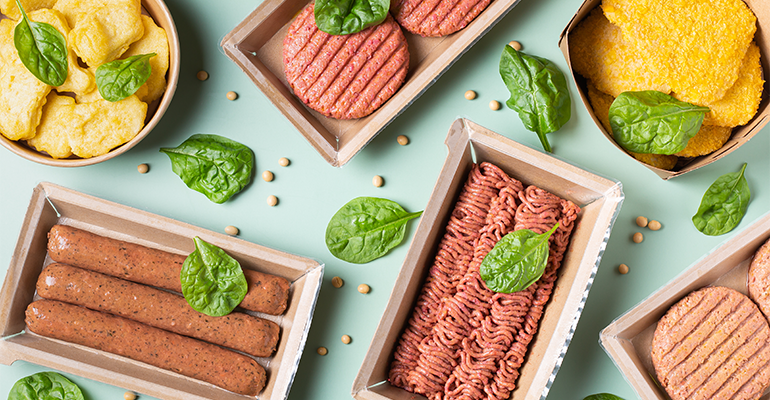
For brands already operating in the plant-based space, or for those looking to enter the market in future, the opportunities are immense. And when set against the context of the stagnating animal-based-meat sector, these opportunities only appear to be more profitable, the latest report from ProVeg International finds.
What do plant-based consumers want?
In a highly competitive and fastmoving market, understanding the dietary habits of consumers is no longer enough. Brands must also pay close attention to specific consumer demands to be well versed on the factors driving purchasing decisions.
A recent survey conducted by the Smart Protein project reveals that for European consumers, taste is one of the most important purchase drivers of plant-based foods. This is a sentiment which is reflected globally, with data from the Good Food Institute showing that taste is also the number one consideration for US consumers of plant-based alternatives.
Brands must not only seek to produce products that are tasty, but also competitively priced. As well as replicating the taste, consumers are demanding price parity between conventional meat and plant-based options. The same survey found that despite demonstrating a keen willingness to replace meat products with plant-based counterparts, few consumers are prepared to pay a premium for making this switch.
To get ahead in this market, brands must seek to lower the price of plant-based products so that the are competitive with traditional meat products, all the while achieving an indulgent, meat-like taste. Several players such as Beyond Meat, who are forecasting that their alternative products will undercut the prices of their conventional animal-based competitors within the next two years, are already making practical steps to respond to these demands.
The UK’s plant-based sector is the fastest growing in Europe
The UK is driving the European plant-based industry, with sales values peaking at €502 million in 2020, according to the report. Germany comes in second at €357 million, closely followed by the Netherlands (€174m).
All countries included in the ProVeg analysis however boasted double-digit annual growth rates, led by Germany at a ground-breaking 75%, exemplifying the fact that plant-based alternatives are a growing, geographically diverse phenomenon.
Looking at consumer demands reveals a strong preference for plant-based refrigerated meat, and more specifically plant-based burger patties and sausages, which in 2020 grew by 51% in the UK and 127% in Germany.
Plant-based milk is another key sector quickly growing in popularity and value across Europe. Oat milk is the consumer favourite, showing sales volumes of over 100% in both Germany and the UK, followed by almond and soy milk.
Most plant-based alternative consumers are flexitarians
Despite originally being aimed at vegetarian and vegan consumers, the main target group for plant-based products has shifted to a primarily flexitarian market. In fact, according to ProVeg data, as much as 90% of plant-based consumers are flexitarians.
In markets such as Germany, where flexitarians account for over half of all consumers (55%), there is a solid and growing base of consumers who are activity switching out conventional meat for alternative products.
While in Europe as a whole, around one in two consumers report to have eaten plant-based meats. According to ProVeg, this number is only expected to grow as new products, technologies, and foodservice providers continue to enter and disrupt the market.
Companies leading the plant-based trend
Following the plant-based trend closely, many large manufacturers of traditional animal-based products have recently begun introducing plant-based alternatives to conventional products, realising the potential of the sector.
Key market players such as JBS, the world’s largest conventional meat company, and Nomad Foods, European frozen food giant, have entered the plant-based space via acquisition and collaboration with the likes of Vivera, Dutch-based alternative company, and BlueNalu, an alternative seafood producer, respectively.
And for German meat producer, Rügenwalder Mühle, revenues from plant-based alternatives exceeded those from traditional cold cuts and sausages in 2020, after only six years of coming to market.
This trend is not exclusive to food manufacturers. Stakeholders at every stage of the food chain are taking advantage of the new opportunities emerging from the plant-based space.
Foodservice companies have introduced new plant-based products, such as McDonalds’ McPlant burger, and many new food processing companies have expanded their operations, including the likes of fermentation companies, Mycorena and ENOUGH, who are due to open plants in Europe later this year.

Get more of our news on Google
Set Ingredients Network as a 'Preferred Source' to get quicker access to the news you value.
Related news

Kellogg accelerates work to remove artificial colours from all US cereals
3 Sep 2026
WK Kellogg has announced an accelerated timeline to eliminate all artificial colours and the chemical preservative, BHT, across its full US portfolio of cereals and cereal packaging.
Read more
Skimpflation: An ‘unfair’ and risky approach to keeping prices low
2 Sep 2026
Consumers see skimpflation – reducing the quality of ingredients due to rising costs – as more unfair than shrinkflation, making it a risky strategy according to recent research.
Read more
‘Urgent gaps’ in achieving 2030 food system goals
27 Aug 2026
Global food systems are failing to meet 2030 targets across indicators including health, environment, and resilience, according to a report co-authored by the Food and Agriculture Organisation (FAO).
Read more
Seven-Eleven uses microbial testing tech to extend katsudon shelf life
26 Aug 2026
Japanese retail company Seven-Eleven has improved its factory’s microbial environment to keep comfort-food staple, katsudon, fresher for longer.
Read more
Chimac’s fusion sauces bring Korean flavours to Europe
25 Aug 2026
Irish sauce brand Chimac is tapping into Korea’s culinary traditions, bringing its flavours and products to European consumers who want a taste of K-food.
Read more
Global demand for instant noodles continues to rise
24 Aug 2026
Global demand for instant noodles reached 124.21 billion servings last year, representing a 0.7% year-on-year increase – or 900 million extra servings.
Read more
China beverages: Is herbal innovation the future?
20 Aug 2026
Herbal and botanical innovation in China's drinks market continues to grow, with ingredients like astragalus root, ginger, and ginseng in the spotlight – and focus shifting far beyond refreshment.
Read more
Popular barbecue staples experience sharp price increases
19 Aug 2026
The typical cost of US shoppers’ barbecue baskets has risen by 12% over the past year – the fastest annual rise in a decade, figures from The Economist show.
Read more
Hot NPD: Nissin launches first cold-water Cup Noodles
18 Aug 2026
Nissin is taking one of Japan’s most iconic instant meals in a completely new direction with the launch of the first cold water-only Cup Noodles in the brand’s 55-year history.
Read more
Beyond 'nice to have': A spotlight on US functional beverages
12 Aug 2026
Functional beverage interest in the US is gaining important ground as consumers now expect function rather than see it as "nice to have", and there are clear market gaps for growth, according to Spate.
Read more