
Ingredients Categories
Finished Products
Finished Food Categories
- Bakery
- Beverages / Juices
- Cereal and grain products
- Confectionery
- Cooking Fats & Oils
- Dairy
- Egg products
- Fruits & Vegetables
- Infant & Baby food
- Meat, Poultry & Fish
- Nuts & Seeds products
- Other Finished Food Categories
- Pet Food
- Plant-based foods
- Prepared foods
- Sauces & Seasonings
- Sweet & Savoury Spreads
Specialised Finished Products
- Bee products
- Biotic products
- Dietary supplements
- Energy drinks
- Functional beverages
- Functional confectionery
- Functional food
- Functional powders
- Meal replacement products
- Nutricosmetics
- Other Specialised Finished Products
- Pet Dietary Supplements
- Pharma and OTC products
- Protein products
- Sugar replacers / Sweeteners
Health & Wellness Areas
Delivery Formats
Operations & Services
- 3D printing
- Analysis/ Testing
- Auditing & certifications
- Blending & mixing
- Bottling
- Certification
- Clinical trials
- Co-packing
- Coating
- Consulting
- Contract manufacturing
- Drying
- Electrospinning
- Encapsulating
- Enzymatic processing
- Extracting
- Extrusion
- Fat structuring
- Fermentation
- Filling
- Flavour development
- Freeze drying
- Granulating/ grinding/ milling / mixing
- High-pressure processing
- Labelling
- Other Operations & Services
- Packaging
- Packet filling
- Pasturising
- Quality assurance
- Saccharification
- Shear cell processing
- Spray drying
- Sterilisation
- Storage & Logistics
- Tabletting
- Toasting / roasting
- Ultra-high temperature processing
News
Impossible Foods secures reinstatement of EU patent for heme protein
28 Jan 2025The decision overturns the 2022 revocation of the patent and solidifies legal protection of the innovative ingredient that can be used in plant-based food production.
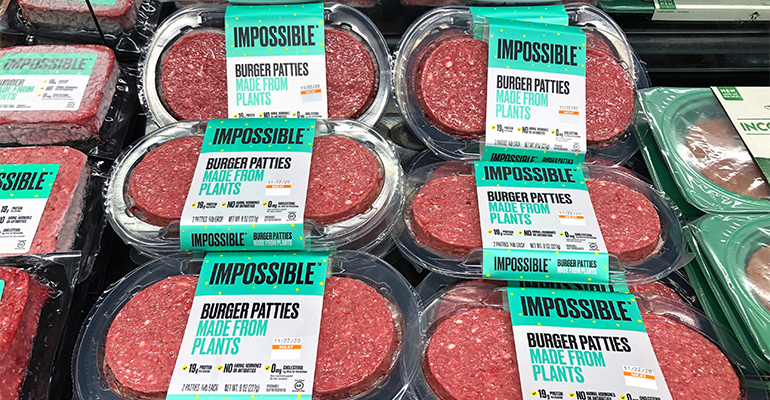
The patent, filed in 2014 and originally granted in 2017, protects a method for using heme proteins, produced via precision fermentation, in combination with flavour precursor molecules to give plant-based products the taste, smell, and appearance of conventional meat.
This decision issued by the European Patent Office (EPO) Board of Appeals on 20 December 2024 resolves a years-long dispute over the novelty, inventive step, and sufficiency of disclosure of Impossible Foods’ invention.
Soy leghemoglobin: at the bleeding edge
At the heart of the reinstated patent is soy leghemoglobin, a protein derived from genetically modified yeast (Komagataella phaffii). The yeast is engineered to produce leghemoglobin, a molecule naturally found in soy roots that contains iron and mimics the properties of haemoglobin found in animal blood.
Through a precision fermentation process, the company inserts DNA from soy plants into the yeast strain, enabling it to produce soy leghemoglobin, a heme protein that closely mimics the sensory properties of its animal counterpart. During cooking, the heme protein interacts with flavour precursors such as cysteine, glucose, and thiamine, creating the aroma and taste associated with meat.
Impossible Foods’ heme protein also enables its flagship burgers to “bleed” like traditional meat, a feature that appeals to consumers seeking authentic sensory experiences in plant-based products. It further provides bioavailable iron, addressing nutrient equivalence in plant-based foods.
The patent dispute
Impossible Foods’ patent was initially challenged in 2018 on the basis of the lack of novelty and sufficient disclosure. While the EPO’s Opposition Division determined in 2022 that the patent’s invention was novel, it revoked the patent on the grounds of insufficient disclosure.
The revocation cited the broad claims of the patent, which covered billions of potential combinations of heme-containing proteins and flavour precursors and stated that the patent failed to provide enough detail for skilled practitioners to reproduce the invention across its full scope.
The recent appeal overturned this decision. The EPO Board of Appeals ruled that the patent adequately described the process of isolating heme proteins and identified specific flavour precursor combinations that create the desired sensory effect. It also confirmed that the invention involved an inventive step, as the use of heme proteins in this specific context was not obvious based on prior art.
The decision secures Impossible Foods’ exclusive rights to its heme-based method in Europe, marking the resolution of a lengthy legal process.
Impossible to enter Europe?
The EPO’s decision comes at a time of heightened regulatory and market challenges for the plant-based meat sector in Europe. While consumer interest in alternative proteins remains high, the industry has faced opposition to the use of meat-related terms on labels, as well as regulatory hurdles related to novel ingredients and precision fermentation.
For Impossible Foods, the reinstatement of its heme patent is a key milestone as it seeks to enter the European market. Although its flagship burgers are already available in regions such as the US, Canada, Australia, and Singapore, the company has faced delays in the EU due to the regulatory approval processes.
Recent progress with the European Food Safety Authority (EFSA) has brought the company closer to market entry. In June 2024, EFSA’s food additives panel issued a positive safety assessment of LegH Prep, Impossible Foods’ heme-containing ingredient, concluding that it poses no safety concerns for its proposed uses. A further assessment from EFSA’s GMO panel in November 2024 confirmed the safety of the genetically modified yeast used to produce soy leghemoglobin.
Pending final approval by the European Commission and the Standing Committee on Plants, Animals, Food and Feed, Impossible Foods could bring its heme-containing products to European consumers in the near future.
Heme innovation
Beyond its implications for Impossible Foods, the patent reinstatement could be a broader victory for innovation in alternative proteins. As companies increasingly turn to precision fermentation to develop functional ingredients, the case reinforces the importance of heme proteins as a key area of research and commercialisation.
While Impossible Foods is currently the only company using heme in commercially available plant-based meat products, other companies are exploring alternative sources of heme to compete in this space. In 2021, US-based startup Back of the Yards Algae Sciences (BYAS), for example, developed a heme protein derived from spirulina, a type of blue-green algae.
The scientific community has also started to pay attention to alternative heme applications. An article published last year in the academic journal Algal Research investigated the potential for heme-enriched microalgae as a source of iron. The researchers concluded that “many hurdles remain until the idea of heme rich microalgal biomass is realised, but the possibilities for utilising such a product to address chronic iron deficiencies in humans and production animals are tantalizing.”

Get more of our news on Google
Set Ingredients Network as a 'Preferred Source' to get quicker access to the news you value.
Related news

Skimpflation: An ‘unfair’ and risky approach to keeping prices low
2 Sep 2026
Consumers see skimpflation – reducing the quality of ingredients due to rising costs – as more unfair than shrinkflation, making it a risky strategy according to recent research.
Read more
NielsenIQ’s EU barometer shows Britain leading in grocery inflation
31 Aug 2026
Britain was the only country to record grocery inflation above 2%, according to NielsenIQ data that compared Europe’s five biggest grocery markets from February to May 2026.
Read more
‘Urgent gaps’ in achieving 2030 food system goals
27 Aug 2026
Global food systems are failing to meet 2030 targets across indicators including health, environment, and resilience, according to a report co-authored by the Food and Agriculture Organisation (FAO).
Read more
Seven-Eleven uses microbial testing tech to extend katsudon shelf life
26 Aug 2026
Japanese retail company Seven-Eleven has improved its factory’s microbial environment to keep comfort-food staple, katsudon, fresher for longer.
Read more
Chimac’s fusion sauces bring Korean flavours to Europe
25 Aug 2026
Irish sauce brand Chimac is tapping into Korea’s culinary traditions, bringing its flavours and products to European consumers who want a taste of K-food.
Read more
Global demand for instant noodles continues to rise
24 Aug 2026
Global demand for instant noodles reached 124.21 billion servings last year, representing a 0.7% year-on-year increase – or 900 million extra servings.
Read more
Popular barbecue staples experience sharp price increases
19 Aug 2026
The typical cost of US shoppers’ barbecue baskets has risen by 12% over the past year – the fastest annual rise in a decade, figures from The Economist show.
Read more
Hot NPD: Nissin launches first cold-water Cup Noodles
18 Aug 2026
Nissin is taking one of Japan’s most iconic instant meals in a completely new direction with the launch of the first cold water-only Cup Noodles in the brand’s 55-year history.
Read more
Animal welfare claims on UK meat ‘have no agreed meaning’
17 Aug 2026
Animal welfare claims on meat in the UK have no agreed meaning, meaning shoppers cannot make comparisons between products – and labels on processed foods tell them even less, a report has found.
Read more
Manam Chocolate aims to bring premium Indian cacao to 'the world stage'
11 Aug 2026
Craft chocolate brand Manam Chocolate is investing in local expansion and supply chain innovation throughout India as it works to build out the premium reputation of its locally produced cacao products.
Read more