
Ingredients Categories
Finished Products
Finished Food Categories
- Bakery
- Beverages / Juices
- Cereal and grain products
- Confectionery
- Cooking Fats & Oils
- Dairy
- Egg products
- Fruits & Vegetables
- Infant & Baby food
- Meat, Poultry & Fish
- Nuts & Seeds products
- Other Finished Food Categories
- Pet Food
- Plant-based foods
- Prepared foods
- Sauces & Seasonings
- Sweet & Savoury Spreads
Specialised Finished Products
- Bee products
- Biotic products
- Dietary supplements
- Energy drinks
- Functional beverages
- Functional confectionery
- Functional food
- Functional powders
- Meal replacement products
- Nutricosmetics
- Other Specialised Finished Products
- Pet Dietary Supplements
- Pharma and OTC products
- Protein products
- Sugar replacers / Sweeteners
Health & Wellness Areas
Delivery Formats
Operations & Services
- 3D printing
- Analysis/ Testing
- Auditing & certifications
- Blending & mixing
- Bottling
- Certification
- Clinical trials
- Co-packing
- Coating
- Consulting
- Contract manufacturing
- Drying
- Electrospinning
- Encapsulating
- Enzymatic processing
- Extracting
- Extrusion
- Fat structuring
- Fermentation
- Filling
- Flavour development
- Freeze drying
- Granulating/ grinding/ milling / mixing
- High-pressure processing
- Labelling
- Other Operations & Services
- Packaging
- Packet filling
- Pasturising
- Quality assurance
- Saccharification
- Shear cell processing
- Spray drying
- Sterilisation
- Storage & Logistics
- Tabletting
- Toasting / roasting
- Ultra-high temperature processing
News
Targeting the sustainable consumer in Latin America
8 Oct 2021Latin Americans are among the most concerned about climate change and the most interested in sustainable actions but they are also highly price sensitive, according to Euromonitor. How can brands strike the right balance?
Latin American consumers are the most concerned about climate change and express the greatest interest in generating positive change in the environment, according to a 2021 Euromonitor Lifestyles survey that questioned individuals from around the world.

Additionally, there are currently 80 policies in the Latin American region that ban single-use plastics or promote a circular economy, according to a recent report by London-based Latin American think tank Chatham House. These include a packaging law in Uruguay, a zero-waste initiative in Panama, a decarbonisation programme in Costa Rica, and the Clean Production Agreement in Chile.
Saving money and the planet
However, consumers in the region are also highly price sensitive and this can be a barrier to uptake for products that are produced sustainably and thus carry a price premium. The COVID-19 pandemic, with national lockdowns and mandatory curfews that prevented millions of people from working, has further reduced the disposable income for many Latinos.
In March last year, the UN Economic Commission for Latin America and the Caribbean (ECLAC) forecast the economic contraction following COVID-19 would result in a 10% rise in unemployment, increasing the number of people classified as poor in the region from 185 million to 220 million.
“Price continues to be one of the biggest challenges to sustainable production in the region,” note Euromonitor analysts Jorge Araya and Jorge Zuniga. “Products that have a sustainable attribute (often the result of a redesign in the production process or the packaging, or external certifications such as carbon neutrality or organic production) carry an additional charge that is normally passed on to the consumer. This immediately limits or restricts sustainable products from achieving mass consumption in a region full of very price-sensitive consumers.”
Nevertheless, Araya and Zuniga see opportunities for brands to link environmentally-focussed initiatives with saving money. They point to Chilean start-up Algramo’s business model as an example. Algramo works with big brands, such as Unilever and Nestlé, to sell their branded produce in durable, reusable containers and says its target consumer base is as much people who care about the environment as it is those who want to save money.
Clear communication for plant-based products
The plant-based category also has good potential to find its place in the Latin American market as long as brands provide more transparent information on ingredients and sustainability, according to Graciana Méndez, senior regional consumer insights analyst at Mintel. Its data shows that nearly seven out of 10 Colombians agree that plant-based foods are better for the environment, for instance.
“Plant-based started as a food trend, rooted in younger consumers who were using their eating habits to promote social and environmental justice,” Méndez writes in a recent Mintel blogpost. “Lately, however, consumers are becoming more interested in plant-based formulations for a number of reasons, including health benefits and improved animal welfare. The pandemic has played a part, with people viewing plant-based as healthier and safer than meat due to COVID-19’s suspected zoonotic origin.
“But there is still work to be done on educating people about the wider environmental benefits. While there is already an understanding that plant-based foods are better for the planet, helping consumers properly understand the link between plant-based foods and environmental gains such as reducing carbon emissions and water use, will encourage more people to limit their meat intake.”
Méndez references Mexican brand Asante, which claims that eating one vegetable protein-based product contributes to water savings equal to 19 showers and saves 14m² of forest.
Brands could also leverage traditional and native ingredients to appeal to consumers.
In Chile, for instance, the algae cochayuyo (Durvillaea antárctica) is a traditional food that has a reputation for being healthy and cheap, and is found both in markets and supermarkets in its whole, dried form. However, a number of emerging plant-based players are incorporating this ingredient into their finished products. Quelp uses 50% cochayuyo in its vegan burgers and meatballs; Munani makes oven-baked cochayuyo chips; and Nün sells pasta made from a blend of seaweed and high-protein ingredients such as lentils, chickpeas and quinoa.
Méndez concludes: “As it has in other parts of the world, plant-based has emerged as a buzzword in Latin America. However, for it to become a more meaningful term, brands will need to communicate how it can be good for people, animals and planet.

Get more of our news on Google
Set Ingredients Network as a 'Preferred Source' to get quicker access to the news you value.
Related news

Kellogg accelerates work to remove artificial colours from all US cereals
3 Sep 2026
WK Kellogg has announced an accelerated timeline to eliminate all artificial colours and the chemical preservative, BHT, across its full US portfolio of cereals and cereal packaging.
Read more
Skimpflation: An ‘unfair’ and risky approach to keeping prices low
2 Sep 2026
Consumers see skimpflation – reducing the quality of ingredients due to rising costs – as more unfair than shrinkflation, making it a risky strategy according to recent research.
Read more
‘Urgent gaps’ in achieving 2030 food system goals
27 Aug 2026
Global food systems are failing to meet 2030 targets across indicators including health, environment, and resilience, according to a report co-authored by the Food and Agriculture Organisation (FAO).
Read more
Seven-Eleven uses microbial testing tech to extend katsudon shelf life
26 Aug 2026
Japanese retail company Seven-Eleven has improved its factory’s microbial environment to keep comfort-food staple, katsudon, fresher for longer.
Read more
Global demand for instant noodles continues to rise
24 Aug 2026
Global demand for instant noodles reached 124.21 billion servings last year, representing a 0.7% year-on-year increase – or 900 million extra servings.
Read more
Popular barbecue staples experience sharp price increases
19 Aug 2026
The typical cost of US shoppers’ barbecue baskets has risen by 12% over the past year – the fastest annual rise in a decade, figures from The Economist show.
Read more
Hot NPD: Nissin launches first cold-water Cup Noodles
18 Aug 2026
Nissin is taking one of Japan’s most iconic instant meals in a completely new direction with the launch of the first cold water-only Cup Noodles in the brand’s 55-year history.
Read more
Savoury protein snacks shake up the on-the-go market
10 Aug 2026
Sweet flavours have dominated the high-protein snack category but savoury snacks, such as cheese bars and meat sticks, can appeal to health-conscious consumers.
Read more
Nestlé invests in regeneratively farmed wheat for KitKat
5 Aug 2026
Nestlé will pay a premium for Wildfarmed’s regeneratively farmed wheat but the CPG remains reticent to promote the move on packs of its KitKat bars.
Read more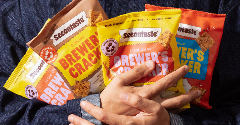
How Secon Taste is putting upcycled snacks on shelves
4 Aug 2026
Hungarian zero-waste startup Secon Taste is turning surplus food into upcycled snacks such as fibre-packed granola, instant porridge, and a circular coffee-tasting box.
Read more