
Ingredients Categories
Finished Products
Finished Food Categories
- Bakery
- Beverages / Juices
- Cereal and grain products
- Confectionery
- Cooking Fats & Oils
- Dairy
- Egg products
- Fruits & Vegetables
- Infant & Baby food
- Meat, Poultry & Fish
- Nuts & Seeds products
- Other Finished Food Categories
- Pet Food
- Plant-based foods
- Prepared foods
- Sauces & Seasonings
- Sweet & Savoury Spreads
Specialised Finished Products
- Bee products
- Biotic products
- Dietary supplements
- Energy drinks
- Functional beverages
- Functional confectionery
- Functional food
- Functional powders
- Meal replacement products
- Nutricosmetics
- Other Specialised Finished Products
- Pet Dietary Supplements
- Pharma and OTC products
- Protein products
- Sugar replacers / Sweeteners
Health & Wellness Areas
Delivery Formats
Operations & Services
- 3D printing
- Analysis/ Testing
- Auditing & certifications
- Blending & mixing
- Bottling
- Certification
- Clinical trials
- Co-packing
- Coating
- Consulting
- Contract manufacturing
- Drying
- Electrospinning
- Encapsulating
- Enzymatic processing
- Extracting
- Extrusion
- Fat structuring
- Fermentation
- Filling
- Flavour development
- Freeze drying
- Granulating/ grinding/ milling / mixing
- High-pressure processing
- Labelling
- Other Operations & Services
- Packaging
- Packet filling
- Pasturising
- Quality assurance
- Saccharification
- Shear cell processing
- Spray drying
- Sterilisation
- Storage & Logistics
- Tabletting
- Toasting / roasting
- Ultra-high temperature processing
News
Unilever in $120m biotech venture to scale palm oil alternative
20 Jun 2022
Unilever has teamed up with US biotech company Genomatica to commercialise its palm oil alternative produced via a biotechnology fermentation process.
The $120 million (€114m) will be jointly invested in the newly formed initiative and other strategic investors are expected to join, according to a statement. Unilever’s investment with Genomatica, also known as Geno, represents its largest collaboration in biotech-produced alternatives to palm oil to date, it said. Geno is already starting to scale up the process to produce the exclusive ingredient.
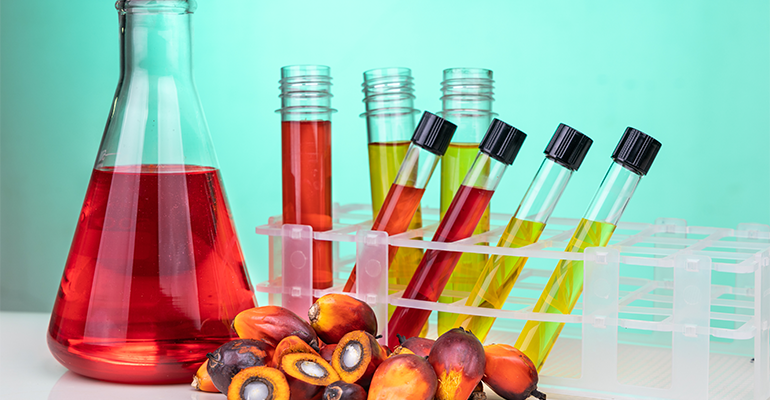
With growing demand for sustainably sourced palm oil, Unilever said the venture aimed to deliver additional responsibly sourced palm oil alternatives to the market. These alternatives had a role to play in diversifying supply chains to drive sustainability, cost efficiencies and transparency. However, it added that conventional palm oil would remain an important feedstock for its ingredients.
‘Cleaning up’ cleaning products with palm oil alternatives
Currently, Geno’s palm oil alternatives replace surfactants and therefore are targeted towards the personal care, home care and industrial cleaning sectors only. Unilever – one of the world’s biggest soap and detergent manufacturers – will use it for these categories.
Ingredients Network asked Unilever whether it planned to explore the use of microbial fermentation to replace some of the palm oil in its food portfolio but the soup-to-soap manufacturer did not say.
There are a number of startups leveraging biotechnology to produce food-grade palm oil alternatives via microbial fermentation, such as Dutch startup NoPalm and US company C16 Biosciences, marketing their products as ‘deforestation-free’ palm oil or ‘conflict-free’ palm oil.
In 2020, Unilever committed to achieving a zero-deforestation supply chain by 2023 for crops with high deforestation risk, including palm oil, tea, soy and cocoa.
Unilever: ‘Palm oil itself is not the problem’
A spokesperson for the company told Ingredients Network: “Palm oil itself is not the problem. It is the most land efficient vegetable oil and the source of livelihoods for millions of farmers across Indonesia and Malaysia. It is also neutral in taste and smell and provides a smooth and creamy texture that is suitable for manufacturing a wide range of food products, such as bakery and chocolate confectionary products. It also has a natural preservative effect, extending the shelf life of food products.
“The problem lies with the rapid expansion of the palm oil industry that has accelerated deforestation and led to poor production standards. So, we will continue to work with governments, NGOs and other partners to advocate for industry change.” Unilever R&D chief: ‘Marrying science & nature for sustainable products’
Commenting on the Geno venture, Unilever’s chief R&D officer Richard Slater said biotechnology had the potential to ensure Unilever was a future-fit business.
“This new venture will sit at the intersection of science and sustainability, meaning we can continue to grow our business without relying only on palm oil or fossil fuel derivatives, while also making our supply chains more resilient from having access to ingredient alternatives,” he said.
“We will be marrying science and nature to make sure there is no trade-off for our consumers between the efficacy and sustainability of their products. We are building this innovative new venture to have the scale to drive real impact and change in our industry, helping to reinvent the chemistry of home and personal care products for the 21st century.”
According to the CEO of San Diego-headquartered Geno, Christophe Schilling, Geno’s technology has the potential to reduce greenhouse gas emissions by 100 million tons in upcoming years.
Geno biotech for ketogenic sports nutrition
In addition to personal care ingredients, materials and textiles, Geno uses its proprietary biotech process to make the food ingredient (R)-1,3 Butanediol. Sold under the brand name Avela, the compound is a ketogenic ingredient used in sports nutrition products that offers an easy and accessible way to raise B-hydroxybutyrate (BHB) levels in the body, leading to improved endurance, clarity and energy, according to the company.
Avela has GRAS (generally recognised as safe) status in the US and is approved for sports drinks, bars and gels.
“Raising blood BHB levels provides energy, increases endurance, aids in recovery and fuels the brain,” says Geno.
Cargill JV licences Geno’s tech for biodegradable plastic.
In 2021, a joint venture between Cargill and German company Helm licenced Geno’s technology to produce a bio-based version of 1,4-butanediol (BDO) at scale, using Cargill’s global feedstock supply and fermentation manufacturing. BDO is used to make polyester-based chemical fibres, biodegradable plastics, polyurethane coatings, and other materials.
The companies said Geno’s BDO saves up to 93% of greenhouse gas emissions compared to the use of conventional BDO.

Get more of our news on Google
Set Ingredients Network as a 'Preferred Source' to get quicker access to the news you value.
Related news

Kellogg accelerates work to remove artificial colours from all US cereals
3 Sep 2026
WK Kellogg has announced an accelerated timeline to eliminate all artificial colours and the chemical preservative, BHT, across its full US portfolio of cereals and cereal packaging.
Read more
Skimpflation: An ‘unfair’ and risky approach to keeping prices low
2 Sep 2026
Consumers see skimpflation – reducing the quality of ingredients due to rising costs – as more unfair than shrinkflation, making it a risky strategy according to recent research.
Read more
‘Urgent gaps’ in achieving 2030 food system goals
27 Aug 2026
Global food systems are failing to meet 2030 targets across indicators including health, environment, and resilience, according to a report co-authored by the Food and Agriculture Organisation (FAO).
Read more
Seven-Eleven uses microbial testing tech to extend katsudon shelf life
26 Aug 2026
Japanese retail company Seven-Eleven has improved its factory’s microbial environment to keep comfort-food staple, katsudon, fresher for longer.
Read more
Chimac’s fusion sauces bring Korean flavours to Europe
25 Aug 2026
Irish sauce brand Chimac is tapping into Korea’s culinary traditions, bringing its flavours and products to European consumers who want a taste of K-food.
Read more
Global demand for instant noodles continues to rise
24 Aug 2026
Global demand for instant noodles reached 124.21 billion servings last year, representing a 0.7% year-on-year increase – or 900 million extra servings.
Read more
China beverages: Is herbal innovation the future?
20 Aug 2026
Herbal and botanical innovation in China's drinks market continues to grow, with ingredients like astragalus root, ginger, and ginseng in the spotlight – and focus shifting far beyond refreshment.
Read more
Popular barbecue staples experience sharp price increases
19 Aug 2026
The typical cost of US shoppers’ barbecue baskets has risen by 12% over the past year – the fastest annual rise in a decade, figures from The Economist show.
Read more
Hot NPD: Nissin launches first cold-water Cup Noodles
18 Aug 2026
Nissin is taking one of Japan’s most iconic instant meals in a completely new direction with the launch of the first cold water-only Cup Noodles in the brand’s 55-year history.
Read more
Beyond 'nice to have': A spotlight on US functional beverages
12 Aug 2026
Functional beverage interest in the US is gaining important ground as consumers now expect function rather than see it as "nice to have", and there are clear market gaps for growth, according to Spate.
Read more