
Ingredients Categories
Finished Products
Finished Food Categories
- Bakery
- Beverages / Juices
- Cereal and grain products
- Confectionery
- Cooking Fats & Oils
- Dairy
- Egg products
- Fruits & Vegetables
- Infant & Baby food
- Meat, Poultry & Fish
- Nuts & Seeds products
- Other Finished Food Categories
- Pet Food
- Plant-based foods
- Prepared foods
- Sauces & Seasonings
- Sweet & Savoury Spreads
Specialised Finished Products
- Bee products
- Biotic products
- Dietary supplements
- Energy drinks
- Functional beverages
- Functional confectionery
- Functional food
- Functional powders
- Meal replacement products
- Nutricosmetics
- Other Specialised Finished Products
- Pet Dietary Supplements
- Pharma and OTC products
- Protein products
- Sugar replacers / Sweeteners
Health & Wellness Areas
Delivery Formats
Operations & Services
- 3D printing
- Analysis/ Testing
- Auditing & certifications
- Blending & mixing
- Bottling
- Certification
- Clinical trials
- Co-packing
- Coating
- Consulting
- Contract manufacturing
- Drying
- Electrospinning
- Encapsulating
- Enzymatic processing
- Extracting
- Extrusion
- Fat structuring
- Fermentation
- Filling
- Flavour development
- Freeze drying
- Granulating/ grinding/ milling / mixing
- High-pressure processing
- Labelling
- Other Operations & Services
- Packaging
- Packet filling
- Pasturising
- Quality assurance
- Saccharification
- Shear cell processing
- Spray drying
- Sterilisation
- Storage & Logistics
- Tabletting
- Toasting / roasting
- Ultra-high temperature processing
News
Editor’s choice: Our roundup of the most innovative dairy alternative products
19 Sep 2022
There is so much innovation in the alternative dairy space it can be hard to keep track. From sesame milk to bean-based cheese, our editors have rounded up of some products that showcase the trends in this constantly-evolving category.
The products below were cited during the Dairy and Dairy Alternatives Deep Dive Day, held as part of the Fi Webinar Series, and include sesame milk, a bean-based vegan cheese, an artificial intelligence-powered plant-based milk, a creamy plant-based fat ingredient and a plant-based milk made from grains and seeds.
Let’s take a closer look…
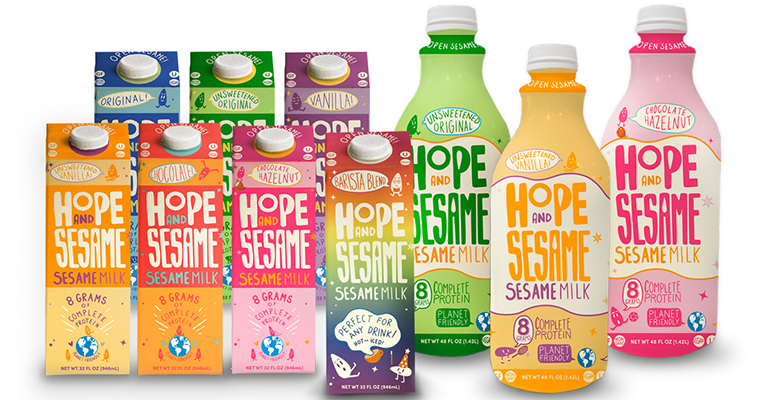
Hope and Sesame’s barista sesamemilk
US plant-based brand Hope and Sesame has rolled out a range of sesame milks including a ‘breakthrough’ barista blend.
The sesame milk range is made up of two formats – chilled and shelf-stable - with six flavours that are ‘nutritionally comparable to dairy milk’, according to the company. An 8oz serving, has 8g of complete protein, all nine essential amino acids, and is considered a source of vitamin D and calcium.
The line-up includes chocolate, chocolate hazelnut, vanilla, original, unsweetened original, unsweetened vanilla and a barista blend.
“It shows how plant-based milks have really captured the barista market by developing milk alternatives that have better foaming properties. And, of course, those barista milks are not just being used by professional baristas in coffee shops but also by consumers who have barista-style coffee machines, which is a growing trend,” said Niamh Michail, senior content editor at Fi Global.
Willicroft’s plant-based cheese alternative
In the Netherlands, Willicroft combines dairy farming techniques with plant-based ingredients to create cheese alternatives. All products are vegan, bean-based and come in CO2 neutral packaging. The range of “planet proof” cheeses include young Dutch, original fondue, original sauce, Italian aged and Greek white.
The plant-based cheese company initially used cashews for its cheese before discovering it had the highest emissions of all its ingredients. It later identified white beans as a functional, sustainable alternative that could be grown in a Northern European climate.
“Willicroft began working with local government departments, non-profits and farmers on a transitional farming project to convert land currently used by dairy cows into bean fields, and promised to buy the white beans for its cheeses from the newly transitioned farmers.
“I like this story because it’s an example of the dairy and dairy alt sectors working together to meet consumer demands in a sustainable way, create new business models with existing players,” said Michail.
NotCo’s plant-based milk alternative
NotCo use artificial intelligence and machine learning algorithms to formulate products that mimic animal-based foods using plant-based ingredients. The Chilean food tech company has two product ranges – NotMilk and NotBurger.
Guiseppe, NotCo’s artificial intelligence programme, matches the recipes of animal-based products by analysing the product structure at a molecular level and replicating it using plant-based ingredients.
NotCo’s plant-based milk “sips, slurps and froths like milk”, says the company, but is made entirely from plants. It comes in the options found traditionally in dairy milk - whole, 2% reduced fat, 1% and chocolate.
“The milk alternative is designed to provide consumers with the same taste and texture that replicates dairy-based milk. The dairy alternative is made with a blend of pea protein, chicory root fibre, pineapple juice, coconut oil, sunflower oil and cabbage juice,” said Kinga Swiderska, head of content at Fi Global.
Time Travelling Milkman’s plant-based fat ingredient
Time Travelling Milkman (TTM) produces plant-based fat for “sustainable creaminess inside dairy alternatives”. The plant-based fat ingredient comes in powder and liquid cream format to create creamier, healthier, and more sustainable plant-based products.
Designed to be an alternative to the fat ingredients currently used such as palm and coconut oils, TTM’s plant-based fat ingredient contains no preservatives or petrochemicals.
“A finalist of 2021 Start-up Innovation Challenge at Fi Europe in the Most Innovative Plant-Based or Alternative Ingredient category was Travelling Milkman (TTM) - great name!,” said Swiderska,
“TTM’s unsaturated fat ingredients are made through a process that extracts natural fat droplets from seeds, such as sunflower seeds, for sustainable production of fat that is texturally similar to milk cream, adding a very nice mouthfeel. These oleosomes have a high potential as milk fat equivalents for creamy and tasty dairy alternatives, while having almost no environmental impact.”
Lilk’s plant-based milk alternative
Lilk blends grains and seeds such as quinoa, rice, oat and coconut to create “tastier and more balanced” plant-based milks. This product caught the eye of content editor Segi Adewusi who thought it was an innovative idea to blend multiple grains and seeds to offer a distinct mouthfeel, taste, and texture for different occasions.
“The uncommon blend is described by Lilk as ‘very, very milky’ light, neutral for everyday use whilst the lush blend is ‘perfect for stay-at-home treats’ and ideal for desserts and even cocktails,” said Adewusi.
The UK plant-based milk brand is founded by two siblings who were dissatisfied with the plant-based milk offerings on the market during the Covid-19 lockdown. The range is comprised of two varieties - the uncommon blend and the lush blend. Both are vegan, unsweetened and enriched with calcium, and vitamins B12 and D.

Get more of our news on Google
Set Ingredients Network as a 'Preferred Source' to get quicker access to the news you value.
Related news

Kellogg accelerates work to remove artificial colours from all US cereals
3 Sep 2026
WK Kellogg has announced an accelerated timeline to eliminate all artificial colours and the chemical preservative, BHT, across its full US portfolio of cereals and cereal packaging.
Read more
Skimpflation: An ‘unfair’ and risky approach to keeping prices low
2 Sep 2026
Consumers see skimpflation – reducing the quality of ingredients due to rising costs – as more unfair than shrinkflation, making it a risky strategy according to recent research.
Read more
‘Urgent gaps’ in achieving 2030 food system goals
27 Aug 2026
Global food systems are failing to meet 2030 targets across indicators including health, environment, and resilience, according to a report co-authored by the Food and Agriculture Organisation (FAO).
Read more
Popular barbecue staples experience sharp price increases
19 Aug 2026
The typical cost of US shoppers’ barbecue baskets has risen by 12% over the past year – the fastest annual rise in a decade, figures from The Economist show.
Read more
Savoury protein snacks shake up the on-the-go market
10 Aug 2026
Sweet flavours have dominated the high-protein snack category but savoury snacks, such as cheese bars and meat sticks, can appeal to health-conscious consumers.
Read more
Digital twin technology gains ground in food manufacturing
6 Aug 2026
Food and beverage companies are increasingly turning to digital twins to optimise and automate manufacturing processes, but opportunities stretch far beyond this, say experts.
Read more
Nestlé invests in regeneratively farmed wheat for KitKat
5 Aug 2026
Nestlé will pay a premium for Wildfarmed’s regeneratively farmed wheat but the CPG remains reticent to promote the move on packs of its KitKat bars.
Read more
Codex sets global thresholds for ‘may contain’ labels
3 Aug 2026
Codex Alimentarius has adopted its first global guidance on when to use “may contain” allergen warnings, setting thresholds intended to stop the label being used as blanket legal cover.
Read more
EU sets maximum MOAH levels to protect human health
28 Jul 2026
The EU will adopt maximum levels for mineral oil aromatic hydrocarbons (MOAH) in food to protect human health. What do manufacturers need to know?
Read more
UK publishes guidance on SPS food trade agreement with EU
27 Jul 2026
The UK government has shared guidance on how food businesses can prepare for its upcoming Sanitary and Phytosanitary (SPS) agreement with the EU.
Read more