
Ingredients Categories
Finished Products
Finished Food Categories
- Bakery
- Beverages / Juices
- Cereal and grain products
- Confectionery
- Cooking Fats & Oils
- Dairy
- Egg products
- Fruits & Vegetables
- Infant & Baby food
- Meat, Poultry & Fish
- Nuts & Seeds products
- Other Finished Food Categories
- Pet Food
- Plant-based foods
- Prepared foods
- Sauces & Seasonings
- Sweet & Savoury Spreads
Specialised Finished Products
- Bee products
- Biotic products
- Dietary supplements
- Energy drinks
- Functional beverages
- Functional confectionery
- Functional food
- Functional powders
- Meal replacement products
- Nutricosmetics
- Other Specialised Finished Products
- Pet Dietary Supplements
- Pharma and OTC products
- Protein products
- Sugar replacers / Sweeteners
Health & Wellness Areas
Delivery Formats
Operations & Services
- 3D printing
- Analysis/ Testing
- Auditing & certifications
- Blending & mixing
- Bottling
- Certification
- Clinical trials
- Co-packing
- Coating
- Consulting
- Contract manufacturing
- Drying
- Electrospinning
- Encapsulating
- Enzymatic processing
- Extracting
- Extrusion
- Fat structuring
- Fermentation
- Filling
- Flavour development
- Freeze drying
- Granulating/ grinding/ milling / mixing
- High-pressure processing
- Labelling
- Other Operations & Services
- Packaging
- Packet filling
- Pasturising
- Quality assurance
- Saccharification
- Shear cell processing
- Spray drying
- Sterilisation
- Storage & Logistics
- Tabletting
- Toasting / roasting
- Ultra-high temperature processing
Sponsored Content
Agrigum Redefined FIBER
27 Oct 2025Agrigum has transformed gum acacia into a natural, science-backed fibre that supports gut health, sustainability, and innovation across global food and nutrition applications.
From African trees to global kitchens: The Agrigum story
In the vast, sun-drenched landscapes of Sudan and across the African Sahel grows a remarkable tree – the Acacia. For centuries, its golden tears of gum have been harvested and treasured for their unique properties. Today, these droplets are at the heart of some of the world’s favourite foods, from soft drinks and sweets to nutrition bars and pharmaceuticals.
At the centre of this journey stands Agrigum International, a company that has turned a natural resource into a bridge between tradition and innovation, Africa and the world, sustainability and science.
Agrigum: Global reach, local roots
Agrigum’s story is one of heritage. The Haddad family has been part of the gum acacia trade since the 1950s. What began as traditional commodity trading has evolved into a global enterprise headquartered in the UK, with distribution partners spanning Europe, the Middle East, Asia, the Americas, and Australia.
By combining deep-rooted connections with African growers and a robust international supply chain, Agrigum guarantees gum acacia that is consistent, traceable, and sustainably sourced – bringing the desert’s golden drops to global tables.
Gum Acacia: Nature’s smart fibre for modern nutrition
If you’ve ever enjoyed a sparkling soda, silky chocolate, or a gummy fortified with fibre, you’ve already experienced the benefits of gum acacia – often without realising it. This versatile natural ingredient delivers functional benefits like emulsification, encapsulation, film-forming, stabilisation, and improved texture.
Gum acacia: Your gut saviour

What truly sets gum acacia apart is its digestive profile. Unlike many fibres, it is gentle on the gut. Clinical studies confirm its prebiotic effect, boosting bifidobacteria and lactobacilli while avoiding bloating and discomfort. Even better, it delivers these benefits invisibly – without thickening or altering taste or texture.
The launch of the year
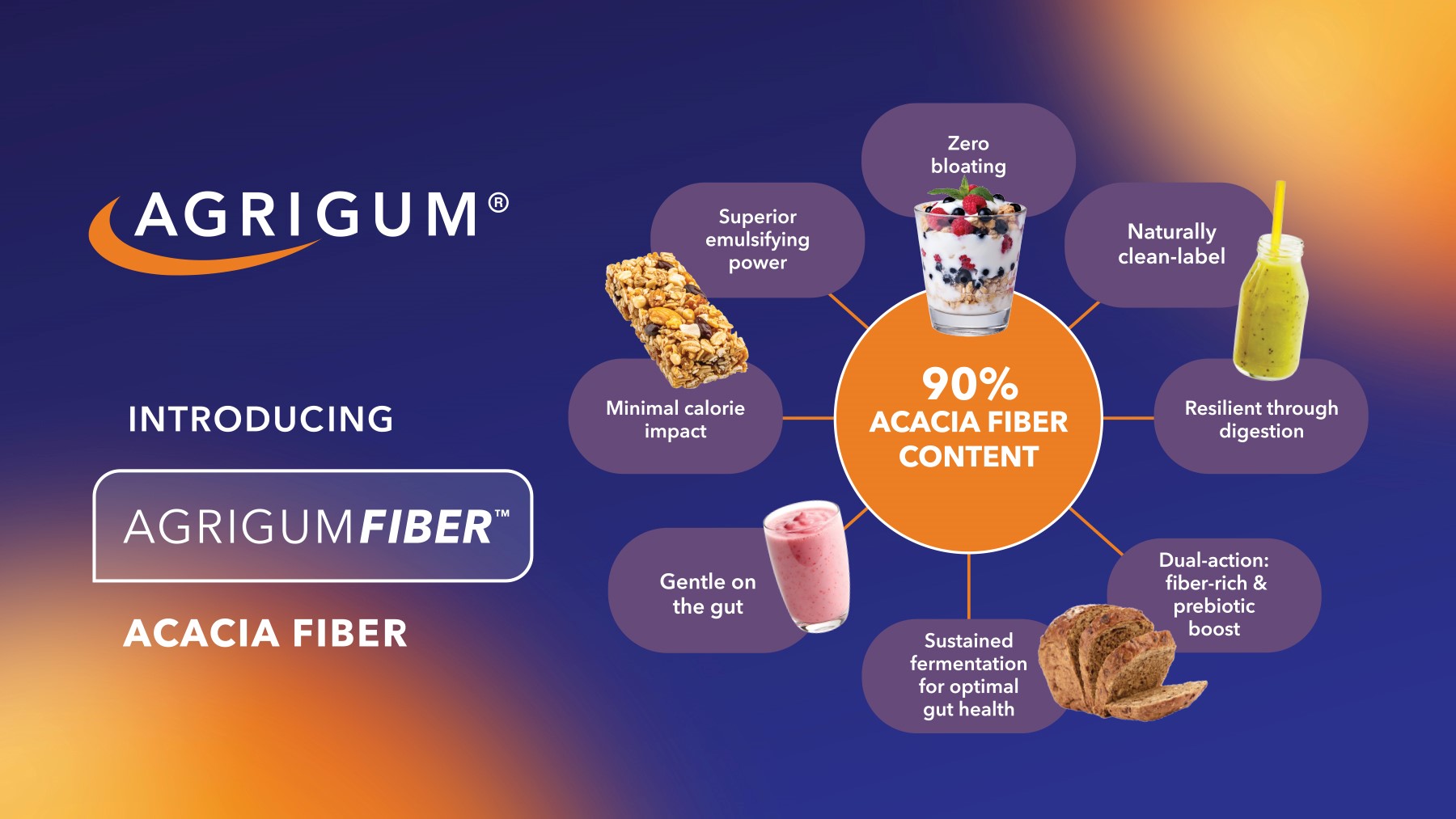
This year, Agrigum proudly introduced AGRIGUMFIBER™ – a flagship innovation addressing the global fibre gap. Combining the natural efficacy of gum acacia with proven health benefits, it represents Agrigum’s commitment to advancing functional, clean-label solutions for a healthier world.
Gum arabic, redefined
More than just a fibre, AGRIGUMFIBER™ represents the union of nature and science, offering unmatched functionality and digestive wellness. It is a versatile dietary fibre used in applications ranging from dairy and plant-based milks to confectionery, baked goods, beverages, and nutritional supplements.
What makes AGRIGUMFIBER™ different?
- Gentle and well-tolerated: Unlike synthetic or fermentable fibres, AGRIGUMFIBER™ is slowly fermented in the colon, promoting gut health without causing bloating or gas. Research shows gum acacia is well tolerated in healthy adults up to 30–40g per day.
- 100% natural and clean-label: Extracted from acacia tree sap and processed without chemical modification – a pure, plant-based ingredient aligned with clean label formulations.
- Prebiotic power: Clinically proven to enhance gut microbiota diversity and support long-term digestive health.
- Stable and neutral: Highly soluble, heat-stable, and neutral in taste, AGRIGUMFIBER™ integrates seamlessly into food and beverage applications.
- Excellent emulsification properties: Improves texture and mouthfeel, and extends product shelf-life.
A message from Agrigum’s innovation scientists
“Add just 1–3% Agri-Spray Acacia AGRIGUMFIBER™ to your gluten or gluten-free bread recipe to create a softer, longer-lasting loaf – and naturally boost its fibre content. Every slice brings a healthier start to the day, helping close the global fibre gap without changing taste or texture.”
Agrigum science: Innovation hub
For Agrigum, gum acacia is not just a product – it is a science. The company partnered with the University of Nottingham to launch Agrigum science, its technical centre of excellence at the School of Biosciences. Here, Agrigum’s technical team and state-of-the-art labs enable it to analyse, innovate, and optimise formulations by understanding gum acacia’s molecular structure and unlocking its potential.
Agrigum is on a mission to address today’s global issues with impactful solutions that benefit people, society, and the environment. Our team pioneers applications shaping the future of food and nutrition and is developing a pipeline of exciting products.
More than a supplier: A partner in innovation
Agrigum transcends the role of supplier; it is a partner in the science and story of gum acacia. In blending heritage with innovation, Agrigum honours a centuries-old ingredient while applying modern science to meet today’s demand for clean, sustainable, and health-driven solutions. With Agrigum, you don’t just source an ingredient – you gain a partner dedicated to helping you unlock the full potential of gum acacia.
Sponsored by:
.png)
This piece of content is provided by an advertiser or created on behalf of an advertiser. The views or opinions expressed in this piece of content do not reflect those of Informa.
Companies mentioned


Get more of our news on Google
Set Ingredients Network as a 'Preferred Source' to get quicker access to the news you value.
Related news

Kellogg accelerates work to remove artificial colours from all US cereals
3 Sep 2026
WK Kellogg has announced an accelerated timeline to eliminate all artificial colours and the chemical preservative, BHT, across its full US portfolio of cereals and cereal packaging.
Read more
Skimpflation: An ‘unfair’ and risky approach to keeping prices low
2 Sep 2026
Consumers see skimpflation – reducing the quality of ingredients due to rising costs – as more unfair than shrinkflation, making it a risky strategy according to recent research.
Read more
NielsenIQ’s EU barometer shows Britain leading in grocery inflation
31 Aug 2026
Britain was the only country to record grocery inflation above 2%, according to NielsenIQ data that compared Europe’s five biggest grocery markets from February to May 2026.
Read more
‘Urgent gaps’ in achieving 2030 food system goals
27 Aug 2026
Global food systems are failing to meet 2030 targets across indicators including health, environment, and resilience, according to a report co-authored by the Food and Agriculture Organisation (FAO).
Read more
Chimac’s fusion sauces bring Korean flavours to Europe
25 Aug 2026
Irish sauce brand Chimac is tapping into Korea’s culinary traditions, bringing its flavours and products to European consumers who want a taste of K-food.
Read more
Global demand for instant noodles continues to rise
24 Aug 2026
Global demand for instant noodles reached 124.21 billion servings last year, representing a 0.7% year-on-year increase – or 900 million extra servings.
Read more
Popular barbecue staples experience sharp price increases
19 Aug 2026
The typical cost of US shoppers’ barbecue baskets has risen by 12% over the past year – the fastest annual rise in a decade, figures from The Economist show.
Read more
Hot NPD: Nissin launches first cold-water Cup Noodles
18 Aug 2026
Nissin is taking one of Japan’s most iconic instant meals in a completely new direction with the launch of the first cold water-only Cup Noodles in the brand’s 55-year history.
Read more
Savoury protein snacks shake up the on-the-go market
10 Aug 2026
Sweet flavours have dominated the high-protein snack category but savoury snacks, such as cheese bars and meat sticks, can appeal to health-conscious consumers.
Read more
Digital twin technology gains ground in food manufacturing
6 Aug 2026
Food and beverage companies are increasingly turning to digital twins to optimise and automate manufacturing processes, but opportunities stretch far beyond this, say experts.
Read more