
Ingredients Categories
Finished Products
Finished Food Categories
- Bakery
- Beverages / Juices
- Cereal and grain products
- Confectionery
- Cooking Fats & Oils
- Dairy
- Egg products
- Fruits & Vegetables
- Infant & Baby food
- Meat, Poultry & Fish
- Nuts & Seeds products
- Other Finished Food Categories
- Pet Food
- Plant-based foods
- Prepared foods
- Sauces & Seasonings
- Sweet & Savoury Spreads
Specialised Finished Products
- Bee products
- Biotic products
- Dietary supplements
- Energy drinks
- Functional beverages
- Functional confectionery
- Functional food
- Functional powders
- Meal replacement products
- Nutricosmetics
- Other Specialised Finished Products
- Pet Dietary Supplements
- Pharma and OTC products
- Protein products
- Sugar replacers / Sweeteners
Health & Wellness Areas
Delivery Formats
Operations & Services
- 3D printing
- Analysis/ Testing
- Auditing & certifications
- Blending & mixing
- Bottling
- Certification
- Clinical trials
- Co-packing
- Coating
- Consulting
- Contract manufacturing
- Drying
- Electrospinning
- Encapsulating
- Enzymatic processing
- Extracting
- Extrusion
- Fat structuring
- Fermentation
- Filling
- Flavour development
- Freeze drying
- Granulating/ grinding/ milling / mixing
- High-pressure processing
- Labelling
- Other Operations & Services
- Packaging
- Packet filling
- Pasturising
- Quality assurance
- Saccharification
- Shear cell processing
- Spray drying
- Sterilisation
- Storage & Logistics
- Tabletting
- Toasting / roasting
- Ultra-high temperature processing
News
EU Breakfast Directive: What food brands must do before June deadline
Tessa Wiles, Content Editor - Food 20 Apr 2026Honey origin labelling, higher fruit content for jams, and new categories for reduced-sugar juices: What must brands do to comply with the EU Breakfast Directive?
On 14 June 2026, the revised Breakfast Directive will apply, meaning food manufacturers across the EU have less than three months to prepare.

Ingredients Network spoke to Shannon Fahy, associate at Dublin-based law firm Browne Jacobson, about what the directive means in practice.
Honey origin labelling mandated
Of the four categories, Fahy identified honey as facing the most complex compliance challenges.
“This is because the Breakfast Directive amends labelling requirements in respect of honey products,” she explained.
The rules respond to a coordinated EU sampling campaign in 2023 that found nearly half (46%) of honey imported to the EU was suspected of being adulterated. This finding prompted regulatory action on origin transparency.
“If the honey consists of a mixture of honeys from different countries, all countries must be set out in the label in decreasing order based on their weight and the percentage of each origin. A tolerance of 5% is allowed for each individual share within the blend, but this is calculated on the basis of the operator’s traceability documentation,” Fahy said.
Packages containing less than 30 grams of honey are permitted to use two-letter ISO country codes, instead of full country names.
“This means that honey manufacturers will not only have to amend the labels of their honeys to include additional information but will also need to ensure their traceability documentation is maintained and their labels accurately reflect those records,” she explained.
Effectively, the requirement mandates per-batch traceability, which will require significant operational shifts for blenders who source honey from multiple origins.
“The upside for honey manufacturers is that honey products which are placed on the market or labelled before 14 June 2026 may continue to be marketed until the exhaustion of stocks,” she said, adding that
This allows manufacturers to continue selling old stock, while working on implementing labelling measures to comply with the Directive.
“The Breakfast Directive also authorises the European Commission to establish methods of analysis to verify whether honey is compliant with the Breakfast Directive, as well as to detect adulterated honey. Therefore, in due course, honey manufacturers may be placed under even more scrutiny,” Fahy added.
Fruit jams and juices: Reducing sugar and raising the fruit content
The Breakfast Directive also raises the minimum fruit content for standard jams from 350 grams/kilogram to 450g/kg of finished product. Extra jams and extra jellies, which refer to those made from unconcentrated fruit pulp, are required to increase from 450g/kg to 500g/kg.
This reformulation aims to reduce the amount of added sugar in these products, promoting healthier formulations and supporting fruit producers across the EU.
For fruit juices, the directive introduces three new reduced-sugar categories: reduced-sugar fruit juice, reduced-sugar fruit juice from concentrate, and concentrated reduced-sugar fruit juice.
All three categories must contain at least 30% less naturally occurring sugar than their standard equivalents, and sweeteners cannot be used to compensate for the reduction.
The directive also allows manufacturers to label standard fruit juices as containing “only naturally occurring sugars” to differentiate them from nectars with added sugars. However, labels on reduced-sugar products must not carry nutrition and/or health claims linked to the sugar reduction.
Juice made from concentrate must state this both clearly and visibly close to the product name.
Full compliance is required for products labelled after the deadline
For products labelled after the 14 June 2026 deadline, full compliance is expected.
Fahy explained that in Ireland, authorised officers appointed by the Food Safety Authority will have jurisdiction to seize, remove, or detain products deemed non-compliant.
She added that the Authority can also direct the non-compliant products to be withdrawn from the market and issue prohibition orders.

Get more of our news on Google
Set Ingredients Network as a 'Preferred Source' to get quicker access to the news you value.
Related news

M&S launches own-brand pet food range
11 Sep 2026
UK retailer Marks & Spencer has launched its own-brand pet food line Paws & Pals – a well-timed and strategic move that will appeal to loyal shoppers, says a marketing expert.
Read more
Do the US dietary guidelines put UPFs under pressure?
10 Sep 2026
Will the US dietary guidelines change the way Americans eat, swapping ultra-processed foods for whole foods? We asked Dr Barry Popkin, renowned nutrition and obesity researcher.
Read more
Food fraud costs UK economy £2bn each year
9 Sep 2026
Food fraud is costing the UK economy up to £2 billion (€2.3 billion) every year although the food sector is more “resilient” than others, according to a recent study.
Read more
Kellogg accelerates work to remove artificial colours from all US cereals
3 Sep 2026
WK Kellogg has announced an accelerated timeline to eliminate all artificial colours and the chemical preservative, BHT, across its full US portfolio of cereals and cereal packaging.
Read more
‘Urgent gaps’ in achieving 2030 food system goals
27 Aug 2026
Global food systems are failing to meet 2030 targets across indicators including health, environment, and resilience, according to a report co-authored by the Food and Agriculture Organisation (FAO).
Read more
Chimac’s fusion sauces bring Korean flavours to Europe
25 Aug 2026
Irish sauce brand Chimac is tapping into Korea’s culinary traditions, bringing its flavours and products to European consumers who want a taste of K-food.
Read more
Savoury protein snacks shake up the on-the-go market
10 Aug 2026
Sweet flavours have dominated the high-protein snack category but savoury snacks, such as cheese bars and meat sticks, can appeal to health-conscious consumers.
Read more
Nestlé invests in regeneratively farmed wheat for KitKat
5 Aug 2026
Nestlé will pay a premium for Wildfarmed’s regeneratively farmed wheat but the CPG remains reticent to promote the move on packs of its KitKat bars.
Read more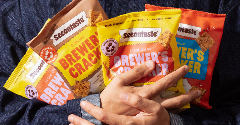
How Secon Taste is putting upcycled snacks on shelves
4 Aug 2026
Hungarian zero-waste startup Secon Taste is turning surplus food into upcycled snacks such as fibre-packed granola, instant porridge, and a circular coffee-tasting box.
Read more
Codex sets global thresholds for ‘may contain’ labels
3 Aug 2026
Codex Alimentarius has adopted its first global guidance on when to use “may contain” allergen warnings, setting thresholds intended to stop the label being used as blanket legal cover.
Read more