
Ingredients Categories
Finished Products
Finished Food Categories
- Bakery
- Beverages / Juices
- Cereal and grain products
- Confectionery
- Cooking Fats & Oils
- Dairy
- Egg products
- Fruits & Vegetables
- Infant & Baby food
- Meat, Poultry & Fish
- Nuts & Seeds products
- Other Finished Food Categories
- Pet Food
- Plant-based foods
- Prepared foods
- Sauces & Seasonings
- Sweet & Savoury Spreads
Specialised Finished Products
- Bee products
- Biotic products
- Dietary supplements
- Energy drinks
- Functional beverages
- Functional confectionery
- Functional food
- Functional powders
- Meal replacement products
- Nutricosmetics
- Other Specialised Finished Products
- Pet Dietary Supplements
- Pharma and OTC products
- Protein products
- Sugar replacers / Sweeteners
Health & Wellness Areas
Delivery Formats
Operations & Services
- 3D printing
- Analysis/ Testing
- Auditing & certifications
- Blending & mixing
- Bottling
- Certification
- Clinical trials
- Co-packing
- Coating
- Consulting
- Contract manufacturing
- Drying
- Electrospinning
- Encapsulating
- Enzymatic processing
- Extracting
- Extrusion
- Fat structuring
- Fermentation
- Filling
- Flavour development
- Freeze drying
- Granulating/ grinding/ milling / mixing
- High-pressure processing
- Labelling
- Other Operations & Services
- Packaging
- Packet filling
- Pasturising
- Quality assurance
- Saccharification
- Shear cell processing
- Spray drying
- Sterilisation
- Storage & Logistics
- Tabletting
- Toasting / roasting
- Ultra-high temperature processing
News
UK retailers flout unhealthy product regulation
Will Chu, Freelance Journalist 4 Jul 2023
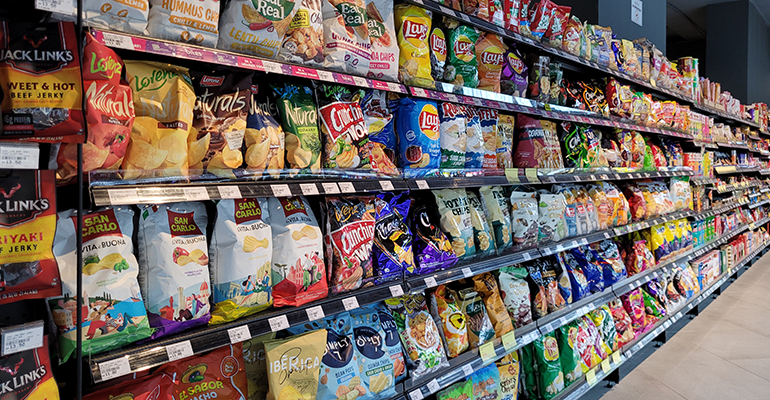
UK retailers are continuing to promote unhealthy products that are high in fat, salt, and sugar (HFSS) despite recent regulation that bans such practices.
In a tweet earlier this month, professor in food policy at City University of London Christina Vogel expressed dismay at the placement of HFSS products located in prominent locations such as end-of-aisles, checkouts, and designated queuing areas.

The move is in direct violation of HFSS placement legislation, which came into force on 1 October 2022 that also seeks to ban prominent HFSS item placement online such as on the homepage or checkout page.
Vogel commented: “I am increasingly gobsmacked to see UK retailers disregarding the HFSS placement legislation. Pics below taken in April/May 2023.”
Dr Vogel, who is author of a recent study on this issue, added that the, “lack of enforcement - as predicted in [the] paper – means retailers are now not fully adhering to the rules.”
“We can’t blame local authorities for lack of enforcement – they are stretched and don’t have resources to enforce it,” Dr Vogel said in another tweet.
“Worryingly retailers are now exploiting this situation & the loopholes (big in-aisle/island HFSS displays + alcohol & non-prepacked HFSS foods in key locations).”
HFSS enforcement appropriate to local resources
Her words were echoed by the Chartered Trading Standards Institute’s (CTSI) David Pickering, who said when the regulation took effect that its enforcement approach would be “graduated and proportionate.”
“While these regulations are seen as an important public health measure, it will be for local trading standards services to liaise with their public health teams and adopt an approach that is in keeping with the public health priorities in their area,” added Pickering, who is the CTSI’s lead officer for food.
 © AdobeStock/Nadezhda Kozhedub
The HFSS placement legislation specifically applies to retail stores over 185.8 square metres (2,000 square feet) with 50 employees or more.
According to UK government guidelines, failure to adhere to the regulations could result in firms being issued with an improvement notice and later a fixed monetary penalty if compliance is not achieved.
But the HFSS legislation by location is just one part of the puzzle as 1 October 2023 sees the delayed introduction of restrictions banning the promotion of HFSS products via buy-one-get-one-free schemes.
The government has come under fierce criticism by the food and drink industry, who have urged them to abandon these plans, arguing they will affect companies and consumers already struggling in the cost of living crisis. However, at the time of writing the plans will be rolled out in later this year.
“Supermarkets have a vital role to play in improving food environments to help consumers make healthier and more sustainable food purchases,” said The European Consumer Organisation’s (BEUC) Food Policy expert Emma Calvert.
“They can push consumers towards certain purchases through many levers such as price promotions, placement in strategic locations as well as determining the available food offer.
Steps in moving towards a healthier retail environment
Calvert pointed out that the UK legislation sought to ensure that prominent selling locations such as the check-out or end-of-aisles were reserved for healthier options and was therefore a “ground-breaking” and “important” step in moving towards a healthier retail environment for shoppers.
She added it was a shame that it appeared that retailers are flouting these rules and authorities were not cracking down on these infringements.
 © AdobeStock/ltyuan
“You can have the best laws in Europe, but without properly resourced enforcement, it’s for naught,” she said.
“No single action on unhealthy food environments is going to solve all the problems of our current food environment.
“We need multiple actions on multiple fronts to tackle the numerous issues with the food system. But we should, at the very least, make sure that the rules we do have are being adhered to.”
October will be another eventful month for this legislation as the UK government is now pressing ahead with a ban on adverts for HFSS foods before 9pm as well as a sweeping ban on HFSS advertising online in October 2025.
In the latest consultation by the Department of Health and Social Care, and Department for Digital, Culture, Media & Sport, it stated that the government had drafted a final policy for introducing these advertising restrictions.
It was now gathering views on the draft Advertising (Less Healthy Food Definitions and Exemptions) Regulations 2022 to complement the primary legislation.

Get more of our news on Google
Set Ingredients Network as a 'Preferred Source' to get quicker access to the news you value.
Related news

M&S launches own-brand pet food range
11 Sep 2026
UK retailer Marks & Spencer has launched its own-brand pet food line Paws & Pals – a well-timed and strategic move that will appeal to loyal shoppers, says a marketing expert.
Read more
Do the US dietary guidelines put UPFs under pressure?
10 Sep 2026
Will the US dietary guidelines change the way Americans eat, swapping ultra-processed foods for whole foods? We asked Dr Barry Popkin, renowned nutrition and obesity researcher.
Read more
Food fraud costs UK economy £2bn each year
9 Sep 2026
Food fraud is costing the UK economy up to £2 billion (€2.3 billion) every year although the food sector is more “resilient” than others, according to a recent study.
Read more
Kellogg accelerates work to remove artificial colours from all US cereals
3 Sep 2026
WK Kellogg has announced an accelerated timeline to eliminate all artificial colours and the chemical preservative, BHT, across its full US portfolio of cereals and cereal packaging.
Read more
Skimpflation: An ‘unfair’ and risky approach to keeping prices low
2 Sep 2026
Consumers see skimpflation – reducing the quality of ingredients due to rising costs – as more unfair than shrinkflation, making it a risky strategy according to recent research.
Read more
NielsenIQ’s EU barometer shows Britain leading in grocery inflation
31 Aug 2026
Britain was the only country to record grocery inflation above 2%, according to NielsenIQ data that compared Europe’s five biggest grocery markets from February to May 2026.
Read more
‘Urgent gaps’ in achieving 2030 food system goals
27 Aug 2026
Global food systems are failing to meet 2030 targets across indicators including health, environment, and resilience, according to a report co-authored by the Food and Agriculture Organisation (FAO).
Read more
Seven-Eleven uses microbial testing tech to extend katsudon shelf life
26 Aug 2026
Japanese retail company Seven-Eleven has improved its factory’s microbial environment to keep comfort-food staple, katsudon, fresher for longer.
Read more
Chimac’s fusion sauces bring Korean flavours to Europe
25 Aug 2026
Irish sauce brand Chimac is tapping into Korea’s culinary traditions, bringing its flavours and products to European consumers who want a taste of K-food.
Read more
Global demand for instant noodles continues to rise
24 Aug 2026
Global demand for instant noodles reached 124.21 billion servings last year, representing a 0.7% year-on-year increase – or 900 million extra servings.
Read more