
Ingredients Categories
Finished Products
Finished Food Categories
- Bakery
- Beverages / Juices
- Cereal and grain products
- Confectionery
- Cooking Fats & Oils
- Dairy
- Egg products
- Fruits & Vegetables
- Infant & Baby food
- Meat, Poultry & Fish
- Nuts & Seeds products
- Other Finished Food Categories
- Pet Food
- Plant-based foods
- Prepared foods
- Sauces & Seasonings
- Sweet & Savoury Spreads
Specialised Finished Products
- Bee products
- Biotic products
- Dietary supplements
- Energy drinks
- Functional beverages
- Functional confectionery
- Functional food
- Functional powders
- Meal replacement products
- Nutricosmetics
- Other Specialised Finished Products
- Pet Dietary Supplements
- Pharma and OTC products
- Protein products
- Sugar replacers / Sweeteners
Health & Wellness Areas
Delivery Formats
Operations & Services
- 3D printing
- Analysis/ Testing
- Auditing & certifications
- Blending & mixing
- Bottling
- Certification
- Clinical trials
- Co-packing
- Coating
- Consulting
- Contract manufacturing
- Drying
- Electrospinning
- Encapsulating
- Enzymatic processing
- Extracting
- Extrusion
- Fat structuring
- Fermentation
- Filling
- Flavour development
- Freeze drying
- Granulating/ grinding/ milling / mixing
- High-pressure processing
- Labelling
- Other Operations & Services
- Packaging
- Packet filling
- Pasturising
- Quality assurance
- Saccharification
- Shear cell processing
- Spray drying
- Sterilisation
- Storage & Logistics
- Tabletting
- Toasting / roasting
- Ultra-high temperature processing
News
Could plant-based protection replace plastic packaging?
Natasha Spencer-Jolliffe, Freelance Journalist 29 Oct 2025Swedish foodtech company Saveggy has launched an additive-free plant-based protection for cucumbers, offering a waste-free packaging solution for fruit and vegetables.
As the European Union (EU) prepares to ban single-use plastics for fresh produce by 2030, packaging and technology companies are developing new ways to make the switch away from plastic while preserving freshness and shelf life.
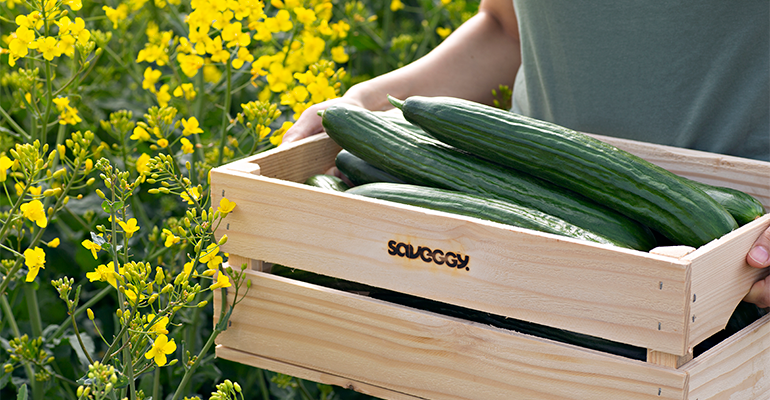
Saveggy’s newly developed SaveCucumber solution eliminates the need for plastic packaging for cucumbers. Rather than packaging, the brand describes its SaveCucumber protection as a foodstuff.
Made from two ingredients – rapeseed oil and oat oil – the plant-based protection is designed to offer a waste-free alternative to the traditional plastic products found in supermarkets across Europe.
Saveggy’s solution has a shelf life of 12 to 14 days, matching traditional plastic packaging. It hopes this will prevent potential consumer concerns about maintaining freshness from becoming a barrier to uptake and acceptance.
A two-pronged attack on single-use plastic and food waste crisis
The Swedish brand’s edible, additive-free fresh produce is launching on the country’s domestic market in preparation for the EU’s ban on single-use plastics for fresh produce by 2030.
The EU’s Packaging and Packaging Waste Regulation (PPWR) will limit the use of single-use plastic packaging for fresh produce by 2030. The law will extend to plastic wrap and trays for pre-packed fruits and vegetables weighing under 1.5kg, such as those currently used to package cucumbers.
Solutions to help cultivate a circular economy are therefore a key priority for brands.
Single-use packaging for fruit and vegetables has a considerable impact on the plastic pollution problem. According to Saveggy’s research, more than 3,000 tonnes of plastic are used to package cucumbers in the EU every year, while Eurostat's 2024 findings show that more than 59 million tonnes of food waste are generated annually.
The EU is working towards a 30% drop in discarded food across retail and consumer settings, and addressing food waste a key component of Europe’s Farm to Fork Strategy and the European Green Deal.
Saveggy’s research confirms the scale of the food waste problem and its deep impact on people, nature, and the economy.
“That knowledge really fuels us,” Arash Fayyazi, co-founder of Saveggy, told Ingredients Network. “Cucumbers highlight the challenge: food waste on one side, plastic-wrapped shelves on the other.”
Moving from plastic to plant-based protection
Saveggy began researching plastic-free protection options for cucumbers after learning that around one million tonnes are wasted each year in the EU, mainly due to water loss.
However, the company has faced both technical and ingredient-related obstacles.
“Even though it sounds simple, creating a very thin layer consisting of just two ingredients has been a major challenge,” Fayyazi said.
Saveggy has partnered with Aarhus University and is supported by EIT Food, which in turn is supported by the European Institute of Innovation and Technology (EIT), to carry out its research and development (R&D). Collectively, the team needed to ensure that its plastic-free alternative solved technical challenges and complied with regulatory requirements.
The technology has undergone multiple development phases and countless tests to arrive at the formula that now makes up its first product. The team has tested many different ingredients and combinations, always aiming for a clean recipe with no additives.
“Our patience has been tested time and again,” said Fayyazi.
Consumers are increasingly concerned not only about plastics but also about additives and chemicals in food. To reassure shoppers that its product could retain freshness and shelf life, Saveggy saw from the outset that its protection needed to be free from additives and made with as few ingredients as possible.
“At the same time, we recognised a clear challenge: our product is invisible, odourless, and tasteless, yet it still needs to be clear to the consumer that it’s there,” he said.
Transparency is a strong driving force behind the brand. Saveggy strives to communicate openly so that consumers understand both the product’s presence and its value.
“When it comes to shelf life, we’ve conducted extensive quality testing, and we can confidently say our protection delivers the same shelf life as plastic,” Fayyazi added.
Plant-based protection that supports nature
Saveggy also drew inspiration from nature. Many fruits and vegetables naturally have a thin, fatty, protective layer called “bloom”.
“That idea has always fascinated me: how something so minimal can be so effective, and how it returns to nature in a truly circular way,” Fayyazi said.
Finding plastic packaging alternatives for cucumbers is the starting point for Saveggy. The brand anticipates that its two-ingredient solution could feature in a wide range of fruit and vegetable applications, with product development ongoing.
It is now scaling to bell peppers, courgettes, and eggplants.

Get more of our news on Google
Set Ingredients Network as a 'Preferred Source' to get quicker access to the news you value.
Related news

M&S launches own-brand pet food range
11 Sep 2026
UK retailer Marks & Spencer has launched its own-brand pet food line Paws & Pals – a well-timed and strategic move that will appeal to loyal shoppers, says a marketing expert.
Read more
Do the US dietary guidelines put UPFs under pressure?
10 Sep 2026
Will the US dietary guidelines change the way Americans eat, swapping ultra-processed foods for whole foods? We asked Dr Barry Popkin, renowned nutrition and obesity researcher.
Read more
Food fraud costs UK economy £2bn each year
9 Sep 2026
Food fraud is costing the UK economy up to £2 billion (€2.3 billion) every year although the food sector is more “resilient” than others, according to a recent study.
Read more
Health and wellness engagement matures across Middle East and Africa
4 Sep 2026
Many consumers in the Middle East and Africa are now proactively engaged in health and wellness, looking to integrate better habits and products into their daily lives, say experts.
Read more
Kellogg accelerates work to remove artificial colours from all US cereals
3 Sep 2026
WK Kellogg has announced an accelerated timeline to eliminate all artificial colours and the chemical preservative, BHT, across its full US portfolio of cereals and cereal packaging.
Read more
Skimpflation: An ‘unfair’ and risky approach to keeping prices low
2 Sep 2026
Consumers see skimpflation – reducing the quality of ingredients due to rising costs – as more unfair than shrinkflation, making it a risky strategy according to recent research.
Read more
Royal Canin launches ‘freshly-cooked’ therapeutic dog food
1 Sep 2026
Mars-owned Royal Canin has moved into the therapeutic diet sector with the launch of its Fresh Veterinary Diets range for dogs with health conditions. We asked a veterinary nutritionist for her opinion.
Read more
NielsenIQ’s EU barometer shows Britain leading in grocery inflation
31 Aug 2026
Britain was the only country to record grocery inflation above 2%, according to NielsenIQ data that compared Europe’s five biggest grocery markets from February to May 2026.
Read more
‘Urgent gaps’ in achieving 2030 food system goals
27 Aug 2026
Global food systems are failing to meet 2030 targets across indicators including health, environment, and resilience, according to a report co-authored by the Food and Agriculture Organisation (FAO).
Read more
Seven-Eleven uses microbial testing tech to extend katsudon shelf life
26 Aug 2026
Japanese retail company Seven-Eleven has improved its factory’s microbial environment to keep comfort-food staple, katsudon, fresher for longer.
Read more