
Ingredients Categories
Finished Products
Finished Food Categories
- Bakery
- Beverages / Juices
- Cereal and grain products
- Confectionery
- Cooking Fats & Oils
- Dairy
- Egg products
- Fruits & Vegetables
- Infant & Baby food
- Meat, Poultry & Fish
- Nuts & Seeds products
- Other Finished Food Categories
- Pet Food
- Plant-based foods
- Prepared foods
- Sauces & Seasonings
- Sweet & Savoury Spreads
Specialised Finished Products
- Bee products
- Biotic products
- Dietary supplements
- Energy drinks
- Functional beverages
- Functional confectionery
- Functional food
- Functional powders
- Meal replacement products
- Nutricosmetics
- Other Specialised Finished Products
- Pet Dietary Supplements
- Pharma and OTC products
- Protein products
- Sugar replacers / Sweeteners
Health & Wellness Areas
Delivery Formats
Operations & Services
- 3D printing
- Analysis/ Testing
- Auditing & certifications
- Blending & mixing
- Bottling
- Certification
- Clinical trials
- Co-packing
- Coating
- Consulting
- Contract manufacturing
- Drying
- Electrospinning
- Encapsulating
- Enzymatic processing
- Extracting
- Extrusion
- Fat structuring
- Fermentation
- Filling
- Flavour development
- Freeze drying
- Granulating/ grinding/ milling / mixing
- High-pressure processing
- Labelling
- Other Operations & Services
- Packaging
- Packet filling
- Pasturising
- Quality assurance
- Saccharification
- Shear cell processing
- Spray drying
- Sterilisation
- Storage & Logistics
- Tabletting
- Toasting / roasting
- Ultra-high temperature processing
News
Updated US dietary guidelines: Common sense or ‘compromised’ advice?
Rik Moors 16 Jan 2026The US government says its updated US dietary guidelines are “common sense” advice to “eat real food” – but they are compromised by conflicts of interest, critics argue.
The 2025-2030 Dietary Guidelines for Americans are “the most significant reset of federal nutrition policy in [the] nation’s history”.
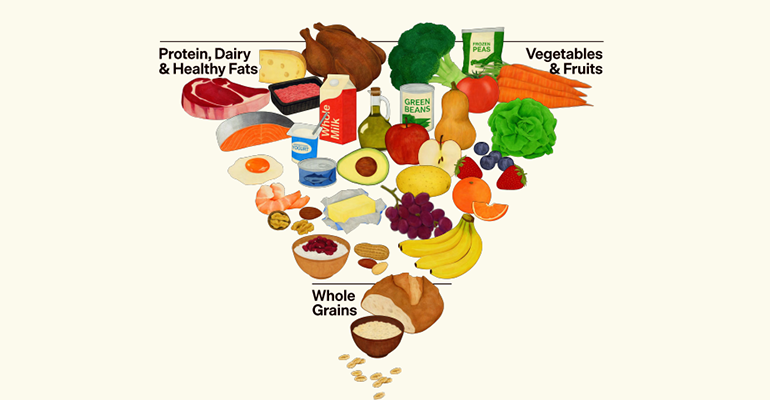
This is what Health and Human Services Secretary Robert F. Kennedy Jr. and Agriculture Secretary Brooke Rollins claimed in early January as they presented their updated national nutritional guidance.
Positioned as a central part of the ‘Make America Healthy Again’ (MAHA) agenda, the Trump administration hailed these guidelines, launched on RealFood.gov, as a return to “common sense” nutrition advice to “eat real food”.
However, by taking some notable departures from previous nutrition advice and scientific recommendations, the Make America Healthy Again guidelines have triggered some intense debates across the food industry and nutrition community.
MAHA endorses more protein, dairy, meats
One of the most striking changes involves the elevation of (animal) protein consumption. The guidelines recommend 1.2-1.6 grams of protein per kilogram of body weight daily, representing a substantial increase from the 0.8g/kg recommended in the Dietary Reference Intake. This translates to approximately 84-112 grams daily for a 2,000-calorie diet.
The guidelines specifically advocate prioritising high-quality, nutrient-dense protein at every meal, with an emphasis on animal sources such as eggs, poultry, seafood, and red meat, alongside plant-sourced proteins including beans, peas, lentils, legumes, nuts, seeds, and soy.
Breaking from decades of low-fat recommendations, the guidelines explicitly endorse three servings of full-fat dairy daily, describing it as “an excellent source of protein, healthy fats, vitamins, and minerals”. This includes whole milk, full-fat yoghurt, and cheese.
Butter and tallow fat redefined as ‘healthy fats’
Perhaps most controversially, the guidelines redefine “healthy fats” to include butter and beef tallow alongside olive oil, marking a significant departure from previous recommendations that favoured unsaturated vegetable oils.
The guidelines also recommend avoiding “highly processed packaged, prepared, ready-to-eat, or other foods that are salty or sweet” and explicitly discourage sugar-sweetened beverages. However, the guidelines notably fall short of using the term “ultra-processed foods” (UPFs).
The guidance further states that “no amount of added sugars or non-nutritive sweeteners is recommended or considered part of a healthy or nutritious diet” and calls for parents to completely avoid added sugar for children aged four and under.
‘Oxymoronic’ and ‘compromised’ guidance?
Nutrition expert Marion Nestle described the guidelines as “cheerful, but muddled, contradictory, ideological, and retro.” She acknowledged positives, including the “eat real food” message and specific mentions of reducing processed foods with additives, whilst highlighting several concerns.
Nestle questioned the protein promotion despite Americans already consuming adequate amounts, noting the complete avoidance of sustainability considerations and contradictory advice on saturated fat. The guidelines promote high-saturated fat foods whilst maintaining the less than 10% saturated fat limit, creating what she describes as “oxymoronic” guidance.
The non-profit organisation, Center for Science in the Public Interest (CSPI), meanwhile, has voiced particularly loud and comprehensive criticism of the guidelines. CSPI president Dr. Peter Lurie stated that the guidelines are “insufficient to guide federal policy” and “diverge from the science-based recommendations” of the Dietary Guidelines Advisory Committee (DGAC).
Multiple conflicts of interest
A central point of criticism from both CSPI and Nestle is the assertion that, despite Kennedy’s promises to eliminate conflicts of interest, several committee members reported financial ties to meat and dairy industry organisations, including connections to the Global Dairy Platform, National Cattlemen’s Beef Association, National Dairy Council, National Pork Board, and various dairy research foundations – as reported in the New York Times.
In response to perceived industry influence, CSPI and the Center for Biological Diversity launched their own guidance soon after the official DGA launch, which they call the ‘uncompromised’ DGA.
This alternative demonstrates envisions what the guidelines could have looked like if the Trump administration fully adopted the scientific committee’s recommendations.
Notable differences include an emphasis on eating more plant-based sources of protein and fat, including beans, peas, lentils, nuts and seeds, vegetable oils higher in unsaturated fats, and “underconsumed nutrients” like Vitamin D, calcium, potassium, and dietary fibre; and recommendations to eat less, rather than more red meat.
What is the real world impact of this so-called ‘real food revolution’?
The guidelines’ influence extends far beyond individual dietary choices.
As CSPI notes, “all federal nutrition programs are required to promote the DGA, meaning at least 1 in 4 Americans are directly affected by the recommendations”, through initiatives like school meal programmes, military and veteran feeding programmes, SNAP policies, WIC programme guidelines, and healthcare nutrition counselling.
However, the full impact of dietary guidelines can be limited in the absence of other policy shifts.
Barbara Bray, a food safety and nutrition strategist at Alo Solutions who has studied dietary guidelines and food environments in several global markets, told Ingredients Network that whilst she welcomed some of the new guidance, including the recommendation of three portions of vegetables to two portions of fruit, the food environment must support these recommendations to ensure real-world impact.
“How easy is it to get three portions of vegetables with the way foods are sold in the out-of-home sector or even in supermarkets?” Bray said. “Are they in a format that’s easy for people to access, cook, or eat raw? If the answer is no, it doesn’t matter what the dietary guidelines say.”
Pointing to examples of more holistic approaches, she added: “Some dietary guidelines are in step with their food environment and can pull levers to make changes work better. But if you’re just dictating to people without giving them the structure to make those changes, it’s not going to help.”

Get more of our news on Google
Set Ingredients Network as a 'Preferred Source' to get quicker access to the news you value.
Related news

Do the US dietary guidelines put UPFs under pressure?
10 Sep 2026
Will the US dietary guidelines change the way Americans eat, swapping ultra-processed foods for whole foods? We asked Dr Barry Popkin, renowned nutrition and obesity researcher.
Read more
Food fraud costs UK economy £2bn each year
9 Sep 2026
Food fraud is costing the UK economy up to £2 billion (€2.3 billion) every year although the food sector is more “resilient” than others, according to a recent study.
Read more
Kellogg accelerates work to remove artificial colours from all US cereals
3 Sep 2026
WK Kellogg has announced an accelerated timeline to eliminate all artificial colours and the chemical preservative, BHT, across its full US portfolio of cereals and cereal packaging.
Read more
Skimpflation: An ‘unfair’ and risky approach to keeping prices low
2 Sep 2026
Consumers see skimpflation – reducing the quality of ingredients due to rising costs – as more unfair than shrinkflation, making it a risky strategy according to recent research.
Read more
‘Urgent gaps’ in achieving 2030 food system goals
27 Aug 2026
Global food systems are failing to meet 2030 targets across indicators including health, environment, and resilience, according to a report co-authored by the Food and Agriculture Organisation (FAO).
Read more
Popular barbecue staples experience sharp price increases
19 Aug 2026
The typical cost of US shoppers’ barbecue baskets has risen by 12% over the past year – the fastest annual rise in a decade, figures from The Economist show.
Read more
Savoury protein snacks shake up the on-the-go market
10 Aug 2026
Sweet flavours have dominated the high-protein snack category but savoury snacks, such as cheese bars and meat sticks, can appeal to health-conscious consumers.
Read more
Digital twin technology gains ground in food manufacturing
6 Aug 2026
Food and beverage companies are increasingly turning to digital twins to optimise and automate manufacturing processes, but opportunities stretch far beyond this, say experts.
Read more
Nestlé invests in regeneratively farmed wheat for KitKat
5 Aug 2026
Nestlé will pay a premium for Wildfarmed’s regeneratively farmed wheat but the CPG remains reticent to promote the move on packs of its KitKat bars.
Read more
Codex sets global thresholds for ‘may contain’ labels
3 Aug 2026
Codex Alimentarius has adopted its first global guidance on when to use “may contain” allergen warnings, setting thresholds intended to stop the label being used as blanket legal cover.
Read more