
Ingredients Categories
Finished Products
Finished Food Categories
- Bakery
- Beverages / Juices
- Cereal and grain products
- Confectionery
- Cooking Fats & Oils
- Dairy
- Egg products
- Fruits & Vegetables
- Infant & Baby food
- Meat, Poultry & Fish
- Nuts & Seeds products
- Other Finished Food Categories
- Pet Food
- Plant-based foods
- Prepared foods
- Sauces & Seasonings
- Sweet & Savoury Spreads
Specialised Finished Products
- Bee products
- Biotic products
- Dietary supplements
- Energy drinks
- Functional beverages
- Functional confectionery
- Functional food
- Functional powders
- Meal replacement products
- Nutricosmetics
- Other Specialised Finished Products
- Pet Dietary Supplements
- Pharma and OTC products
- Protein products
- Sugar replacers / Sweeteners
Health & Wellness Areas
Delivery Formats
Operations & Services
- 3D printing
- Analysis/ Testing
- Auditing & certifications
- Blending & mixing
- Bottling
- Certification
- Clinical trials
- Co-packing
- Coating
- Consulting
- Contract manufacturing
- Drying
- Electrospinning
- Encapsulating
- Enzymatic processing
- Extracting
- Extrusion
- Fat structuring
- Fermentation
- Filling
- Flavour development
- Freeze drying
- Granulating/ grinding/ milling / mixing
- High-pressure processing
- Labelling
- Other Operations & Services
- Packaging
- Packet filling
- Pasturising
- Quality assurance
- Saccharification
- Shear cell processing
- Spray drying
- Sterilisation
- Storage & Logistics
- Tabletting
- Toasting / roasting
- Ultra-high temperature processing
News
Oatly stirs debate over plant-based milk processing
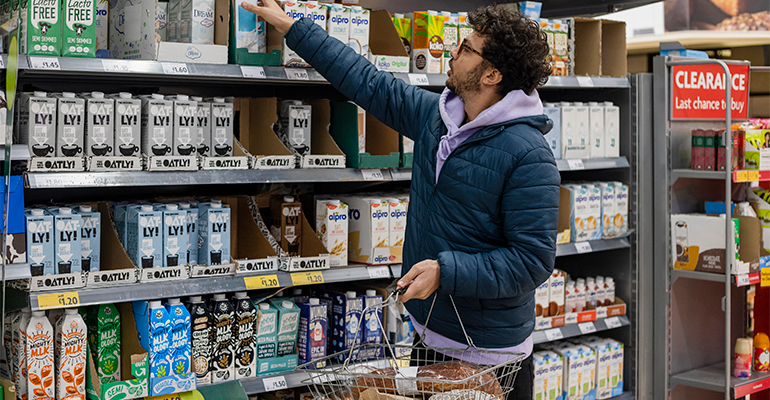
David Burrows, Freelance Journalist 8 Jan 2026Oatly has weighed into the health debate surrounding processed foods via messaging on packaging for its oat drinks.
Making reference to the ongoing debate around processed and ultra-processed foods (UPFs), the side of cartons of its barista oat drink in the UK bears the words: “Trust the processed.”
This is followed by an explanation: “When turning oats into a tasty liquid like the one you’re holding, we use clever production processes like heat treatment and homogenisation. These are also used for cow’s milk, and we guess that makes our drinks processed, which apparently can be scary for some.”
Oatly’s blurb continues: “That’s cool – food processing has been adopted by humans for centuries to reduce nutrient loss, curb food waste, and give people access to safe, nutritious, and more affordable food.”
Caroline Orfila Jenkins, vice-president (science and technology) at Oatly and professor of plant biochemistry and nutrition at the University of Leeds, said that packaging is one of the company’s “most powerful comms tools”.
She wrote on social media: “When we chose to address this topic on our pack, we anticipated debate and that’s part of the intent…
“Current opinions around UPFs are polarising, offering simplistic yet confusing narratives about food processing which are – in my view – distracting us from tackling the integrated challenges of climate change and food injustice.”
Experts divided over Oatly’s approach to UPF debate
Experts were divided over the merits of Oatly’s intervention in what proved to be one of last year’s most heated debates.
Some marketers argued that it was only likely to confuse consumers further on UPFs. Others suggested the company was side-stepping the real issue people have with processed foods, such as long lists of confusing ingredients.
Some, however, called the move bold and brave.
Susan Thomas, an independent food industry consultant who was previously sustainability director at the UK supermarket chain Asda, said it was encouraging that Oatly was challenging the “dangerous idea” that any type of processing is problematic.
“The industry could be more assertive on this,” she said.
However, the wording is “slightly patronising and also slightly mis-directive, as I expect it’s more likely to be the unfamiliar ingredients like dipotassium phosphate than the heating that may un-nerve people (and I am sure they could have explained perfectly well why that’s not actually something to worry about)”, she added.
The right mix for plant-based milks
The classification and impact of foods based on their level of processing is a live debate.
Defined under the Nova classification system, UPFs are formulations of industrial ingredients such as protein isolates, modified starches, non-nutritive sweeteners, and emulsifiers, designed for shelf stability and sensory appeal, but typically low in fibre and micronutrients and high in added sugar, salt, and saturated fat.
A key criticism of the Nova system has been that by classifying foods based on processing rather than nutrient content, the methodology groups products with varying nutritional profiles, such as flavoured yoghurt and sugary beverages, into the same category.
Plant-based milks rely on added ingredients to enhance the sensory elements and improve shelf life, and are also often fortified with micronutrients.
According to a UK analysis published in the journal Current Developments in Nutrition in June 2025, 84% of all plant-based milks were classified as ultra-processed (Nova 4), 14% as processed (Nova 3), and just 2% as minimally processed (Nova 1).
As many as 97% of the non-organic “milks” were classified as Nova 4, compared with 30% of organic ones.
Added ingredients in these plant-based milks included salt (92%), sugar (26%), flavours (33%), stabilsers (66%), emulsifiers (24%), and acidity regulators (77%), the team from the University of Hertfordshire found.
Past research has showed the ingredients most commonly added to these drinks are salt, sugar, tricalcium phosphate, and gellan gum. The latter is, for example, the stabiliser used by Rude Health in its oat barista drink, along with water, gluten-free oats (13%), sunflower oil, and sea salt.
“You wouldn’t chuck artificial nasties into your espresso machine; we don’t pout them into our drinks,” the company’s cartons read.
Amy Williams, a science communication expert at the Good Food Institute (GFI), which supports the market for alternative proteins, praised the intervention from Oatly.
“I like companies standing by their choices and offering greater transparency rather than just being cowed into going ‘clean label’ at the expense of important things like fortification,” she said.
However, she wondered if consumer education were best left to nutritionists.
Cause for concern but confusion reins
In November 2025, the first paper in a three-part series on UPF research and policy, published in The Lancet, acknowledged critiques of Nova’s scope and granularity but defended the classification’s policy utility.
UPFs, the authors argued, differ from traditional processed foods not only in composition but in their function within food systems, where they displace whole and minimally processed foods and promote overconsumption.
Studies have identified an association between higher consumption of UPFs and adverse health outcomes.
However, it remains unclear whether this association is due to the “processing”, including the addition of ingredients that are chemically synthesised, or because processed foods naturally tend to be higher in calories, saturated fat, salt, and/or sugar.
The authors of The Lancet paper noted: “The totality of the evidence supports the thesis that displacement of long-established dietary patterns by ultra-processed foods is a key driver of the escalating global burden of multiple diet-related chronic diseases.”
While the review identified strong associations between UPF consumption and a wide range of health outcomes, it stopped short of asserting direct causality.

Get more of our news on Google
Set Ingredients Network as a 'Preferred Source' to get quicker access to the news you value.
Related news

Do the US dietary guidelines put UPFs under pressure?
10 Sep 2026
Will the US dietary guidelines change the way Americans eat, swapping ultra-processed foods for whole foods? We asked Dr Barry Popkin, renowned nutrition and obesity researcher.
Read more
Food fraud costs UK economy £2bn each year
9 Sep 2026
Food fraud is costing the UK economy up to £2 billion (€2.3 billion) every year although the food sector is more “resilient” than others, according to a recent study.
Read more
Skimpflation: An ‘unfair’ and risky approach to keeping prices low
2 Sep 2026
Consumers see skimpflation – reducing the quality of ingredients due to rising costs – as more unfair than shrinkflation, making it a risky strategy according to recent research.
Read more
NielsenIQ’s EU barometer shows Britain leading in grocery inflation
31 Aug 2026
Britain was the only country to record grocery inflation above 2%, according to NielsenIQ data that compared Europe’s five biggest grocery markets from February to May 2026.
Read more
‘Urgent gaps’ in achieving 2030 food system goals
27 Aug 2026
Global food systems are failing to meet 2030 targets across indicators including health, environment, and resilience, according to a report co-authored by the Food and Agriculture Organisation (FAO).
Read more
China beverages: Is herbal innovation the future?
20 Aug 2026
Herbal and botanical innovation in China's drinks market continues to grow, with ingredients like astragalus root, ginger, and ginseng in the spotlight – and focus shifting far beyond refreshment.
Read more
Popular barbecue staples experience sharp price increases
19 Aug 2026
The typical cost of US shoppers’ barbecue baskets has risen by 12% over the past year – the fastest annual rise in a decade, figures from The Economist show.
Read more
Beyond 'nice to have': A spotlight on US functional beverages
12 Aug 2026
Functional beverage interest in the US is gaining important ground as consumers now expect function rather than see it as "nice to have", and there are clear market gaps for growth, according to Spate.
Read more
Manam Chocolate aims to bring premium Indian cacao to 'the world stage'
11 Aug 2026
Craft chocolate brand Manam Chocolate is investing in local expansion and supply chain innovation throughout India as it works to build out the premium reputation of its locally produced cacao products.
Read more
Digital twin technology gains ground in food manufacturing
6 Aug 2026
Food and beverage companies are increasingly turning to digital twins to optimise and automate manufacturing processes, but opportunities stretch far beyond this, say experts.
Read more