
Ingredients Categories
Finished Products
Finished Food Categories
- Bakery
- Beverages / Juices
- Cereal and grain products
- Confectionery
- Cooking Fats & Oils
- Dairy
- Egg products
- Fruits & Vegetables
- Infant & Baby food
- Meat, Poultry & Fish
- Nuts & Seeds products
- Other Finished Food Categories
- Pet Food
- Plant-based foods
- Prepared foods
- Sauces & Seasonings
- Sweet & Savoury Spreads
Specialised Finished Products
- Bee products
- Biotic products
- Dietary supplements
- Energy drinks
- Functional beverages
- Functional confectionery
- Functional food
- Functional powders
- Meal replacement products
- Nutricosmetics
- Other Specialised Finished Products
- Pet Dietary Supplements
- Pharma and OTC products
- Protein products
- Sugar replacers / Sweeteners
Health & Wellness Areas
Delivery Formats
Operations & Services
- 3D printing
- Analysis/ Testing
- Auditing & certifications
- Blending & mixing
- Bottling
- Certification
- Clinical trials
- Co-packing
- Coating
- Consulting
- Contract manufacturing
- Drying
- Electrospinning
- Encapsulating
- Enzymatic processing
- Extracting
- Extrusion
- Fat structuring
- Fermentation
- Filling
- Flavour development
- Freeze drying
- Granulating/ grinding/ milling / mixing
- High-pressure processing
- Labelling
- Other Operations & Services
- Packaging
- Packet filling
- Pasturising
- Quality assurance
- Saccharification
- Shear cell processing
- Spray drying
- Sterilisation
- Storage & Logistics
- Tabletting
- Toasting / roasting
- Ultra-high temperature processing
News
What the latest US tariffs mean for transatlantic food and beverage trade
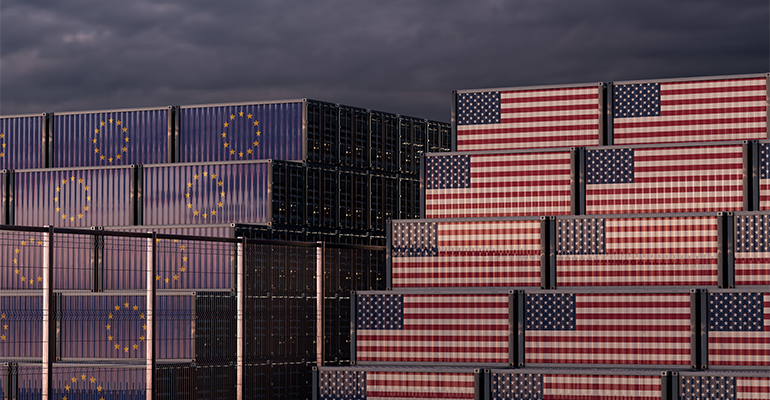
Rik Moors 13 Aug 2025The EU-US tariff agreement that took effect on 1 August established a 15% tariff rate on most EU exports to the US. The deal averts a full-scale trade war, but locks in higher costs for exporters to a market that accounts for a significant share of Europe’s high-value agrifood sales.
Sensitive categories will suffer
Earlier this year, research from RaboResearch (published before the 15% ceiling was agreed) identified categories of European export products that would suffer from high tariff rates. According to this analysis, highly “price elastic” food products, where consumers are likely to seek alternatives if costs increase, like butter, are more sensitive to tariffs than products that are highly valued and hard to replace, such as artisanal cheeses.
With the US seemingly committed to implementing tariffs on virtually all major trading partners, EU exporters with limited competition from US domestic producers, such as olive oil and certain seeds, also have less to fear from the new trade rules. That leaves producers of processed products like pasta, condiments, beverages, and dairy with more to lose. Canned foods face a dual hit: tariffs on the food itself and on the steel packaging material, which could force significant pricing adjustments.
All exporters will face the decision of absorbing costs, passing them on to US buyers, restructuring supply chains to avoid tariffs, or investing in production in the US. Rabobank analysts estimate the latter option as a “realistic scenario” for vegetable, potato, and fruit processing companies.
EU agrifood standards off the negotiating table
The US has long criticised strict EU sanitary and phytosanitary rules, such as bans on hormone-treated beef, chlorinated chicken, and genetically modified crops, as “non-tariff barriers” that unfairly restrict market access.
US industry organisations like the American Farm Bureau argue that these measures are “overly strict” and “non-scientific”, claiming they reduce US farm income and limit export opportunities for rural communities. The EU, however, sees them as essential to protecting food safety, environmental sustainability, and agricultural traditions.
During the latest round of trade negotiations in Scotland, the US reportedly pushed for concessions on these standards, but the EU made it clear that food safety and animal welfare remain red lines.
“EU standards, particularly as they relate to food, health, and safety, are sacrosanct. That’s not part of the negotiation, and never will be,” European Commission spokesperson Olof Gill told reporters in April.
In the end (or at least for now), the agreement did avoid the “sensitive” agrifood products associated with the biggest standards disagreements.
Aslak Berg, a research fellow at the Centre for European Reform, a London-based think tank, warned American exporters that it is unlikely that there will be further change in this area, noting that “on the contrary, the Trump administration is likelier to move closer to EU standards under the influence of US health secretary Robert F Kennedy Jr, who has pushed for stricter US standards more akin to the EU approach”.
Consumer and workforce impacts
With drastic shifts in the global trade system, the economic impacts from the EU-US deal alone are hard to predict, but it is clear that consumers will feel the effects of a more protectionist trade policy.
In the US, the Budget Lab estimates that tariffs imposed in 2025 have raised food prices by 3.2% in the short term and 2.9% in the long run, with fresh produce up 7%, as part of a total cost for households of around $2,400 annually.
In Europe, a Euroconsumers survey found that roughly nine in 10 European respondents believe “tariffs will negatively impact both their national economies and the EU economy as a whole”, with similar proportions expecting the cost of living to rise as a result. Rises in food and beverage costs are only anticipated by nearly one in five (18%) consumers.
The European Federation of Food, Agriculture, and Tourism Trade Unions (EFFAT) meanwhile warned that “the costs of this new reality will ultimately be paid for by workers, many businesses across Europe, as well as consumers in the United States”, citing the combined effect of tariffs, currency shifts, and Europe’s higher energy costs. According to the EFFAT, exports to the US total over €25 billion annually, with hundreds of thousands of jobs linked to these trade flows.
Future uncertainty under shifting US trade policy
The current arrangement followed tense negotiations in which the US threatened tariffs as high as 30% unless the EU removed all duties on American exports. These threats were dialled back to the 15% ceiling, but the process underscored the transactional and unpredictable nature of the Trump administration’s trade approach.
Responses ranged from the French government’s protestations about Europe’s “humiliation” to more pragmatic interpretations, with commentators finding many “performative concessions” that might have been designed to let the US claim victory without forcing the EU into major structural changes.
One concession that gained a lot of attention is the pledge to invest $600 billion in US energy, which the European Commission describes as an “indication” of the intention of private industry.
Confronted in recent days with questions about these promises, the US President has already gone back to threatening Europe with a blanket 35% rate in case the investments fail to materialise.

Get more of our news on Google
Set Ingredients Network as a 'Preferred Source' to get quicker access to the news you value.
Related news

M&S launches own-brand pet food range
11 Sep 2026
UK retailer Marks & Spencer has launched its own-brand pet food line Paws & Pals – a well-timed and strategic move that will appeal to loyal shoppers, says a marketing expert.
Read more
Do the US dietary guidelines put UPFs under pressure?
10 Sep 2026
Will the US dietary guidelines change the way Americans eat, swapping ultra-processed foods for whole foods? We asked Dr Barry Popkin, renowned nutrition and obesity researcher.
Read more
Food fraud costs UK economy £2bn each year
9 Sep 2026
Food fraud is costing the UK economy up to £2 billion (€2.3 billion) every year although the food sector is more “resilient” than others, according to a recent study.
Read more
EU's ban on Brazilian meat expected to raise prices
7 Sep 2026
Around 25% of the EU’s imported chicken and beef comes from Brazil. From September, products that fail to meet the EU antimicrobial resistance rules will be banned.
Read more
Skimpflation: An ‘unfair’ and risky approach to keeping prices low
2 Sep 2026
Consumers see skimpflation – reducing the quality of ingredients due to rising costs – as more unfair than shrinkflation, making it a risky strategy according to recent research.
Read more
NielsenIQ’s EU barometer shows Britain leading in grocery inflation
31 Aug 2026
Britain was the only country to record grocery inflation above 2%, according to NielsenIQ data that compared Europe’s five biggest grocery markets from February to May 2026.
Read more
‘Urgent gaps’ in achieving 2030 food system goals
27 Aug 2026
Global food systems are failing to meet 2030 targets across indicators including health, environment, and resilience, according to a report co-authored by the Food and Agriculture Organisation (FAO).
Read more
Seven-Eleven uses microbial testing tech to extend katsudon shelf life
26 Aug 2026
Japanese retail company Seven-Eleven has improved its factory’s microbial environment to keep comfort-food staple, katsudon, fresher for longer.
Read more
Chimac’s fusion sauces bring Korean flavours to Europe
25 Aug 2026
Irish sauce brand Chimac is tapping into Korea’s culinary traditions, bringing its flavours and products to European consumers who want a taste of K-food.
Read more
Global demand for instant noodles continues to rise
24 Aug 2026
Global demand for instant noodles reached 124.21 billion servings last year, representing a 0.7% year-on-year increase – or 900 million extra servings.
Read more