
Ingredients Categories
Finished Products
Finished Food Categories
- Bakery
- Beverages / Juices
- Cereal and grain products
- Confectionery
- Cooking Fats & Oils
- Dairy
- Egg products
- Fruits & Vegetables
- Infant & Baby food
- Meat, Poultry & Fish
- Nuts & Seeds products
- Other Finished Food Categories
- Pet Food
- Plant-based foods
- Prepared foods
- Sauces & Seasonings
- Sweet & Savoury Spreads
Specialised Finished Products
- Bee products
- Biotic products
- Dietary supplements
- Energy drinks
- Functional beverages
- Functional confectionery
- Functional food
- Functional powders
- Meal replacement products
- Nutricosmetics
- Other Specialised Finished Products
- Pet Dietary Supplements
- Pharma and OTC products
- Protein products
- Sugar replacers / Sweeteners
Health & Wellness Areas
Delivery Formats
Operations & Services
- 3D printing
- Analysis/ Testing
- Auditing & certifications
- Blending & mixing
- Bottling
- Certification
- Clinical trials
- Co-packing
- Coating
- Consulting
- Contract manufacturing
- Drying
- Electrospinning
- Encapsulating
- Enzymatic processing
- Extracting
- Extrusion
- Fat structuring
- Fermentation
- Filling
- Flavour development
- Freeze drying
- Granulating/ grinding/ milling / mixing
- High-pressure processing
- Labelling
- Other Operations & Services
- Packaging
- Packet filling
- Pasturising
- Quality assurance
- Saccharification
- Shear cell processing
- Spray drying
- Sterilisation
- Storage & Logistics
- Tabletting
- Toasting / roasting
- Ultra-high temperature processing
News
Animal welfare standards remain a worry as chicken commitments wane
David Burrows, Freelance Journalist 11 Apr 2025Food businesses have been hit with two stinging reports that outline a lack of effort and investment in improving the lives of animals in their supply chains.
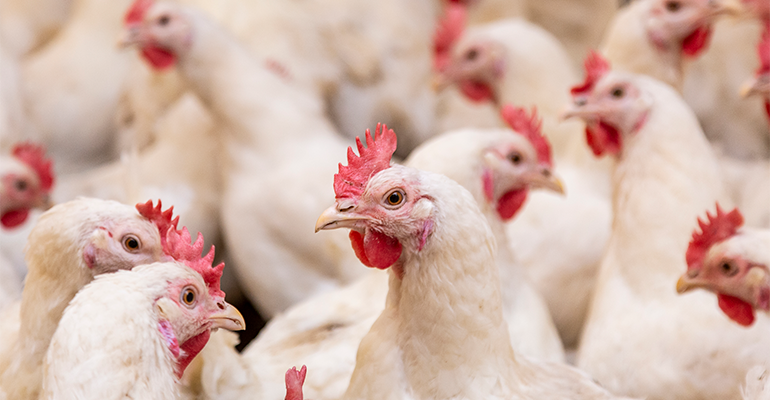
The Chicken Track Report published in March by Compassion in World Farming (CIWF), an NGO, showed that very few of the 93 most influential food companies in Europe will meet their 2026 deadline to align with all aspects of the Better Chicken Commitment (BCC, also known as the European Chicken Commitment, ECC).
The BCC is a “comprehensive set of science-based criteria that will, when used as a complete package, significantly improve the lives of millions of chickens reared for food”, according to CIWF. There are five main criteria, all of which need to be met for all the chickens in food company supply chains by 2026.
Slow progress on slower-growing breeds
In some areas, such as access to natural light and more humane slaughter, progress has been steady if not speedy. However, companies across Europe are really struggling to ensure all their chickens are from slower growing breeds and have more space.
Eataly (Italy), Premier Foods (UK) and Greggs (UK) are among the exceptions, having achieved respectively an 80% transition on use of slower growing breeds, a 65% overall transition across all criteria and a 65% transition on stocking density. Danone has managed to reach 61% on stocking density but only 18% of birds in its supply chain are slower growing.
Across all the manufacturers assessed, the transition to slower-growing birds remains below 10%, while 21% of chickens have the additional space required under the BCC. Supermarkets and companies offering meal kits have performed slightly better, with Carrefour, Casino, and Colruyt (Belgium) making more progress than many.
Restaurants are further behind. Major names like Burger King (UK and France) and Domino’s (Europe) are yet to source any chickens from slower-growing breeds. Of all the chicken sourced by KFC’s European outlets, just 2.5% is from the higher welfare, slower-growing breeds. The chain has already admitted defeat in reaching the BCC commitment by next year.
Failure to report
Many others will undoubtedly struggle too. Major European poultry producer 2 Sisters Food Group has managed only a 20% transition across all criteria (and offers no breakdown of this). Aldi and Lidl, the discount supermarkets, are reporting in some countries but not others.
As of March, 21 are not reporting at all, despite having enjoyed positive publicity in making a commitment – in some cases more than four years ago. Nestlé, which signed up to the BCC in June 2018, is among them. “As part of our commitment to source ingredients responsibly we will improve welfare standards for millions of chickens used in our food products in Europe, including our Herta, Buitoni, Wagner and Maggi ranges,” the food company said at the time.
CIWF was reserved in its criticism of the food corporates it is tracking closely (93 of the 380+ companies to have signed up to the BCC); the campaign group has a delicate balance to strike between pushing for action and not scaring current and potential signatories off.
Other groups have got wind of the failures and are beginning to apply pressure. The Humane League, for example, is targeting KFC UK & Ireland. Matthew Melton, corporate relations manager at the group told Ingredients Network that “one of the most pressing and wide-reaching animal welfare crises of our time is unfolding right now in the UK – the use of chickens bred to grow so fast their bodies simply can’t keep up. While it’s good to see companies giving their chickens more space, as many in the industry are now doing, until they stop using fast-growing breeds they are not doing nearly enough,” he added.
Farm animal benchmark produces worrying welfare results
It’s not just chickens where food companies have been found wanting. “Too many food companies still provide limited evidence that they are managing animal welfare effectively,” said Nicky Amos, executive director of the BBFAW as she launched the latest Business Benchmark on Farm Animal Welfare.
The benchmark assesses 150 companies, across farm animal welfare policies, practices and performance based on 51 criteria spanning five pillars; then ranking firms in one of six tiers.
No company managed tier one, though four (Greggs, Marks and Spencer, Waitrose and Premier Foods) are in tier two. Progress for a majority of food companies is slow, however. Some 118 companies (79%), including Nestlé, McDonald’s, Tyson Foods and Cargill, are in the bottom two tiers (Tiers 5 and 6) – meaning they provide limited or no evidence that they have policies or processes in place to manage farm animal welfare effectively.
This year’s BBFAW also identified an ‘Atlantic gap’ – while the UK is the highest-performing region, practically all North American food companies are stuck in the bottom two tiers of the benchmark.

Get more of our news on Google
Set Ingredients Network as a 'Preferred Source' to get quicker access to the news you value.
Related news

Do the US dietary guidelines put UPFs under pressure?
10 Sep 2026
Will the US dietary guidelines change the way Americans eat, swapping ultra-processed foods for whole foods? We asked Dr Barry Popkin, renowned nutrition and obesity researcher.
Read more
Food fraud costs UK economy £2bn each year
9 Sep 2026
Food fraud is costing the UK economy up to £2 billion (€2.3 billion) every year although the food sector is more “resilient” than others, according to a recent study.
Read more
EU's ban on Brazilian meat expected to raise prices
7 Sep 2026
Around 25% of the EU’s imported chicken and beef comes from Brazil. From September, products that fail to meet the EU antimicrobial resistance rules will be banned.
Read more
Kellogg accelerates work to remove artificial colours from all US cereals
3 Sep 2026
WK Kellogg has announced an accelerated timeline to eliminate all artificial colours and the chemical preservative, BHT, across its full US portfolio of cereals and cereal packaging.
Read more
‘Urgent gaps’ in achieving 2030 food system goals
27 Aug 2026
Global food systems are failing to meet 2030 targets across indicators including health, environment, and resilience, according to a report co-authored by the Food and Agriculture Organisation (FAO).
Read more
Critics slam ‘chaotic’ response to cyclosporiasis outbreak after first deaths reported
7 Aug 2026
Questions have been raised over the “chaotic” response to the cyclosporiasis outbreak in the US after two deaths were reported.
Read more
Nestlé invests in regeneratively farmed wheat for KitKat
5 Aug 2026
Nestlé will pay a premium for Wildfarmed’s regeneratively farmed wheat but the CPG remains reticent to promote the move on packs of its KitKat bars.
Read more
Codex sets global thresholds for ‘may contain’ labels
3 Aug 2026
Codex Alimentarius has adopted its first global guidance on when to use “may contain” allergen warnings, setting thresholds intended to stop the label being used as blanket legal cover.
Read more
EU sets maximum MOAH levels to protect human health
28 Jul 2026
The EU will adopt maximum levels for mineral oil aromatic hydrocarbons (MOAH) in food to protect human health. What do manufacturers need to know?
Read more
UK publishes guidance on SPS food trade agreement with EU
27 Jul 2026
The UK government has shared guidance on how food businesses can prepare for its upcoming Sanitary and Phytosanitary (SPS) agreement with the EU.
Read more