
Ingredients Categories
Finished Products
Finished Food Categories
- Bakery
- Beverages / Juices
- Cereal and grain products
- Confectionery
- Cooking Fats & Oils
- Dairy
- Egg products
- Fruits & Vegetables
- Infant & Baby food
- Meat, Poultry & Fish
- Nuts & Seeds products
- Other Finished Food Categories
- Pet Food
- Plant-based foods
- Prepared foods
- Sauces & Seasonings
- Sweet & Savoury Spreads
Specialised Finished Products
- Bee products
- Biotic products
- Dietary supplements
- Energy drinks
- Functional beverages
- Functional confectionery
- Functional food
- Functional powders
- Meal replacement products
- Nutricosmetics
- Other Specialised Finished Products
- Pet Dietary Supplements
- Pharma and OTC products
- Protein products
- Sugar replacers / Sweeteners
Health & Wellness Areas
Delivery Formats
Operations & Services
- 3D printing
- Analysis/ Testing
- Auditing & certifications
- Blending & mixing
- Bottling
- Certification
- Clinical trials
- Co-packing
- Coating
- Consulting
- Contract manufacturing
- Drying
- Electrospinning
- Encapsulating
- Enzymatic processing
- Extracting
- Extrusion
- Fat structuring
- Fermentation
- Filling
- Flavour development
- Freeze drying
- Granulating/ grinding/ milling / mixing
- High-pressure processing
- Labelling
- Other Operations & Services
- Packaging
- Packet filling
- Pasturising
- Quality assurance
- Saccharification
- Shear cell processing
- Spray drying
- Sterilisation
- Storage & Logistics
- Tabletting
- Toasting / roasting
- Ultra-high temperature processing
News
Beyond insoluble and soluble: A new framework for fibre
Tessa Wiles, Content Editor - Food 18 Apr 2025Australian researchers are paving the way for targeted health food products with a proposed reclassification of the traditional soluble vs insoluble dietary fibre model.

According to Raj Eri, a professor of food science at the Royal Melbourne Institute of Technology (RMIT), the food industry's biggest misconception about dietary fibre is “the idea that fibre can be meaningfully described solely as soluble or insoluble”.
Eri and PhD candidate Christo Opperman sought to develop a more precise and nuanced fibre classification system that looked beyond these two fibre classifications – soluble and insoluble.
Eri told Ingredients Network that a more detailed classification system could offer greater insight into the specific health benefits of various fibre types.
He hopes that in the future, we will see a standardised rating system tailored for dietary fibre, similar to Australia’s Health Star Rating or the voluntary Nutri-Score classification used in various European countries.
“Consumer-friendly labelling could then highlight not just fibre content but also clearly indicate which health outcomes a specific fibre supports, such as relief from constipation, reduced inflammation, or support for weight management,” he explained.
While there is potential, Eri noted that strong scientific evidence will be essential to support such claims, particularly regarding fibre's impact on gut microbiota.
Five fibre properties proposed under reclassification
In the study, which was published in Food Research International, Eri and Opperman developed a more precise fibre classification system based on five essential properties: backbone structure, water-holding capacity, structural charge, fibre matrix, and fermentation rate.
Backbone structure refers to the molecular makeup of the fibre, which directly influences how it behaves in the gut. Fibres can have linear or branched structures, or both, which impact its fermentation, solubility, and ability to interact with other nutrients. Cellulose, for example, is contained within the cell walls of plants and has a linear structure that resists digestion, whereas beta-glucan has a branched and more flexible structure that allows it to form viscous solutions, which is key to lowering cholesterol. Sources of beta-glucan include oats, yeast, and mushrooms.
Water-holding capacity refers to how much water a fibre can both absorb and retain. Fibres with high water-holding capacity can help prevent constipation and increase stool bulk.
Structural charge refers to the overall electrical charge of dietary fibre, which can be either negatively charged, neutral, or positively charged. The structure of negatively charged dietary fibres can contain functional groups – carboxyl, phenolic, and sulphate – which can enhance fibre's ability to bind to toxic cations like arsenic or lead, and increase its water-holding capacity, among other functions.
The fibre matrix is defined in the study as “the physical state of the fibre once it enters the stomach” and the fermentation rate refers to how quickly the gut bacteria breaks down the fibre and produce short-chain fatty acids, which are beneficial for gut and metabolic health.
Upping the appeal of fibre-rich products
Recommendations for daily fibre intake vary across the world and by age group; however, around 25 to 30 grams a day is generally recommended for adults.
It is also established that most people do not consume enough fibre. In the UK, for example, the average intake is around 20 g.
When it comes to getting people to increase their fibre intake, Eri believes that consumer education and knowledge of the reclassified framework could help.
“Most current fibre products don’t highlight the fact that different types of fibre have distinct effects based on their characteristics. A better understanding of fibre types and their specific roles – especially their impact on the gut microbiome – would empower consumers to make more informed and personalised dietary choices,” he said.
Personalised nutrition potential
Given that different fibres interact differently with the gut microbiome, Eri believes that personalised nutrition may play a bigger role in fibre recommendations in the future.
“Once we can accurately assess how the microbiome responds to diet, personalised nutrition can be precisely tailored to individual needs – marking a major leap forward in the field,” Eri said.
Eri explained that this could look like the modulation of microbial diversity through targeted dietary fibres and specific nutritional strategies to deliver measurable health benefits.
“In the next five to 10 years, it's likely that both genomic and microbiome analyses will become standard practice, enabling fully customised therapeutic approaches,” he said.
Balancing fibre functionality with consumer preferences
Combining functionality with consumer taste preferences could significantly boost acceptance and overall fibre intakes, Eri explained.
“Mild processing to enhance taste and texture, in my view, poses no issue – especially if it helps align with consumer expectations,” he said. “Our classification system can be readily applied to processed fibre products.
“In fact, understanding which fibre properties drive specific health benefits offers the food industry a valuable framework for incorporating these attributes while also optimising the overall eating experience.”

Get more of our news on Google
Set Ingredients Network as a 'Preferred Source' to get quicker access to the news you value.
Related news

M&S launches own-brand pet food range
11 Sep 2026
UK retailer Marks & Spencer has launched its own-brand pet food line Paws & Pals – a well-timed and strategic move that will appeal to loyal shoppers, says a marketing expert.
Read more
Do the US dietary guidelines put UPFs under pressure?
10 Sep 2026
Will the US dietary guidelines change the way Americans eat, swapping ultra-processed foods for whole foods? We asked Dr Barry Popkin, renowned nutrition and obesity researcher.
Read more
Food fraud costs UK economy £2bn each year
9 Sep 2026
Food fraud is costing the UK economy up to £2 billion (€2.3 billion) every year although the food sector is more “resilient” than others, according to a recent study.
Read more
Kellogg accelerates work to remove artificial colours from all US cereals
3 Sep 2026
WK Kellogg has announced an accelerated timeline to eliminate all artificial colours and the chemical preservative, BHT, across its full US portfolio of cereals and cereal packaging.
Read more
‘Urgent gaps’ in achieving 2030 food system goals
27 Aug 2026
Global food systems are failing to meet 2030 targets across indicators including health, environment, and resilience, according to a report co-authored by the Food and Agriculture Organisation (FAO).
Read more
Chimac’s fusion sauces bring Korean flavours to Europe
25 Aug 2026
Irish sauce brand Chimac is tapping into Korea’s culinary traditions, bringing its flavours and products to European consumers who want a taste of K-food.
Read more
Savoury protein snacks shake up the on-the-go market
10 Aug 2026
Sweet flavours have dominated the high-protein snack category but savoury snacks, such as cheese bars and meat sticks, can appeal to health-conscious consumers.
Read more
Nestlé invests in regeneratively farmed wheat for KitKat
5 Aug 2026
Nestlé will pay a premium for Wildfarmed’s regeneratively farmed wheat but the CPG remains reticent to promote the move on packs of its KitKat bars.
Read more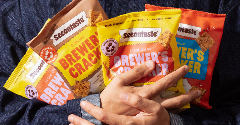
How Secon Taste is putting upcycled snacks on shelves
4 Aug 2026
Hungarian zero-waste startup Secon Taste is turning surplus food into upcycled snacks such as fibre-packed granola, instant porridge, and a circular coffee-tasting box.
Read more
Codex sets global thresholds for ‘may contain’ labels
3 Aug 2026
Codex Alimentarius has adopted its first global guidance on when to use “may contain” allergen warnings, setting thresholds intended to stop the label being used as blanket legal cover.
Read more