
Ingredients Categories
Finished Products
Finished Food Categories
- Bakery
- Beverages / Juices
- Cereal and grain products
- Confectionery
- Cooking Fats & Oils
- Dairy
- Egg products
- Fruits & Vegetables
- Infant & Baby food
- Meat, Poultry & Fish
- Nuts & Seeds products
- Other Finished Food Categories
- Pet Food
- Plant-based foods
- Prepared foods
- Sauces & Seasonings
- Sweet & Savoury Spreads
Specialised Finished Products
- Bee products
- Biotic products
- Dietary supplements
- Energy drinks
- Functional beverages
- Functional confectionery
- Functional food
- Functional powders
- Meal replacement products
- Nutricosmetics
- Other Specialised Finished Products
- Pet Dietary Supplements
- Pharma and OTC products
- Protein products
- Sugar replacers / Sweeteners
Health & Wellness Areas
Delivery Formats
Operations & Services
- 3D printing
- Analysis/ Testing
- Auditing & certifications
- Blending & mixing
- Bottling
- Certification
- Clinical trials
- Co-packing
- Coating
- Consulting
- Contract manufacturing
- Drying
- Electrospinning
- Encapsulating
- Enzymatic processing
- Extracting
- Extrusion
- Fat structuring
- Fermentation
- Filling
- Flavour development
- Freeze drying
- Granulating/ grinding/ milling / mixing
- High-pressure processing
- Labelling
- Other Operations & Services
- Packaging
- Packet filling
- Pasturising
- Quality assurance
- Saccharification
- Shear cell processing
- Spray drying
- Sterilisation
- Storage & Logistics
- Tabletting
- Toasting / roasting
- Ultra-high temperature processing
News
Capri Sun adds monk fruit to US juice drinks to reduce sugar by 40%
15 Aug 2022
With parents increasingly focusing on reducing their children’s sugar intake, Kraft Heinz is using monk fruit to cut sugar in US Capri Sun products to deliver on both taste and health credentials.
The impact of sugar and artificial sweeteners on the health of children has had much attention in recent years. Concerns around sugar consumption have prompted several US cities to adopt a 'soda tax'. This locally levied tax makes distributors of sugar-sweetened drinks pay on the drinks they distribute within cities like Boulder, Philadelphia, Seattle and San Francisco. Recent updates made by the US Food and Drug Administration (FDA) now require manufacturers to list added sugars in grams and as a percent Daily Value (%DV) on nutrition fact labels. As a result, interest in natural sweeteners is growing and monk fruit is becoming a popular natural alternative for manufacturers, according to Mintel. Monk fruit is said to have a similar flavour to sugar but without the bitter aftertaste of stevia.
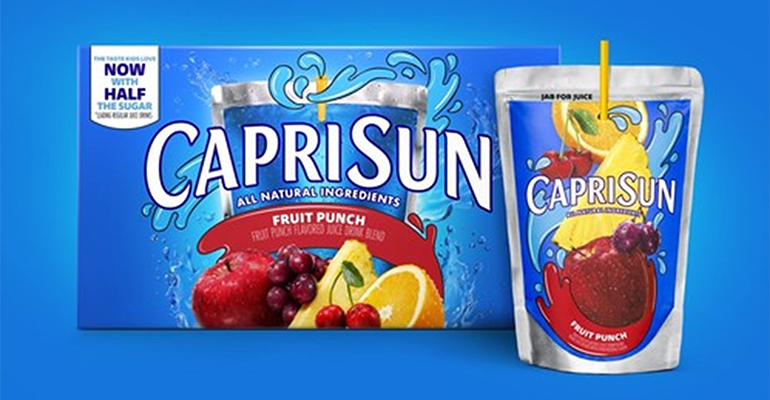
Capri Sun, a key brand under the Kraft Heinz Company, has spent a number of years perfecting this new reformulation.
“Reducing sugar is a key aspiration for Kraft Heinz and has been a long-time goal of Capri Sun. We heard from our consumers that sugar content is a pain point and did extensive testing to find a way to reduce the added sugar naturally while maintaining the great taste consumers and kids know and love,” said a Kraft Heinz spokesperson.
By August this year, each pouch of original juice drink in the US will include monk fruit concentrate and contain around 8g of total sugars and 5g of added sugar. Additionally, new packaging will highlight the sugar reduction in all original juice drinks. The sugar-reduced Capri Sun will be rolled out in the US only, said Kraft Heinz.
A costly natural sweetener
Monk fruit (also known as luo han guo) is part of the melon family and native to China. Its fruit pulp contains compounds called mogroside V which are around 250 times sweeter than table sugar (sucrose) making it a desirable ingredient for food and drink products linked to naturalness and health. However, its high cost compared to other natural sweeteners creates a barrier for growth. Currently, it is not approved in Europe and use is rare but slowly growing in the US, China, Australia, Mexico and Japan with only 1% of product launches using monk fruit as a sweetener ingredient between June 2020 – May 2021. In Canada, monk fruit extract is only approved as tabletop sweetener. Monk fruit juice concentrate however, the ingredient used in Capri Sun, is permitted due to its lower mogroside V content.
Linked to health, plant-based and free-from
Although the number of food and drink products containing monk fruit is relatively small, according to Mintel data, those already on the market tend to be linked to health and diet trends such as free-from and plant-based. The fruit itself has been shown to have antioxidative, liver-protective and glucose-lowering properties. In a 2020 study from the Journal of Dairy Science, researchers developed a yoghurt using monk fruit extract as a sweetener. They found it had similar microstructural properties to yoghurt sweetened with sugar and results indicated monk fruit extract could be used successfully as novel sweetener and a food antioxidant for functional yoghurt and related products.

Get more of our news on Google
Set Ingredients Network as a 'Preferred Source' to get quicker access to the news you value.
Related news

Skimpflation: An ‘unfair’ and risky approach to keeping prices low
2 Sep 2026
Consumers see skimpflation – reducing the quality of ingredients due to rising costs – as more unfair than shrinkflation, making it a risky strategy according to recent research.
Read more
NielsenIQ’s EU barometer shows Britain leading in grocery inflation
31 Aug 2026
Britain was the only country to record grocery inflation above 2%, according to NielsenIQ data that compared Europe’s five biggest grocery markets from February to May 2026.
Read more
‘Urgent gaps’ in achieving 2030 food system goals
27 Aug 2026
Global food systems are failing to meet 2030 targets across indicators including health, environment, and resilience, according to a report co-authored by the Food and Agriculture Organisation (FAO).
Read more
China beverages: Is herbal innovation the future?
20 Aug 2026
Herbal and botanical innovation in China's drinks market continues to grow, with ingredients like astragalus root, ginger, and ginseng in the spotlight – and focus shifting far beyond refreshment.
Read more
Popular barbecue staples experience sharp price increases
19 Aug 2026
The typical cost of US shoppers’ barbecue baskets has risen by 12% over the past year – the fastest annual rise in a decade, figures from The Economist show.
Read more
Beyond 'nice to have': A spotlight on US functional beverages
12 Aug 2026
Functional beverage interest in the US is gaining important ground as consumers now expect function rather than see it as "nice to have", and there are clear market gaps for growth, according to Spate.
Read more
Manam Chocolate aims to bring premium Indian cacao to 'the world stage'
11 Aug 2026
Craft chocolate brand Manam Chocolate is investing in local expansion and supply chain innovation throughout India as it works to build out the premium reputation of its locally produced cacao products.
Read more
Digital twin technology gains ground in food manufacturing
6 Aug 2026
Food and beverage companies are increasingly turning to digital twins to optimise and automate manufacturing processes, but opportunities stretch far beyond this, say experts.
Read more
How Secon Taste is putting upcycled snacks on shelves
4 Aug 2026
Hungarian zero-waste startup Secon Taste is turning surplus food into upcycled snacks such as fibre-packed granola, instant porridge, and a circular coffee-tasting box.
Read more
Codex sets global thresholds for ‘may contain’ labels
3 Aug 2026
Codex Alimentarius has adopted its first global guidance on when to use “may contain” allergen warnings, setting thresholds intended to stop the label being used as blanket legal cover.
Read more