
Ingredients Categories
Finished Products
Finished Food Categories
- Bakery
- Beverages / Juices
- Cereal and grain products
- Confectionery
- Cooking Fats & Oils
- Dairy
- Egg products
- Fruits & Vegetables
- Infant & Baby food
- Meat, Poultry & Fish
- Nuts & Seeds products
- Other Finished Food Categories
- Pet Food
- Plant-based foods
- Prepared foods
- Sauces & Seasonings
- Sweet & Savoury Spreads
Specialised Finished Products
- Bee products
- Biotic products
- Dietary supplements
- Energy drinks
- Functional beverages
- Functional confectionery
- Functional food
- Functional powders
- Meal replacement products
- Nutricosmetics
- Other Specialised Finished Products
- Pet Dietary Supplements
- Pharma and OTC products
- Protein products
- Sugar replacers / Sweeteners
Health & Wellness Areas
Delivery Formats
Operations & Services
- 3D printing
- Analysis/ Testing
- Auditing & certifications
- Blending & mixing
- Bottling
- Certification
- Clinical trials
- Co-packing
- Coating
- Consulting
- Contract manufacturing
- Drying
- Electrospinning
- Encapsulating
- Enzymatic processing
- Extracting
- Extrusion
- Fat structuring
- Fermentation
- Filling
- Flavour development
- Freeze drying
- Granulating/ grinding/ milling / mixing
- High-pressure processing
- Labelling
- Other Operations & Services
- Packaging
- Packet filling
- Pasturising
- Quality assurance
- Saccharification
- Shear cell processing
- Spray drying
- Sterilisation
- Storage & Logistics
- Tabletting
- Toasting / roasting
- Ultra-high temperature processing
News
Mapping the rise and fall and (rise, again?) of the plant-based sector
Lucy Whittaker, Food Content Editor 15 Jan 2024
Recent challenges in the plant-based sector such as consumer acceptance and price inflation led to dips in certain regions while others surged. Kalina Doykova, senior research analyst at Euromonitor, shares her insights into the evolution and future trajectory of the plant-based market.
The global plant-based market has undergone substantial growth recently, with more predicted for the year ahead. Data from Euromonitor International shows that in 2023, 50% of beauty and personal care and 42% of food and beverage companies plan to develop products with plant-based, vegan, and vegetarian claims.

“As a whole there's quite a lot of potential for plant-based in many different industries,” said Kalina Doykova, senior research analyst at Euromonitor, speaking at the Fi Europe Conference in Frankfurt in November.
Yet the plant-based food sector has not been without challenge in 2023, with performance varying between regions such as North America and Europe. In certain regions, anxiety about the future of the plant-based market grew this year following underperformance from well-known companies such as Beyond Meat and collapse from others including Meatless Farms and more recently, VBites.
Euromonitor data shows a decline in North American sales, juxtaposed against Europe's resilience and rebound in sales growth.
“The US had a negative decline in 2021, which become more and more net negative in 2022 and 2023. However, if you look at Europe, we're looking at a different trajectory. We're seeing a decline which does not become negative in 2022, and we're then seeing a rebound,” Doykova said.
A naturally evolving market
The challenges faced by the plant-based industry are multi-dimensional, but not uncommon. These include the failure of products to meet consumer expectations, the maturation of the sector in certain markets such as Germany and the UK, and the cost-of-living crisis and food inflation.
“What we're hearing and seeing with the plant-based [sector] is nothing shocking. It's a natural evolution of the market as we're progressing into a more consolidated market, where companies are focusing on their best performing [stock keeping units] SKUs,” Doykova said.
Despite a dip in 2021 and 2022, growth rates in the plant-based milk sector rebounded in 2023, for example. Along with the meat and seafood substitute sector (8.3%), the sector forecasts positive growth of 6.6% over the next five years, showcasing sustained consumer interest in plant-based products, according to Euromonitor.
Partnerships open new opportunities for the year ahead
Despite facing several challenges such as consumer acceptance, price parity, and the debate surrounding the healthiness of ultra-processed foods, the plant-based market is rife with untapped opportunities moving into 2024.
Collaborations and partnerships, particularly in the food service and ready-meals sectors, present promising avenues for growth, Doykova said.
“Business-to-business partnerships have shown to be really helpful for different plant-based companies when it comes to scaling and speeding up processes and in getting funding towards launching new products,” she said.
This year, fast food giant McDonald’s successfully launched the McPlant, a plant-based alternative burger, in the UK and Ireland after seeing high levels of interest from consumers in various EU countries.
“This really helps brands to gain visibility and boost volumes. It also really helps for consumers because they're having a different taste experience. They don't rely on their own cooking skills but are going to outlets to have this new experience. This could help them to have a better image of plant-based foods and make them more curious to actually try these products,” Doykova said.
 © iStock/SolStock
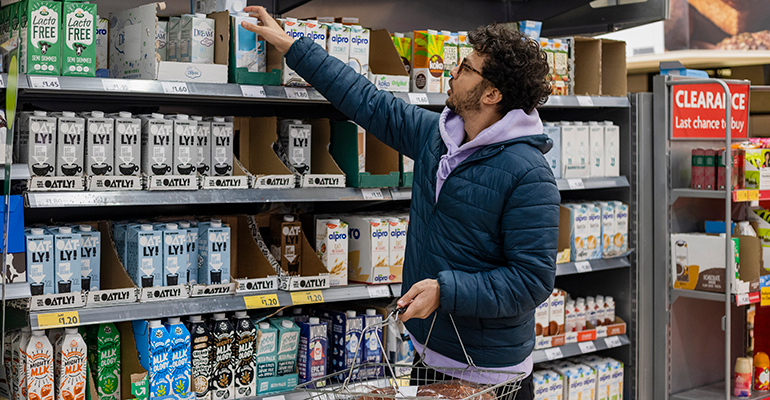
“The market is huge outside milk and meats,” according to Doykova
Additionally, diversification beyond traditional meat and dairy substitutes into categories like seafood and snacks showcases the market's expansiveness. With fisheries facing depletion, the need for sustainable seafood substitutes presents a significant growth opportunity moving forward, according to Doykova.
“[Seafood] is one of the plant-based categories which is growing the most and has some of the highest potential. It’s definitely something to look at,” she said.
In the snack category, continuous innovation and increased consumer demand offers a platform for testing consumer responses and expanding plant-based offerings in the year ahead.
“Snacks is our highest performing category in the food industry as a whole. There's lots and lots of innovation, as well as lots of new product launches, which is a great way to test consumers responses,” said Doykova.

Get more of our news on Google
Set Ingredients Network as a 'Preferred Source' to get quicker access to the news you value.
Related news

Do the US dietary guidelines put UPFs under pressure?
10 Sep 2026
Will the US dietary guidelines change the way Americans eat, swapping ultra-processed foods for whole foods? We asked Dr Barry Popkin, renowned nutrition and obesity researcher.
Read more
Food fraud costs UK economy £2bn each year
9 Sep 2026
Food fraud is costing the UK economy up to £2 billion (€2.3 billion) every year although the food sector is more “resilient” than others, according to a recent study.
Read more
Kellogg accelerates work to remove artificial colours from all US cereals
3 Sep 2026
WK Kellogg has announced an accelerated timeline to eliminate all artificial colours and the chemical preservative, BHT, across its full US portfolio of cereals and cereal packaging.
Read more
Skimpflation: An ‘unfair’ and risky approach to keeping prices low
2 Sep 2026
Consumers see skimpflation – reducing the quality of ingredients due to rising costs – as more unfair than shrinkflation, making it a risky strategy according to recent research.
Read more
‘Urgent gaps’ in achieving 2030 food system goals
27 Aug 2026
Global food systems are failing to meet 2030 targets across indicators including health, environment, and resilience, according to a report co-authored by the Food and Agriculture Organisation (FAO).
Read more
Popular barbecue staples experience sharp price increases
19 Aug 2026
The typical cost of US shoppers’ barbecue baskets has risen by 12% over the past year – the fastest annual rise in a decade, figures from The Economist show.
Read more
Savoury protein snacks shake up the on-the-go market
10 Aug 2026
Sweet flavours have dominated the high-protein snack category but savoury snacks, such as cheese bars and meat sticks, can appeal to health-conscious consumers.
Read more
Digital twin technology gains ground in food manufacturing
6 Aug 2026
Food and beverage companies are increasingly turning to digital twins to optimise and automate manufacturing processes, but opportunities stretch far beyond this, say experts.
Read more
Nestlé invests in regeneratively farmed wheat for KitKat
5 Aug 2026
Nestlé will pay a premium for Wildfarmed’s regeneratively farmed wheat but the CPG remains reticent to promote the move on packs of its KitKat bars.
Read more
Codex sets global thresholds for ‘may contain’ labels
3 Aug 2026
Codex Alimentarius has adopted its first global guidance on when to use “may contain” allergen warnings, setting thresholds intended to stop the label being used as blanket legal cover.
Read more