
Ingredients Categories
Finished Products
Finished Food Categories
- Bakery
- Beverages / Juices
- Cereal and grain products
- Confectionery
- Cooking Fats & Oils
- Dairy
- Egg products
- Fruits & Vegetables
- Infant & Baby food
- Meat, Poultry & Fish
- Nuts & Seeds products
- Other Finished Food Categories
- Pet Food
- Plant-based foods
- Prepared foods
- Sauces & Seasonings
- Sweet & Savoury Spreads
Specialised Finished Products
- Bee products
- Biotic products
- Dietary supplements
- Energy drinks
- Functional beverages
- Functional confectionery
- Functional food
- Functional powders
- Meal replacement products
- Nutricosmetics
- Other Specialised Finished Products
- Pet Dietary Supplements
- Pharma and OTC products
- Protein products
- Sugar replacers / Sweeteners
Health & Wellness Areas
Delivery Formats
Operations & Services
- 3D printing
- Analysis/ Testing
- Auditing & certifications
- Blending & mixing
- Bottling
- Certification
- Clinical trials
- Co-packing
- Coating
- Consulting
- Contract manufacturing
- Drying
- Electrospinning
- Encapsulating
- Enzymatic processing
- Extracting
- Extrusion
- Fat structuring
- Fermentation
- Filling
- Flavour development
- Freeze drying
- Granulating/ grinding/ milling / mixing
- High-pressure processing
- Labelling
- Other Operations & Services
- Packaging
- Packet filling
- Pasturising
- Quality assurance
- Saccharification
- Shear cell processing
- Spray drying
- Sterilisation
- Storage & Logistics
- Tabletting
- Toasting / roasting
- Ultra-high temperature processing
News
Zero-waste water purification system looks to unsettle bottled water industry
7 Nov 2022
The bottled water industry is facing stiff competition from a raft of startups looking to reduce water and plastic waste as demanded by today’s sustainable-conscious consumer.
The new kid on the block is Sküma Water, a London-based firm that makes a water filtration system which reinfuses tap water with electrolytes that are fully customisable.
Sküma Water has just come off the back of a successful pre-seed funding round, which raised €345K (£300K) – enough to extend its manufacturing capacity and build its D2C sales pipeline.
“The functional drink industry is growing rapidly; however, few at-home water purification systems are as easy to use as what Sküma Water has developed, while generating zero waste,” said Sarah Barber, CEO at Jenson Funding Partners, the venture capital firm that led the early-stage funding.

“What makes Sküma Water special is not just that it’s easy to install, but sustainability is just as important as its functionality.”
Jenson pointed to the system’s reverse osmosis (RO) membrane, which removes 99% of all contaminants from tap water without generating wastewater – a common issue faced by RO water purification filters.
It added that a key market for Sküma was consumers searching for a more sustainable long-term alternative to bottled water and functional beverages.
“As an angel investor, it’s important for me to invest in companies that I believe are making a difference in the way that we live our daily lives,” said William Ripley, angel investor and board advisor at Sküma Water.
“Sküma Water benefits not just us, but the planet too. It’s clear that this goal is central to what [founders] Alexandre, Georges, and Tony have created, and this is what drew me in as an investor.”
Water products diversifying to meet demand
Water’s health benefits have never been questioned by consumers, who have been more concerned by the waste generated as the bottled water industry has grown in popularity.
Recent figures point to a $510bn (€522bn) industry by 2030, driven by factors such as an increase in urban population, higher disposable income, and higher standards of living, according to analysis by Market Research Future.
The strong link between clean drinking water and overall health has led to the emergence of nutrient-fortified water, particularly among business travellers, professionals in the workforce.
Products with labels like "alkaline", "electrolyte-rich", "fortified", "caffeinated water", and "fortified with additional hydrogen or oxygen" have gained increasing market share over the past few years.
However, the same analysis points to the inappropriate disposal of plastic water bottles as a factor that may impede market expansion.
Other market restraints include the high energy requirements for water extraction, processing, and bottling, increasing pressure on bottled water manufacturers to streamline their practices.
“The environmental damage brought on by improper plastic bottle disposal adds another layer to this issue and will likely limit the future expansion of the bottled water industry in the United States,” said Market Research Future.
 © AdobeStock/eNJoy Istyle
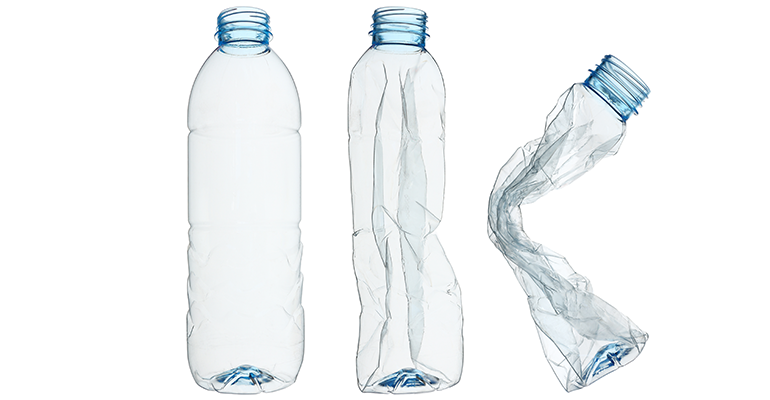
It is not only startups like Sküma Water that are looking to shift away from plastic bottles. In November 2021, UK-based company Vivid Water presented its line-up of flavoured and plain pure spring waters that use a cardboard 500 ml carton.
Commenting on the switch, the company highlighted cardboard’s smaller environmental footprint compared with the plastic and aluminium it previously used.
Meanwhile, Aqua British plant-based bottles are made from raw bio-sourced materials. After use, the bottle, cap, and label can be placed on the compost heap, where they will break down naturally.
Aquapax water cartons are made from 75% plant-based material and Forest Stewardship Council (FSC) certified paper. The carton includes a cap made from renewable sugar cane.
Bottled water not as environmentally damaging?
Data from the Beverage Marketing Corporation (BMC) points to an increased consumer demand for bottled water as a healthy alternative to other packaged drinks.
Jill Culora, vice-president of communications at the International Bottled Water Association (IBWA), said: “People are choosing to drink fewer calories, and making that healthy choice of bottled water has the added benefit of helping the environment.
“Not only are bottled water containers 100% recyclable (including the cap) but they also use much less plastic than soda and other packaged beverages.”
According to the industry group, soda containers, on average, use 188% more PET plastic than bottled water containers (23.9 g vs. 8.3 g for 16.9-ounce containers) due to their carbonation and/or bottling processes.
Even with continuing growth and increased consumption, bottled water still has the smallest water and energy use footprint of any packaged beverage.
On average, only 1.39 litres of water (including the one litre of water consumed) and 0.21 megajoules of energy are used to produce one litre of finished bottled water.

Get more of our news on Google
Set Ingredients Network as a 'Preferred Source' to get quicker access to the news you value.
Related news
Skimpflation: An ‘unfair’ and risky approach to keeping prices low
2 Sep 2026
Consumers see skimpflation – reducing the quality of ingredients due to rising costs – as more unfair than shrinkflation, making it a risky strategy according to recent research.
Read more
NielsenIQ’s EU barometer shows Britain leading in grocery inflation
31 Aug 2026
Britain was the only country to record grocery inflation above 2%, according to NielsenIQ data that compared Europe’s five biggest grocery markets from February to May 2026.
Read more
‘Urgent gaps’ in achieving 2030 food system goals
27 Aug 2026
Global food systems are failing to meet 2030 targets across indicators including health, environment, and resilience, according to a report co-authored by the Food and Agriculture Organisation (FAO).
Read more
China beverages: Is herbal innovation the future?
20 Aug 2026
Herbal and botanical innovation in China's drinks market continues to grow, with ingredients like astragalus root, ginger, and ginseng in the spotlight – and focus shifting far beyond refreshment.
Read more
Popular barbecue staples experience sharp price increases
19 Aug 2026
The typical cost of US shoppers’ barbecue baskets has risen by 12% over the past year – the fastest annual rise in a decade, figures from The Economist show.
Read more
Beyond 'nice to have': A spotlight on US functional beverages
12 Aug 2026
Functional beverage interest in the US is gaining important ground as consumers now expect function rather than see it as "nice to have", and there are clear market gaps for growth, according to Spate.
Read more
Manam Chocolate aims to bring premium Indian cacao to 'the world stage'
11 Aug 2026
Craft chocolate brand Manam Chocolate is investing in local expansion and supply chain innovation throughout India as it works to build out the premium reputation of its locally produced cacao products.
Read more
Digital twin technology gains ground in food manufacturing
6 Aug 2026
Food and beverage companies are increasingly turning to digital twins to optimise and automate manufacturing processes, but opportunities stretch far beyond this, say experts.
Read more
How Secon Taste is putting upcycled snacks on shelves
4 Aug 2026
Hungarian zero-waste startup Secon Taste is turning surplus food into upcycled snacks such as fibre-packed granola, instant porridge, and a circular coffee-tasting box.
Read more
Codex sets global thresholds for ‘may contain’ labels
3 Aug 2026
Codex Alimentarius has adopted its first global guidance on when to use “may contain” allergen warnings, setting thresholds intended to stop the label being used as blanket legal cover.
Read more