
Ingredients Categories
Finished Products
Finished Food Categories
- Bakery
- Beverages / Juices
- Cereal and grain products
- Confectionery
- Cooking Fats & Oils
- Dairy
- Egg products
- Fruits & Vegetables
- Infant & Baby food
- Meat, Poultry & Fish
- Nuts & Seeds products
- Other Finished Food Categories
- Pet Food
- Plant-based foods
- Prepared foods
- Sauces & Seasonings
- Sweet & Savoury Spreads
Specialised Finished Products
- Bee products
- Biotic products
- Dietary supplements
- Energy drinks
- Functional beverages
- Functional confectionery
- Functional food
- Functional powders
- Meal replacement products
- Nutricosmetics
- Other Specialised Finished Products
- Pet Dietary Supplements
- Pharma and OTC products
- Protein products
- Sugar replacers / Sweeteners
Health & Wellness Areas
Delivery Formats
Operations & Services
- 3D printing
- Analysis/ Testing
- Auditing & certifications
- Blending & mixing
- Bottling
- Certification
- Clinical trials
- Co-packing
- Coating
- Consulting
- Contract manufacturing
- Drying
- Electrospinning
- Encapsulating
- Enzymatic processing
- Extracting
- Extrusion
- Fat structuring
- Fermentation
- Filling
- Flavour development
- Freeze drying
- Granulating/ grinding/ milling / mixing
- High-pressure processing
- Labelling
- Other Operations & Services
- Packaging
- Packet filling
- Pasturising
- Quality assurance
- Saccharification
- Shear cell processing
- Spray drying
- Sterilisation
- Storage & Logistics
- Tabletting
- Toasting / roasting
- Ultra-high temperature processing
News
Austria’s new dietary guidelines recommend less animal protein and more plants
Rik Moors 23 Aug 2024Austria's dietary guidelines have been updated to reflect health and climate parameters. Both an omnivorous food pyramid and a vegetarian version are included, marking the first time a separate pyramid for vegetarians is provided.
Dietary guidelines based purely on health parameters may be a thing of the past.
Developed by the Austrian Agency for Health and Food Safety in collaboration with the Austrian Society for Nutrition and the National Nutrition Commission, these updated guidelines, presented as food pyramids, consider on the one hand evidence-based recommendations on nutrient intake and findings on the prevention of diet-related diseases, and the other hand take into account the food system as a driver of climate change and the environmental impact of food choices.
New food pyramids: omnivorous and vegetarian versions
Austria will officially publish the New Austrian Food Pyramids in the autumn of 2024. The updated guidelines follow EAT-Lancet Commissions’ global planetary health diet, which “emphasises a plant-forward diet where whole grains, fruits, vegetables, nuts, and legumes comprise a greater proportion of foods consumed. Meat and dairy constitute important parts of the diet but in significantly smaller proportions than whole grains, fruits, vegetables, nuts and legumes,” according to EAT.
Both an omnivorous food pyramid and a vegetarian version will be included in the guidelines, marking the first time a separate pyramid for vegetarians is provided. These pyramids will visually represent the optimal balance of food groups for both dietary preferences.
Both pyramids recommend drinking six servings (1.5 litres) of water every day. Fatty, sweet, and salty foods are recommended to be consumed less regularly, making up between seven (for ovo-lacto vegetarians) and ten percent (for omnivores) of energy intake.
Daily omnivore recommendations include eating five servings (672 g) of vegetables or fruit, four servings (378 g) of cereals/potatoes, one serving of meat and one serving of fish (32.25 g), two servings (26 g) of fats and oils, and two servings of milk and dairy products (411 g). On a weekly basis, three servings (37 g per day) of legumes and legume products, three servings (26 g per day) of eggs, and an optional serving of meat or fish (28.5 g) are recommended.
Ovo-lacto vegetarian – which refers to a primarily plant-based diet that excludes poultry, fish, and meat, but includes eggs and dairy – recommendations include eating five servings (587 g) of vegetables or fruit, five servings (431 g) of cereals/potatoes, two servings (32 g) of fats and oils and three servings of milk and dairy products (579 g). Per week, four servings (54 g per day) of legumes and products made from them, and four servings (38 g per day) of eggs are recommended.
Emphasis on plant-based foods
The guidelines recommend reducing meat and dairy intake to improve both health and environmental outcomes. Meat products are suggested to be consumed in moderation due to their high cholesterol, saturated fat, and salt content, as well as their resource-intensive production. Plant-based fats, like olive oil and rapeseed oil, are encouraged over animal fats like butter.
When it comes to protein, the guidelines recommend predominantly plant-based sources. Anna-Lena Klapp, a senior specialist in nutrition and health at ProVeg International, a food system NGO, shared her views on the updated guidelines on LinkedIn. In a post, she said: “The main change: more plant-based proteins - less meat, fish, and dairy products. […] I particularly like the diversity of the protein group! In addition to animal-based products, you can also find pulses, nuts, and seeds as well as soya products such as soya milk and yoghurt, tofu, and tempeh.”
Climate-friendly cookbook to help in meal planning
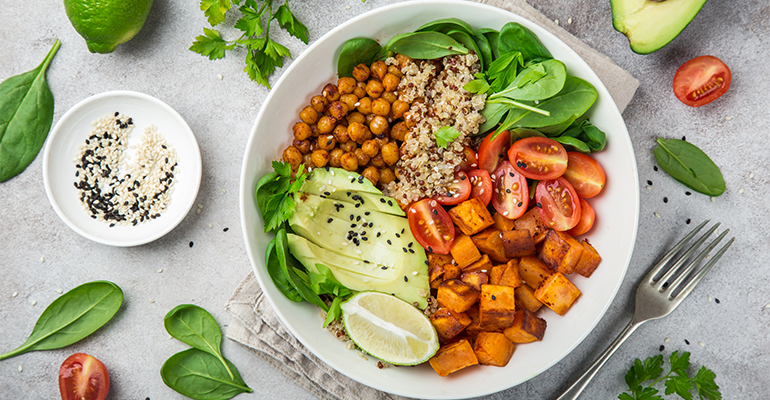
As part of the Austrian guidelines a "plate model" is introduced to illustrate the optimal composition of a meal. The model suggests that half of the plate should be full of fruits and vegetables, a quarter should consist of whole grains and potatoes, and the remaining quarter should contain protein, predominantly from plant-based sources such as legumes, but also includes some animal-based proteins for omnivores.
Alongside these recommendations, to help visualise and put the plate model into practice, the Austrian Ministry of Social Affairs, Health, Care and Consumer Protection published a cookbook to complement the two pyramids. The cookbook, which serves as a practical tool for designing healthy and climate-friendly meals, includes many seasonal and plant-based recipes, for example: wraps with beans, vegetables, and a pea mole; pumpkin and lentil soup with toasted bread; and a potato gröstl (fry-up) with vegetables and smoked tofu.
Every recipe also includes a climate tip and a plant-based alternative (if the recipe includes animal-based products). Some climate tips include eating local where possible; opting for red and yellow lentils over brown and black lentils, as they have a shorter cooking time; saving energy and heating costs by avoiding opening the oven door while in use, and turning the oven off the last five to ten minutes of cooking time and using the residual heat.
Plant-based alternative tips include swapping out parmesan in a risotto for sesame puree; using lentils instead of minced meat; and swapping out cream cheese for silken tofu or a plant-based cream cheese.
Dr Carrie Ruxton, a nutrition and communications consultant, board member for Quality Meat Scotland, and science director for the Fruit Juice Science Centre, commented on Klapp’s LinkedIn post: “Unlike other plant-based diet recommendations, like EAT Lancet, I could actually see the meals that I could make with this selection of foods. It’s so important to think about meal planning and not just present the consumer with a pile of vegetables.”
Recommendations also included avoiding heavily processed foods and using herbs and spices to enhance flavours naturally without adding salt. Additionally, there is an emphasis on considering animal welfare and choosing organic food when possible.
Austrian example ‘will be an inspiration for other countries in Europe’
Klapp also compared Austria's progressive stance with Germany's recent updates to its dietary guidelines. She said: “A few months ago, neighbouring Germany also updated its FBDG [dietary guidelines]. While Germany has also lowered its recommendations for the consumption of meat and dairy, products such as soya milk, yoghurt, and tofu have not been included. A missed opportunity. Moving from a meat-and-dairy-centred to a plant-centric diet can be made much easier by the availability of these products and Germany has the highest sales on plant-based alternative products in Europe.”
Klapp added: “I hope the Austrian example will be an inspiration for other countries in Europe and a perfect reminder for Germany to be a bit more progressive.”

Get more of our news on Google
Set Ingredients Network as a 'Preferred Source' to get quicker access to the news you value.
Related news

Do the US dietary guidelines put UPFs under pressure?
10 Sep 2026
Will the US dietary guidelines change the way Americans eat, swapping ultra-processed foods for whole foods? We asked Dr Barry Popkin, renowned nutrition and obesity researcher.
Read more
Food fraud costs UK economy £2bn each year
9 Sep 2026
Food fraud is costing the UK economy up to £2 billion (€2.3 billion) every year although the food sector is more “resilient” than others, according to a recent study.
Read more
Pump-based liquid pet supplement focuses on health and convenience
8 Sep 2026
Prefera Pet Food uses a plastic pump-based packaging to make administering its liquid supplements for cats and dogs easier, healthier, and more accurate.
Read more
Health and wellness engagement matures across Middle East and Africa
4 Sep 2026
Many consumers in the Middle East and Africa are now proactively engaged in health and wellness, looking to integrate better habits and products into their daily lives, say experts.
Read more
Kellogg accelerates work to remove artificial colours from all US cereals
3 Sep 2026
WK Kellogg has announced an accelerated timeline to eliminate all artificial colours and the chemical preservative, BHT, across its full US portfolio of cereals and cereal packaging.
Read more
Royal Canin launches ‘freshly-cooked’ therapeutic dog food
1 Sep 2026
Mars-owned Royal Canin has moved into the therapeutic diet sector with the launch of its Fresh Veterinary Diets range for dogs with health conditions. We asked a veterinary nutritionist for her opinion.
Read more
‘Urgent gaps’ in achieving 2030 food system goals
27 Aug 2026
Global food systems are failing to meet 2030 targets across indicators including health, environment, and resilience, according to a report co-authored by the Food and Agriculture Organisation (FAO).
Read more
Seven-Eleven uses microbial testing tech to extend katsudon shelf life
26 Aug 2026
Japanese retail company Seven-Eleven has improved its factory’s microbial environment to keep comfort-food staple, katsudon, fresher for longer.
Read more
Chimac’s fusion sauces bring Korean flavours to Europe
25 Aug 2026
Irish sauce brand Chimac is tapping into Korea’s culinary traditions, bringing its flavours and products to European consumers who want a taste of K-food.
Read more
China beverages: Is herbal innovation the future?
20 Aug 2026
Herbal and botanical innovation in China's drinks market continues to grow, with ingredients like astragalus root, ginger, and ginseng in the spotlight – and focus shifting far beyond refreshment.
Read more