
Ingredients Categories
Finished Products
Finished Food Categories
- Bakery
- Beverages / Juices
- Cereal and grain products
- Confectionery
- Cooking Fats & Oils
- Dairy
- Egg products
- Fruits & Vegetables
- Infant & Baby food
- Meat, Poultry & Fish
- Nuts & Seeds products
- Other Finished Food Categories
- Pet Food
- Plant-based foods
- Prepared foods
- Sauces & Seasonings
- Sweet & Savoury Spreads
Specialised Finished Products
- Bee products
- Biotic products
- Dietary supplements
- Energy drinks
- Functional beverages
- Functional confectionery
- Functional food
- Functional powders
- Meal replacement products
- Nutricosmetics
- Other Specialised Finished Products
- Pet Dietary Supplements
- Pharma and OTC products
- Protein products
- Sugar replacers / Sweeteners
Health & Wellness Areas
Delivery Formats
Operations & Services
- 3D printing
- Analysis/ Testing
- Auditing & certifications
- Blending & mixing
- Bottling
- Certification
- Clinical trials
- Co-packing
- Coating
- Consulting
- Contract manufacturing
- Drying
- Electrospinning
- Encapsulating
- Enzymatic processing
- Extracting
- Extrusion
- Fat structuring
- Fermentation
- Filling
- Flavour development
- Freeze drying
- Granulating/ grinding/ milling / mixing
- High-pressure processing
- Labelling
- Other Operations & Services
- Packaging
- Packet filling
- Pasturising
- Quality assurance
- Saccharification
- Shear cell processing
- Spray drying
- Sterilisation
- Storage & Logistics
- Tabletting
- Toasting / roasting
- Ultra-high temperature processing
News
Coca-Cola trials delivery of refillable glass bottles in London
Beth Newhart, Freelance Journalist 1 Aug 2023
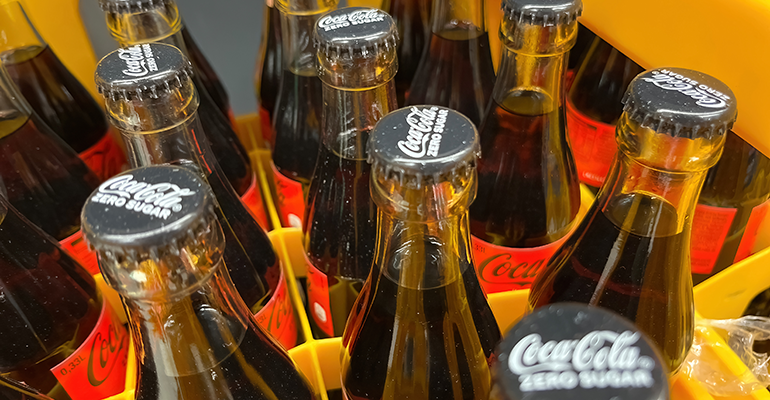
In an effort to make good on commitments to cut back its plastic pollution, Coca-Cola is testing out a new system of delivering, collecting and reusing glass bottles of Coke Zero directly with customers.
The beverage is being distributed to homes in the UK in a partnership with delivery business Milk & More. The trial began on 5 June and will run throughout the summer in south London and central southern England.
“In an incredibly exciting UK industry first, you can now enjoy the delicious taste of Coca-Cola Zero Sugar delivered to your door in refillable glass bottles! No more wishcycling, just re-use,” Milk & More said in a recent LinkedIn post.
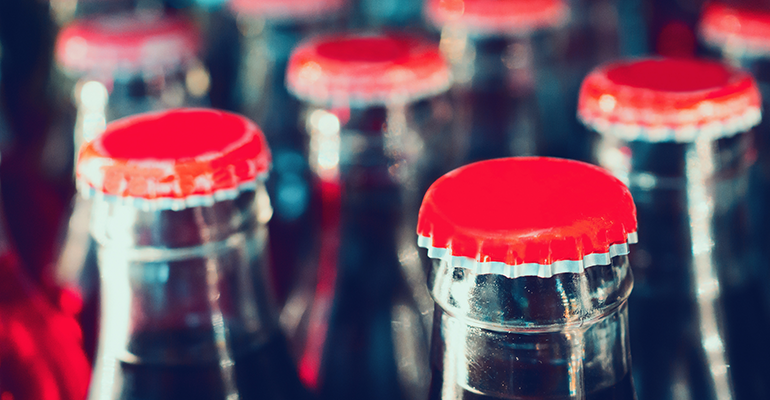
“The bottles are washed and refilled up to 20 times, resulting in an impressive 82% smaller carbon footprint compared to using single-use glass bottles.”
Partnering with the ‘home of refill’
Based in the UK, Milk & More is described as an online artisan grocer. It delivers and collects a variety of other beverages in reusable glass bottles, including milk, fruit juice, water, soft drinks and mixers. It also uses electric vehicles to deliver the drinks, and its glass bottles are reused an average of 28 times.
“This exciting development is part of our journey to become the Home of Refill. With over 43% of recycled glass ending up in landfill or incinerated and 36 million tonnes of carbon emissions produced each year from UK recycling, refill is the future,” Milk & More said.
“We believe that refillable products are the most effective way we can all reduce unnecessary waste and our carbon footprint. Having delivered and collected empties for over 100 years we are in a great position to lead the refill charge and we're dedicated to supporting other brands to switch to refillable and reusable packaging.”
On its website, Milk & More has added Coke Zero to its list of available beverages:
“Enjoy the classic taste of the world's favourite fizz without any sugar, fewer calories, and bottled up in glass just like the good old days. Even better - your milkman will collect the one litre glass bottle to be refilled and reused!”
“We are working with our partners at Coca-Cola to trial customer interest in cutting down on single-use packaging by enjoying refillable Coca-Cola Zero Sugar in a convenient doorstep delivery.”
A step in the right direction
Coca-Cola has been attempting to rehabilitate its sustainability image after a few recent setbacks. The company set a goal of increasing the overall share of its products sold in reusable packaging to 25% by 2030, but that share declined from 16% to 14% in 2022.
Ocean conservation organisation Oceana said that this decline could mean Coca-Cola instead produced the equivalent of an additional 5.8 billion 500ml single-use plastic bottles and cups in place of reusable packaging.
“Oceana estimates that if Coca-Cola meets its commitment to reach 25% reusable packaging, the company could avoid producing the cumulative equivalent of over 100 billion 500ml single-use plastic bottles and cups,” Oceana said.
“In addition, based on global rates of aquatic plastic pollution from a recent peer-reviewed study, Oceana estimates that approximately 8.5 to 14.7 billion plastic bottles and cups could be prevented from reaching our waterways and seas.”
 © AdobeStock/VGV MEDIA
The non-profit advocacy group said that Coca-Cola needs to dedicate more support and leadership toward growing its sales of reusable containers worldwide and marketing the benefits to customers.
Reusable, refillable and recyclable
Coca-Cola is recognised as the world’s worst plastic polluter, and has topped pollution lists for decades. Reusable packaging is just one way the company can lessen its impact on the environment.
Earlier this year, Coca-Cola announced a €40 million investment in refillable bottling infrastructure. The company said this will help to “drive progress on sustainability ambitions while meeting market demand.”
It follows the 1-litre glass bottles for Coca-Cola and Coca-Cola Zero Sugar that were introduced in Germany in 2019, and as well as a EUR €130 million euro investment that Coca-Cola has made in reusable packaging in the region over the last three years.
In addition to reusable packaging, Coca-Cola is trying to address its sustainability pitfalls by investing in new recycling technology in Europe. Recycling start-up CuRe Technology “creates high-quality rPET with a carbon footprint that is approximately 65% lower than virgin PET.”
This material can be used for food and drink packaging and “re-processed as many times as necessary,” Coca-Cola said, which will “offer a new lease of life for hard-to-recycle plastics, accelerating the transition to a circular economy for PET and creating a new stream of rPET.”

Get more of our news on Google
Set Ingredients Network as a 'Preferred Source' to get quicker access to the news you value.
Related news

Do the US dietary guidelines put UPFs under pressure?
10 Sep 2026
Will the US dietary guidelines change the way Americans eat, swapping ultra-processed foods for whole foods? We asked Dr Barry Popkin, renowned nutrition and obesity researcher.
Read more
Food fraud costs UK economy £2bn each year
9 Sep 2026
Food fraud is costing the UK economy up to £2 billion (€2.3 billion) every year although the food sector is more “resilient” than others, according to a recent study.
Read more
Skimpflation: An ‘unfair’ and risky approach to keeping prices low
2 Sep 2026
Consumers see skimpflation – reducing the quality of ingredients due to rising costs – as more unfair than shrinkflation, making it a risky strategy according to recent research.
Read more
NielsenIQ’s EU barometer shows Britain leading in grocery inflation
31 Aug 2026
Britain was the only country to record grocery inflation above 2%, according to NielsenIQ data that compared Europe’s five biggest grocery markets from February to May 2026.
Read more
‘Urgent gaps’ in achieving 2030 food system goals
27 Aug 2026
Global food systems are failing to meet 2030 targets across indicators including health, environment, and resilience, according to a report co-authored by the Food and Agriculture Organisation (FAO).
Read more
China beverages: Is herbal innovation the future?
20 Aug 2026
Herbal and botanical innovation in China's drinks market continues to grow, with ingredients like astragalus root, ginger, and ginseng in the spotlight – and focus shifting far beyond refreshment.
Read more
Popular barbecue staples experience sharp price increases
19 Aug 2026
The typical cost of US shoppers’ barbecue baskets has risen by 12% over the past year – the fastest annual rise in a decade, figures from The Economist show.
Read more
Beyond 'nice to have': A spotlight on US functional beverages
12 Aug 2026
Functional beverage interest in the US is gaining important ground as consumers now expect function rather than see it as "nice to have", and there are clear market gaps for growth, according to Spate.
Read more
Manam Chocolate aims to bring premium Indian cacao to 'the world stage'
11 Aug 2026
Craft chocolate brand Manam Chocolate is investing in local expansion and supply chain innovation throughout India as it works to build out the premium reputation of its locally produced cacao products.
Read more
Digital twin technology gains ground in food manufacturing
6 Aug 2026
Food and beverage companies are increasingly turning to digital twins to optimise and automate manufacturing processes, but opportunities stretch far beyond this, say experts.
Read more