
Ingredients Categories
Finished Products
Finished Food Categories
- Bakery
- Beverages / Juices
- Cereal and grain products
- Confectionery
- Cooking Fats & Oils
- Dairy
- Egg products
- Fruits & Vegetables
- Infant & Baby food
- Meat, Poultry & Fish
- Nuts & Seeds products
- Other Finished Food Categories
- Pet Food
- Plant-based foods
- Prepared foods
- Sauces & Seasonings
- Sweet & Savoury Spreads
Specialised Finished Products
- Bee products
- Biotic products
- Dietary supplements
- Energy drinks
- Functional beverages
- Functional confectionery
- Functional food
- Functional powders
- Meal replacement products
- Nutricosmetics
- Other Specialised Finished Products
- Pet Dietary Supplements
- Pharma and OTC products
- Protein products
- Sugar replacers / Sweeteners
Health & Wellness Areas
Delivery Formats
Operations & Services
- 3D printing
- Analysis/ Testing
- Auditing & certifications
- Blending & mixing
- Bottling
- Certification
- Clinical trials
- Co-packing
- Coating
- Consulting
- Contract manufacturing
- Drying
- Electrospinning
- Encapsulating
- Enzymatic processing
- Extracting
- Extrusion
- Fat structuring
- Fermentation
- Filling
- Flavour development
- Freeze drying
- Granulating/ grinding/ milling / mixing
- High-pressure processing
- Labelling
- Other Operations & Services
- Packaging
- Packet filling
- Pasturising
- Quality assurance
- Saccharification
- Shear cell processing
- Spray drying
- Sterilisation
- Storage & Logistics
- Tabletting
- Toasting / roasting
- Ultra-high temperature processing
News
Farmer-to-manufacturer collaboration lacking in cultivated meat
Natasha Spencer-Jolliffe, Freelance Journalist 7 Aug 2024A UK university report urges stronger relationships between farmers and meat-mimicking manufacturers to advance acceptance of lab-grown protein.
A new report by the UK’s Royal Agricultural University calls for better collaboration between farmers and cultivated meat businesses. In a UK-first, in July 2024, the country approved its inaugural cultivated meat from pet food brand Meatly’s lab-grown chicken.
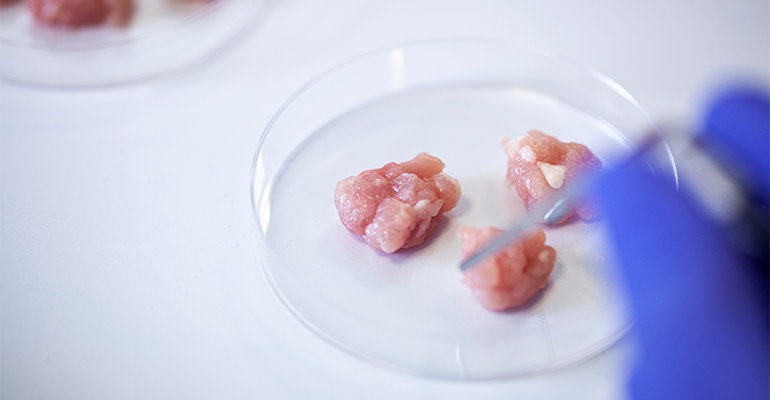
However, as the regulatory go-ahead has only been given for pet food items, product launches destined for human consumption are not here, yet. Regulatory approvals for cultivated chicken and beef are increasing though. In the UK, the Food Standards Agency received its first application to approve cultivated beef in Summer 2023. Approvals are already in place in Singapore, the US and Israel.
Cultivated meat: The big debate
The Royal Agricultural University report follows a two-year study. During Autumn 2022 and Spring 2023, researchers engaged in conversations about cultivated meat with 80 farmers through seven focus groups representing diverse farming systems across the UK’s four nations. Researchers then collaborated with nine UK farms to explore cultivated meat and its potential within the meat-based scene.
“Whilst there is general agreement about the need to transform our food system for healthier people and a healthier planet, there is considerable debate about how best to do that,” said Guy Poppy, programme director of Transforming UK Food Systems SPF, deputy executive chair of BBSRC and UKRI Food Champion, who funded the study.
The study states that as cultivated meat and traditional livestock farming are likely to coexist, their collaboration is vital. “One of the very contested areas relates to the role of livestock farming for meat rather than the race for alternative protein sources such as cultivated meats,” added Poppy.
Farmers are cautious
Of those asked in the report, many farmers were hesitant and sceptical of cultivated meat. These views come after strong opposition to the meat-free sector in Italy and the US, culminating in bans. Concerns about its impact on farming have formed part of the arguments against its introduction.
Now, amid the university’s report, there are calls for better connection and engagement between farmers and cultivated meat companies to avoid division within the food market.
Interestingly, most farmers initially reacted to the non-animal-based meat concept from a consumer or citizen’s perspective, rather than as producers. Their concerns mirrored broader public anxieties, such as the safety, naturalness, healthiness, control, and the beneficiaries of cultivated meat.
However, it was clear that for the farms to take advantage of these opportunities, they would need to have responses to current unanswered questions. These include cultivated meat’s market share and what this was replacing, the terms and conditions on offer, the availability of government support, and ultimately, how the public is likely to respond to cultivated meat.
Farmers’ responses varied widely when asked how cultivated meat could impact their businesses. Concerns ranged from direct and indirect effects on livestock and other enterprises to practical challenges in delivering on the promises of cultivated meat.
Additionally, farmers expressed six primary concerns: uncertainty; unreliability; unfairness; unintended consequences of entering the sector; worries over unrealistic market expectations; and cultivated meat’s unnatural content.
Cutting costs to make cultivated meat competitive
According to the report, technology to produce cultivated meat already exists. Yet, the ability to produce cultivated chicken economically and establish the infrastructure necessary to make it available to consumers is largely missing.
Cost therefore remains a big hurdle. Producing a kilogram of cultivated meat varies widely cost-wise due to different production methods and confidentiality, ranging from an estimated $5 to $520 per kilogram. To date, approximately £2.5 billion has been invested in reducing costs and bringing cultivated meat to market.
Researchers have found that utilising farming by-products may help the industry lower costs while benefiting some farmers. One example could be oilseed rape—the solid residue left after oil extraction—which is used as animal feed or as fertiliser. Farmers may be able to make ingredients for the broth that cells grow in, which demands nutrients.
Proving the sector’s potential
Some farmers are learning more about cultivated meat and getting involved directly. Farmers were particularly interested in opportunities to provide raw materials for the sector’s production process or leasing their farm buildings.
Under specific conditions, cultivated meat could offer advantages to certain UK farmers. These possible benefits include improving their competitive position in selling high-value traditional meat, exploring new markets by supplying animal cells or raw materials, generating income from processing crops or animal by-products, attracting private investment to produce cultivated meat on their farm, and establishing fairer supply-chain relationships.
“At a time when debates about the future of food have become polarised, we welcome this study’s urgent call for sustained open dialogue between farmers and the cultivated meat sector,” said Linus Pardoe, UK policy manager at nonprofit and think tank the Good Food Institute Europe (GFI).
Choosing collaborative communication
“Importantly, the call for greater communication and discussion will be important for many innovations being developed to help make food production and farming be a solution to climate change as opposed to a major contributor to emissions and climate change,” Poppy added.
The UK’s Royal Agricultural University has engaged in workshops with cultivated meat businesses, investors, policymakers, and food and farming groups. It has identified three ways to garner a sense of a common cause through effective communication: joint research and innovation; supporting farmer engagement; and investor criteria.
“This report demonstrates how building bridges between the cultivated meat sector and agricultural communities can offer benefits to both, and it’s great to see that some farmers recognise the potential opportunities cultivated meat can offer,” Pardoe concluded.

Get more of our news on Google
Set Ingredients Network as a 'Preferred Source' to get quicker access to the news you value.
Related news

M&S launches own-brand pet food range
11 Sep 2026
UK retailer Marks & Spencer has launched its own-brand pet food line Paws & Pals – a well-timed and strategic move that will appeal to loyal shoppers, says a marketing expert.
Read more
Do the US dietary guidelines put UPFs under pressure?
10 Sep 2026
Will the US dietary guidelines change the way Americans eat, swapping ultra-processed foods for whole foods? We asked Dr Barry Popkin, renowned nutrition and obesity researcher.
Read more
Food fraud costs UK economy £2bn each year
9 Sep 2026
Food fraud is costing the UK economy up to £2 billion (€2.3 billion) every year although the food sector is more “resilient” than others, according to a recent study.
Read more
EU's ban on Brazilian meat expected to raise prices
7 Sep 2026
Around 25% of the EU’s imported chicken and beef comes from Brazil. From September, products that fail to meet the EU antimicrobial resistance rules will be banned.
Read more
Skimpflation: An ‘unfair’ and risky approach to keeping prices low
2 Sep 2026
Consumers see skimpflation – reducing the quality of ingredients due to rising costs – as more unfair than shrinkflation, making it a risky strategy according to recent research.
Read more
NielsenIQ’s EU barometer shows Britain leading in grocery inflation
31 Aug 2026
Britain was the only country to record grocery inflation above 2%, according to NielsenIQ data that compared Europe’s five biggest grocery markets from February to May 2026.
Read more
‘Urgent gaps’ in achieving 2030 food system goals
27 Aug 2026
Global food systems are failing to meet 2030 targets across indicators including health, environment, and resilience, according to a report co-authored by the Food and Agriculture Organisation (FAO).
Read more
Seven-Eleven uses microbial testing tech to extend katsudon shelf life
26 Aug 2026
Japanese retail company Seven-Eleven has improved its factory’s microbial environment to keep comfort-food staple, katsudon, fresher for longer.
Read more
Chimac’s fusion sauces bring Korean flavours to Europe
25 Aug 2026
Irish sauce brand Chimac is tapping into Korea’s culinary traditions, bringing its flavours and products to European consumers who want a taste of K-food.
Read more
Global demand for instant noodles continues to rise
24 Aug 2026
Global demand for instant noodles reached 124.21 billion servings last year, representing a 0.7% year-on-year increase – or 900 million extra servings.
Read more