
Ingredients Categories
Finished Products
Finished Food Categories
- Bakery
- Beverages / Juices
- Cereal and grain products
- Confectionery
- Cooking Fats & Oils
- Dairy
- Egg products
- Fruits & Vegetables
- Infant & Baby food
- Meat, Poultry & Fish
- Nuts & Seeds products
- Other Finished Food Categories
- Pet Food
- Plant-based foods
- Prepared foods
- Sauces & Seasonings
- Sweet & Savoury Spreads
Specialised Finished Products
- Bee products
- Biotic products
- Dietary supplements
- Energy drinks
- Functional beverages
- Functional confectionery
- Functional food
- Functional powders
- Meal replacement products
- Nutricosmetics
- Other Specialised Finished Products
- Pet Dietary Supplements
- Pharma and OTC products
- Protein products
- Sugar replacers / Sweeteners
Health & Wellness Areas
Delivery Formats
Operations & Services
- 3D printing
- Analysis/ Testing
- Auditing & certifications
- Blending & mixing
- Bottling
- Certification
- Clinical trials
- Co-packing
- Coating
- Consulting
- Contract manufacturing
- Drying
- Electrospinning
- Encapsulating
- Enzymatic processing
- Extracting
- Extrusion
- Fat structuring
- Fermentation
- Filling
- Flavour development
- Freeze drying
- Granulating/ grinding/ milling / mixing
- High-pressure processing
- Labelling
- Other Operations & Services
- Packaging
- Packet filling
- Pasturising
- Quality assurance
- Saccharification
- Shear cell processing
- Spray drying
- Sterilisation
- Storage & Logistics
- Tabletting
- Toasting / roasting
- Ultra-high temperature processing
News
Most categories trading down in US supplements market, says SPINS
5 Jun 2023
Hit by the cost-of-living crisis, sales of most US vitamin and mineral supplements have declined – with the exception of probiotics, digestive aids, and homoeopathic medicines, according to SPINS data.
Post-pandemic, the US vitamins and minerals supplements market steadily rose with consumers taking preventative measures to care for their health needs, yet today there is little growth amongst many categories due to global inflation and the cost-of-living crisis.

With a plethora of formats, categories as well as purchasing channels to choose from, data from SPINS reveals where consumer demand is growing and declining.
“In the categories within vitamins and minerals and supplements […] what you're seeing is most categories are either flat or down, except for two. Probiotics and digestive aids are up, and homoeopathic medicines are up year over year in sales,” said Brandon Casteel, vice president of partnerships speaking as part of his talk ‘Navigating the state of the US supplement market with a data-driven approach’ at Vitafoods Europe earlier this month.
Little to no growth in US vitamins and minerals in supplements market
Global inflation is driving the price of commodities such as eggs, butter, and sugar significantly higher year over year. However, in the vitamins and minerals of supplement space only a slight increase in price has been reported in brick-and-mortar retail stores and e-commerce, according to Casteel. Consumers are reducing product quantity. A study conducted by SPINS last year found consumers were trading down from a 120-count gummy product to a 90-count gummy product.
“If you look at sales across all the major formats that we're tracking, what you see is in natural grocery stores, Amazon, regional independent grocery stores in the US and then the conventional multi-outlet, […] sales are either down slightly or up slightly everywhere except for actually big box retailers or the conventional multi outlet channel, up almost 4% in sales. But units are consistently down. People are buying less, and the average retail prices are up,” said Casteel.
Helping retailers ‘be smarter’ about their products
SPINS collects point-of-sale data from brick-and-mortar retail stores and e-commerce marketplaces, tracking products along with sales. Product details such as packaging, format, formulation, health and wellness attributes, allergens and sensitivities as well as sustainability credentials are tracked.
“[…] we predominantly talk about what is selling in the vitamins and minerals and supplements marketplace and some of the attributes behind those products that are selling so well. Product intelligence is at the core of what we do. Retailers release their data to SPINS, we add product intelligence on top of [a] specific item, and then we give it back to those retailers in order for them to be smarter about the products that they have on their shelves,” added Casteel.
Sports nutrition category is a ‘shining star’
Whilst the market is stagnant, certain ingredients within the vitamins and minerals supplements space are still experiencing growth and some market areas such as sports nutrition are outperforming others. Horehound, MSM (methylsulfonylmethane), beetroot and maca are among the fastest growing ingredients, according to Casteel.
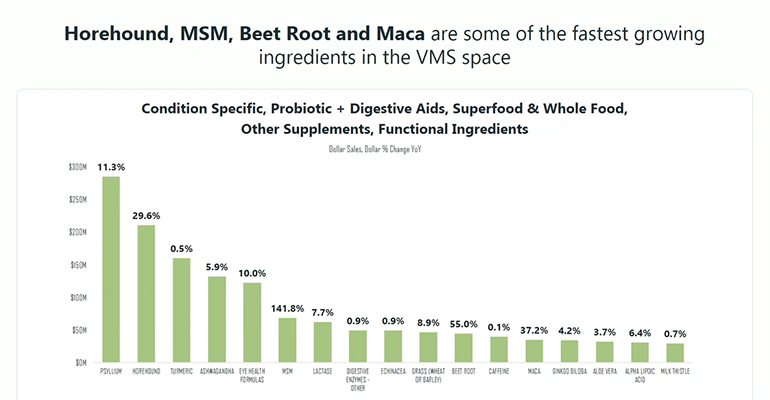 Horehound, MSM (methylsulfonylmethane), beetroot and maca are among the fastest growing ingredients, according to Casteel.
“We have more than 30 partnerships with global ingredient suppliers and they're using our data to find out what finished goods that are selling contain [their] ingredient, which ones are the fastest growing, and which ones have the highest amount of dollar share across different retailer types,” he said.
Suppliers also use SPINS data to identify spikes in sales of a particular ingredient to support new product development.
Data from SPINS shows growth within all of the major sports nutrition categories, with energy and sports drinks the biggest market. The entire category is up 36% and hydration and electrolytes, a significant part is up 68% year over year in sales said Casteel.
“It's a $12 billion market, according to our data sets, but it's still growing at 12%. The fastest growing, even though it's the smallest and dollar share is performance nutrition […]. If you look specifically within the sports nutrition category, this is what's driving it. Creatine sales, hydration and electrolyte sales, and pre workout products.”
Creatine products are increasingly being positioned to women and seniors for cognitive performance. Tik Tok videos by women creators discussing creatine are gaining attention and growing research on the benefits of creatine is contributing to sales, according to Casteel.

Get more of our news on Google
Set Ingredients Network as a 'Preferred Source' to get quicker access to the news you value.
Related news

Skimpflation: An ‘unfair’ and risky approach to keeping prices low
2 Sep 2026
Consumers see skimpflation – reducing the quality of ingredients due to rising costs – as more unfair than shrinkflation, making it a risky strategy according to recent research.
Read more
NielsenIQ’s EU barometer shows Britain leading in grocery inflation
31 Aug 2026
Britain was the only country to record grocery inflation above 2%, according to NielsenIQ data that compared Europe’s five biggest grocery markets from February to May 2026.
Read more
‘Urgent gaps’ in achieving 2030 food system goals
27 Aug 2026
Global food systems are failing to meet 2030 targets across indicators including health, environment, and resilience, according to a report co-authored by the Food and Agriculture Organisation (FAO).
Read more
China beverages: Is herbal innovation the future?
20 Aug 2026
Herbal and botanical innovation in China's drinks market continues to grow, with ingredients like astragalus root, ginger, and ginseng in the spotlight – and focus shifting far beyond refreshment.
Read more
Popular barbecue staples experience sharp price increases
19 Aug 2026
The typical cost of US shoppers’ barbecue baskets has risen by 12% over the past year – the fastest annual rise in a decade, figures from The Economist show.
Read more
Beyond 'nice to have': A spotlight on US functional beverages
12 Aug 2026
Functional beverage interest in the US is gaining important ground as consumers now expect function rather than see it as "nice to have", and there are clear market gaps for growth, according to Spate.
Read more
Manam Chocolate aims to bring premium Indian cacao to 'the world stage'
11 Aug 2026
Craft chocolate brand Manam Chocolate is investing in local expansion and supply chain innovation throughout India as it works to build out the premium reputation of its locally produced cacao products.
Read more
Digital twin technology gains ground in food manufacturing
6 Aug 2026
Food and beverage companies are increasingly turning to digital twins to optimise and automate manufacturing processes, but opportunities stretch far beyond this, say experts.
Read more
How Secon Taste is putting upcycled snacks on shelves
4 Aug 2026
Hungarian zero-waste startup Secon Taste is turning surplus food into upcycled snacks such as fibre-packed granola, instant porridge, and a circular coffee-tasting box.
Read more
Codex sets global thresholds for ‘may contain’ labels
3 Aug 2026
Codex Alimentarius has adopted its first global guidance on when to use “may contain” allergen warnings, setting thresholds intended to stop the label being used as blanket legal cover.
Read more