
Ingredients Categories
Finished Products
Finished Food Categories
- Bakery
- Beverages / Juices
- Cereal and grain products
- Confectionery
- Cooking Fats & Oils
- Dairy
- Egg products
- Fruits & Vegetables
- Infant & Baby food
- Meat, Poultry & Fish
- Nuts & Seeds products
- Other Finished Food Categories
- Pet Food
- Plant-based foods
- Prepared foods
- Sauces & Seasonings
- Sweet & Savoury Spreads
Specialised Finished Products
- Bee products
- Biotic products
- Dietary supplements
- Energy drinks
- Functional beverages
- Functional confectionery
- Functional food
- Functional powders
- Meal replacement products
- Nutricosmetics
- Other Specialised Finished Products
- Pet Dietary Supplements
- Pharma and OTC products
- Protein products
- Sugar replacers / Sweeteners
Health & Wellness Areas
Delivery Formats
Operations & Services
- 3D printing
- Analysis/ Testing
- Auditing & certifications
- Blending & mixing
- Bottling
- Certification
- Clinical trials
- Co-packing
- Coating
- Consulting
- Contract manufacturing
- Drying
- Electrospinning
- Encapsulating
- Enzymatic processing
- Extracting
- Extrusion
- Fat structuring
- Fermentation
- Filling
- Flavour development
- Freeze drying
- Granulating/ grinding/ milling / mixing
- High-pressure processing
- Labelling
- Other Operations & Services
- Packaging
- Packet filling
- Pasturising
- Quality assurance
- Saccharification
- Shear cell processing
- Spray drying
- Sterilisation
- Storage & Logistics
- Tabletting
- Toasting / roasting
- Ultra-high temperature processing
News
Sustainable behaviours must begin to resonate with consumers too
7 Jul 2022
Food producers, brand owners, retailers and governments must work together to help drive consumers towards more sustainable behaviours, experts warn.
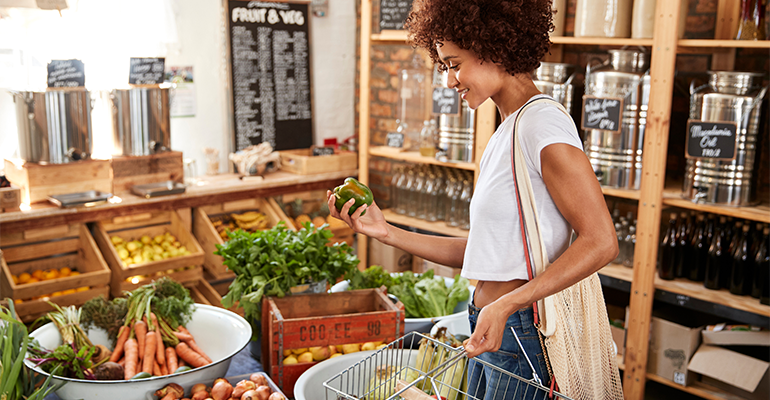
While there is huge industry excitement for new technologies to create more sustainable food solutions, the biggest challenge remains convincing consumers to make a switch, said experts speaking as part of a panel session on sustainable consumer behaviours at F&A Next in Wageningen recently.
“We can have long discussions about the merits of cell cultures compared to plant-based proteins, or what do we do in the milk space, with dairy and plant-based milk or cell-based precision fermentation. But at the end of the day, we have to resonate with the consumer,” said Yoni Glickman, managing director of FoodSparks by PeakBridge, who moderated the panel.
“If we don't resonate with the consumer, basically, we're not doing anything. We're spending a lot of time talking to each other as an industry.”
Dick Boer, non-executive board member at Nestlé and former CEO of Ahold Delhaize, said there is an ‘enormous opportunity’ for the industry to step up in accelerating ambitions towards sustainable food consumption – and warned that the effects of not addressing the issue could be catastrophic for big food companies.
“If you look what the food industry is providing, and also the carbon footprint it has, it can almost become the next oil company,” he said. “We will be challenged a lot, by not only our consumers, but also by NGOs and others to step in.”
Fighting food waste remains critical
The former retail CEO warned that addressing food waste was one of the biggest challenges for every aspect of the supply chain, but put particular emphasis on the need for the food industry and retailers to work with consumers to reduce food waste in the home.
“We need to work with our consumers on how to use the food in a better way because that will already help our carbon footprint a lot in my opinion,” he said.
David Welch, co-founder and CSO at Synthesis Capital, agreed that the issue of food waste across the supply chain is ‘huge’, noting that a recent report showed that it contributed 6% of all greenhouse gas (GHG) emissions – making it a larger contributor to the climate crisis than the entire aviation industry.
“What I see, is that most of the focus right now is on pushing consumers to make better choices with how they use and waste food, but I'm not seeing enough on the industry and government side,” he said, noting that governments tend to be huge consumers of food themselves, and that central contracts for food in areas of government and public service could be a huge contributor if they were improved.
He also noted that it is clear certain food products are worse than others in terms of GHG emissions:
“So, I think perhaps there's a strategy of, rather than just saying don't waste food overall, to look to some of these higher emitters like some of the animal derived products that are really terrible at greenhouse gas emissions, and think of ways to better educate consumers on those products,” said Welch. “Reduce reducing consumption, but also wasting less of those.”
Green points: Can adoption of eco labels drive change?
Koen Boone, managing director of the Sustainability Consortium, said an ‘eco score’ type of label similar to that of the NutriScore, but focused on sustainability of foods, could be a ‘game changer’ for the industry in terms of driving consumer change.
“You can see that some retailers already started with an ‘eco score’, but there are also several competitors,” he said, noting that in the UK for example, all major retailers are connected to Foundation Earth, which is trying to do a ‘more advanced’ version of the eco score labels being trialled in other countries currently, while in France it has been decided that an environmental label will be used on foods by 2023.
“The French government system is making an additional step,” he said. “But, also, in Denmark and Germany and in the Netherlands, governments are working on a harmonized sustainability label.”
Boone conceded that while gaining a consensus between producers, manufacturers, retailers, and governments on eco score labelling will not be easy, it will be an important step, since the use of an eco label can then be used in a wider context that can be linked to other type of incentives.
“You can put it on the invoice when you go to a supermarket for example. You can use it as a base on how a supermarket is performing, but you can also link financial incentives,” he said, noting examples of health insurance companies offering discounts on premiums when people buy healthier foods.
“If you have that type of system also on sustainability for all products, all those types of things become possible,” Boer added. “You can have systems where you can get green points, and get presents if you have a certain number of points … creating much more possibilities to influence consumer behaviour than just the traditional labelling.”
Make the sustainable choice the easy choice
However, Maartje Frederiks, an advisor in online food and retail, investor, and supervisory board member at Plus Retail, warned that changing habits of consumers is “definitely not easy.”
“I think it's also about inspiring customers to change habits to cook differently, to eat differently,” she said, noting that when people plan a meal, they usually start with a protein.
“That’s a bit old fashioned, right. So, you need to get used to a different way of looking at meal planning.”
Frederiks added that inspiring consumers to cook differently with new recipes that drive changes in behaviours should be seen as a major task of retailers.
“I don't think that consumers can do it on their own,” said Boone. “And I also agree that that labelling cannot do it on its own.”
“Make it easy for consumers to make the right choice,” he said. “So, in a catering organisation make the standard meal a sustainability meal. They can still choose the other one, but a lot of consumers will just select the one that is the easiest choice.”

Get more of our news on Google
Set Ingredients Network as a 'Preferred Source' to get quicker access to the news you value.
Related news

Kellogg accelerates work to remove artificial colours from all US cereals
3 Sep 2026
WK Kellogg has announced an accelerated timeline to eliminate all artificial colours and the chemical preservative, BHT, across its full US portfolio of cereals and cereal packaging.
Read more
‘Urgent gaps’ in achieving 2030 food system goals
27 Aug 2026
Global food systems are failing to meet 2030 targets across indicators including health, environment, and resilience, according to a report co-authored by the Food and Agriculture Organisation (FAO).
Read more
Chimac’s fusion sauces bring Korean flavours to Europe
25 Aug 2026
Irish sauce brand Chimac is tapping into Korea’s culinary traditions, bringing its flavours and products to European consumers who want a taste of K-food.
Read more
Savoury protein snacks shake up the on-the-go market
10 Aug 2026
Sweet flavours have dominated the high-protein snack category but savoury snacks, such as cheese bars and meat sticks, can appeal to health-conscious consumers.
Read more
Nestlé invests in regeneratively farmed wheat for KitKat
5 Aug 2026
Nestlé will pay a premium for Wildfarmed’s regeneratively farmed wheat but the CPG remains reticent to promote the move on packs of its KitKat bars.
Read more
How Secon Taste is putting upcycled snacks on shelves
4 Aug 2026
Hungarian zero-waste startup Secon Taste is turning surplus food into upcycled snacks such as fibre-packed granola, instant porridge, and a circular coffee-tasting box.
Read more
Codex sets global thresholds for ‘may contain’ labels
3 Aug 2026
Codex Alimentarius has adopted its first global guidance on when to use “may contain” allergen warnings, setting thresholds intended to stop the label being used as blanket legal cover.
Read more
EU sets maximum MOAH levels to protect human health
28 Jul 2026
The EU will adopt maximum levels for mineral oil aromatic hydrocarbons (MOAH) in food to protect human health. What do manufacturers need to know?
Read more
UK publishes guidance on SPS food trade agreement with EU
27 Jul 2026
The UK government has shared guidance on how food businesses can prepare for its upcoming Sanitary and Phytosanitary (SPS) agreement with the EU.
Read more
Industry hits back at UK’s proposed healthy food rules
24 Jul 2026
Food brands, including Haribo, have hit out against the UK’s proposed nutrient profiling model, which places a new focus on free sugars that are added during manufacturing.
Read more