
Ingredients Categories
Finished Products
Finished Food Categories
- Bakery
- Beverages / Juices
- Cereal and grain products
- Confectionery
- Cooking Fats & Oils
- Dairy
- Egg products
- Fruits & Vegetables
- Infant & Baby food
- Meat, Poultry & Fish
- Nuts & Seeds products
- Other Finished Food Categories
- Pet Food
- Plant-based foods
- Prepared foods
- Sauces & Seasonings
- Sweet & Savoury Spreads
Specialised Finished Products
- Bee products
- Biotic products
- Dietary supplements
- Energy drinks
- Functional beverages
- Functional confectionery
- Functional food
- Functional powders
- Meal replacement products
- Nutricosmetics
- Other Specialised Finished Products
- Pet Dietary Supplements
- Pharma and OTC products
- Protein products
- Sugar replacers / Sweeteners
Health & Wellness Areas
Delivery Formats
Operations & Services
- 3D printing
- Analysis/ Testing
- Auditing & certifications
- Blending & mixing
- Bottling
- Certification
- Clinical trials
- Co-packing
- Coating
- Consulting
- Contract manufacturing
- Drying
- Electrospinning
- Encapsulating
- Enzymatic processing
- Extracting
- Extrusion
- Fat structuring
- Fermentation
- Filling
- Flavour development
- Freeze drying
- Granulating/ grinding/ milling / mixing
- High-pressure processing
- Labelling
- Other Operations & Services
- Packaging
- Packet filling
- Pasturising
- Quality assurance
- Saccharification
- Shear cell processing
- Spray drying
- Sterilisation
- Storage & Logistics
- Tabletting
- Toasting / roasting
- Ultra-high temperature processing
News
Tesco trials methane mitigation supplement for dairy cattle
Simon Pitman, Freelance Journalist 5 Sep 2024Tesco is trialing a methane-reducing feed supplement for one of its key UK dairy farms, sustainable UK milk producer Grosvenor Farms.
The retailer is aiming to tackle the problem of methane from cattle burps and manure, which is a big contributor to the world’s greenhouse gas emissions. According to Tesco, methane is responsible for 14% of human-induced climate emissions, spelling a problem for the dairy industry overcome to remain sustainable and continue to thrive.
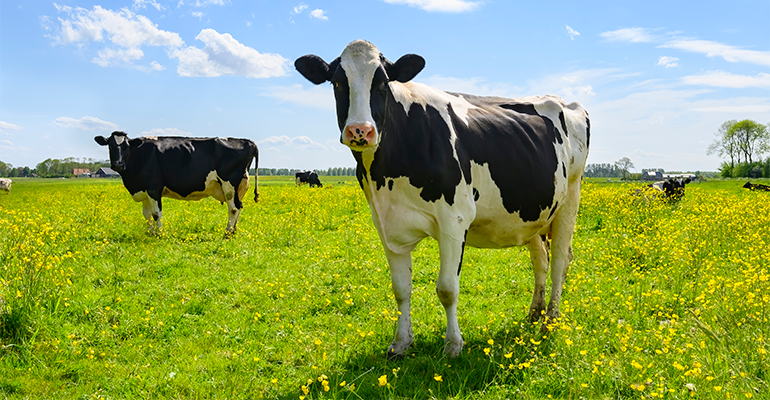
Grosvenor Farms is part of the Tesco Sustainable Dairy Group (TSDG) and is adding the methane-reducing supplement to the feed of a 400-count herd of dairy cattle to assess the difference it makes to the methane emissions.
A supplement to help tackle dairy cattle methane emissions
Cattle digestion of a high fibre feed results in methane as a byproduct. To tackle the problem, Tesco has decided to test out the supplement in the feed of the Grosvenor Farms herd. The supplement works by suppressing the enzyme that combines with hydrogen and carbon dioxide gases in the cow’s rumen, so less methane gas is generated.
Born from a collaboration between Elanco Animal Health and dsm-firmenich, it is said that a quarter of a teaspoon of the supplement helps to reduce emissions in dairy cattle by up to 30%, and as much as 45% in beef cattle.
Natalie Smith, head of sustainable agriculture and fisheries at Tesco, said: “We’ve been carrying out innovative trials like this for a number of years now, so I’m delighted we’re going to be partnering with Grosvenor Farms on a project that could have such a significant effect on emissions reduction in our supply chain.”
The supplement serves to reduce the carbon emissions of cattle
Tesco estimates that the inclusion of the supplement in the Grosvenor Farm herd could lead to an overall reduction in farm greenhouse gas emissions of up to 12%. This should translate into reducing the carbon footprint of each cow by approximately 1.3 tonnes of CO2 annually, it said.
“We already have one of the lowest carbon footprints for milk production in the UK and we are very pleased to be working with our partner Tesco to trial innovative technologies like this feed additive in order to develop a lower-carbon milk supply chain and in doing so support our ambition to be a carbon net zero milk producer by 2030,” said Mark Roach, managing director of Grosvenor Farms.
Tesco says that if the four-month trial is successful, it aims to scale up the use of the supplement across TSDG to reduce emissions across all of its dairy suppliers and create a more sustainable food system.
United Nations report stresses the importance of mitigating carbon emissions
Tesco’s initiative is responding to growing pressure to mitigate carbon emissions caused by the agricultural industry. Last year, the Farm and Agriculture Organization of the United Nations published a report that focused on providing solutions to methane emissions in livestock and rice systems.
The report highlights how a climate change crisis, mixed with a growing world population that needs to be fed (the global population is forecast to reach 9.7 billion by 2050), is putting significant pressure on the agricultural industry to expand production while also trying to ensure that carbon emissions are managed at sustainable levels.
In tackling this challenge, the report highlights the importance of global greenhouse gas mitigation strategies, stressing how emissions from livestock are at the top of the list because they account for roughly 32% of anthropogenic methane emissions.
The report highlights how climate change is already putting a huge strain on the production capacity of the global agricultural industry, stressing the importance of mitigating agricultural carbon emissions if production is to be expanded in the future to meet rising demand.

Get more of our news on Google
Set Ingredients Network as a 'Preferred Source' to get quicker access to the news you value.
Related news

Do the US dietary guidelines put UPFs under pressure?
10 Sep 2026
Will the US dietary guidelines change the way Americans eat, swapping ultra-processed foods for whole foods? We asked Dr Barry Popkin, renowned nutrition and obesity researcher.
Read more
Food fraud costs UK economy £2bn each year
9 Sep 2026
Food fraud is costing the UK economy up to £2 billion (€2.3 billion) every year although the food sector is more “resilient” than others, according to a recent study.
Read more
Kellogg accelerates work to remove artificial colours from all US cereals
3 Sep 2026
WK Kellogg has announced an accelerated timeline to eliminate all artificial colours and the chemical preservative, BHT, across its full US portfolio of cereals and cereal packaging.
Read more
Skimpflation: An ‘unfair’ and risky approach to keeping prices low
2 Sep 2026
Consumers see skimpflation – reducing the quality of ingredients due to rising costs – as more unfair than shrinkflation, making it a risky strategy according to recent research.
Read more
‘Urgent gaps’ in achieving 2030 food system goals
27 Aug 2026
Global food systems are failing to meet 2030 targets across indicators including health, environment, and resilience, according to a report co-authored by the Food and Agriculture Organisation (FAO).
Read more
Popular barbecue staples experience sharp price increases
19 Aug 2026
The typical cost of US shoppers’ barbecue baskets has risen by 12% over the past year – the fastest annual rise in a decade, figures from The Economist show.
Read more
Savoury protein snacks shake up the on-the-go market
10 Aug 2026
Sweet flavours have dominated the high-protein snack category but savoury snacks, such as cheese bars and meat sticks, can appeal to health-conscious consumers.
Read more
Digital twin technology gains ground in food manufacturing
6 Aug 2026
Food and beverage companies are increasingly turning to digital twins to optimise and automate manufacturing processes, but opportunities stretch far beyond this, say experts.
Read more
Nestlé invests in regeneratively farmed wheat for KitKat
5 Aug 2026
Nestlé will pay a premium for Wildfarmed’s regeneratively farmed wheat but the CPG remains reticent to promote the move on packs of its KitKat bars.
Read more
Codex sets global thresholds for ‘may contain’ labels
3 Aug 2026
Codex Alimentarius has adopted its first global guidance on when to use “may contain” allergen warnings, setting thresholds intended to stop the label being used as blanket legal cover.
Read more