
Ingredients Categories
Finished Products
Finished Food Categories
- Bakery
- Beverages / Juices
- Cereal and grain products
- Confectionery
- Cooking Fats & Oils
- Dairy
- Egg products
- Fruits & Vegetables
- Infant & Baby food
- Meat, Poultry & Fish
- Nuts & Seeds products
- Other Finished Food Categories
- Pet Food
- Plant-based foods
- Prepared foods
- Sauces & Seasonings
- Sweet & Savoury Spreads
Specialised Finished Products
- Bee products
- Biotic products
- Dietary supplements
- Energy drinks
- Functional beverages
- Functional confectionery
- Functional food
- Functional powders
- Meal replacement products
- Nutricosmetics
- Other Specialised Finished Products
- Pet Dietary Supplements
- Pharma and OTC products
- Protein products
- Sugar replacers / Sweeteners
Health & Wellness Areas
Delivery Formats
Operations & Services
- 3D printing
- Analysis/ Testing
- Auditing & certifications
- Blending & mixing
- Bottling
- Certification
- Clinical trials
- Co-packing
- Coating
- Consulting
- Contract manufacturing
- Drying
- Electrospinning
- Encapsulating
- Enzymatic processing
- Extracting
- Extrusion
- Fat structuring
- Fermentation
- Filling
- Flavour development
- Freeze drying
- Granulating/ grinding/ milling / mixing
- High-pressure processing
- Labelling
- Other Operations & Services
- Packaging
- Packet filling
- Pasturising
- Quality assurance
- Saccharification
- Shear cell processing
- Spray drying
- Sterilisation
- Storage & Logistics
- Tabletting
- Toasting / roasting
- Ultra-high temperature processing
News
Voluntary actions by industry ‘ineffective’ for public health, warns ‘realist review’
19 Aug 2022
Reliance on voluntary actions to control the composition and marketing of unhealthy foods and drinks by industry is not effective and results in weaker regulations in low- and middle- income countries, warn researchers.
The review, published in Nature Food, examined voluntary actions adopted by the food and beverage industry in low- and middle-income countries (LMIC) in relation to the production and marketing of ‘unhealthy’ foods and drink, and the potential impact on risk non-communicable diseases (NCDs).

Led by Agnes Erzse from the University of Witwatersrand School of Public Health, South Africa, the team noted that in 2013, 194 member states of the World Health Organization (WHO) endorsed a list of cost-effective NCD ‘best-buy’ policies and other recommended measures.
These endorsements included evidence-based policies like taxes on sugar-sweetened beverages (SSBs), direct restrictions and mandates limiting the sale of SSBs in schools and workplaces, reformulation, and improvement of the nutrient profile of food products, and standards regulating marketing to children.
“While an increasing number of jurisdictions have adopted many of these measures with the aim of reducing consumption of unhealthy food and drink, the comprehensive implementation of diet-related NCD policies has been limited,” said Erzse and colleagues – noting that the adoption of regulatory policies on ‘unhealthy commodities’ has faced strong opposition from industry, principally in favour of the adoption of self-regulation and voluntary actions.
“We found evidence that across four NCD prevention areas—product reformulation, simplified nutrition labelling, restricting marketing to children and limiting sales of SSBs in schools—voluntary actions negatively influence the food and beverage environments in LMICs by failing to reduce exposure to unhealthy foods and beverages, and by strategically pre-empting the introduction of evidence-based regulatory actions,” said the research team.
A ‘realist review’ of voluntary actions
Erzse and colleagues state that multinational corporations and international associations have adopted well-publicised voluntary actions that outline their commitment to voluntarily address NCDs – adding that as part of these efforts, the food and beverage industry often assert that self-regulation and voluntary actions are sufficient to protect public health.
However, Erzse and colleagues noted that the use and effectiveness of VAs by the food and beverage industry is much debated – especially given the clear evidence from the alcohol and tobacco industries that VAs do not work.
The authors performed a ‘realist review’ of the of voluntary actions by the food and beverage industry and implications for public health and policy in LMICs, noting that to date, efforts to analyse industry actions have focused on high-income settings including Europe, North America, Australia, and Canada.
“This realist review supplements and extends previous reviews of voluntary actions by adopting a theoretical lens to identify and understand for the first time how voluntary actions function as an NCD prevention intervention in LMICs,” they said, noting that although voluntary actions have a stated purpose of improving public health, they also have a notable impact on the political environment.
“Studies on the political and policy impact show how industry actors have used voluntary actions to prevent mandatory regulation by governments, thereby constraining public health policy action and/or promoting policy ‘non-decision-making’,” they said.
“Given that voluntary actions sometimes replace evidence-based regulatory interventions, evidence of their effectiveness is of particular importance to assess whether they should be a preferred measure to address obesity and NCDs.”
No evidence of benefit
The study found no evidence indicating that voluntary actions are effective in safeguarding public health, said the team, adding that the analysis also showed that actions were often initiated in response to efforts to introduce regulations and were difficult to evaluate due to vague language and a lack of enforcement mechanisms.
“Within the context of the conceptual framework, our review indicates that the effect and purpose of voluntary actions are more often aimed at policy substitution rather than as public health interventions,” they said. “This is of concern as voluntary actions are often said to be initiated and adopted as a means to pre-empt government regulation, particularly in LMICs.”
Indeed, they cited the example of a proposed ‘sugar tax’ on drinks in South Africa, noting that industry leveraged heavily on existing public–private partnerships and voluntary commitments to argue against the adoption of SSB taxation.
Furthermore, they noted that the enforcement and implementation of voluntary measures has a substantial effect on their outcomes – adding that governments often accept self-regulation on the understanding that a statutory regulation may be adopted should the voluntary actions fail to deliver its promises.
The team noted that this makes monitoring and evaluation an imperative component of using voluntary industry measures to achieve public health objectives.
“However, current vague language and lack of benchmarks make it difficult to evaluate,” they said, warning that to enable the evaluation and assessment of their effectiveness, there is a need for industry actors to include transparent accountability mechanisms, develop targets that are quantitative and measurable, and publish progress reports on agreed indicators.
Governments should not involve multinational corporations in policymaking
“In light of our evidence and given the lack of commitment from industry to improving public health, policymakers need to consider mandatory regulatory intervention as a means to effectively address the growing obesity pandemic in LMICs,” said the authors.
“However, this is not without its challenges,” they warned. “In LMICs, despite its high cost, the issue of obesity is usually not high on government health agendas, and economic pressures create barriers to regulating industry behaviour.”
“For this reason, it is necessary for governments in LMICs to adopt strong conflict-of-interest policies and work to reduce the influence and role of multi-national corporations in NCD prevention policy.”
Furthermore, they suggested that the WHO and United Nations should rescind endorsements of industry involvement in favour of mandatory measures: “There have been consistent endorsements from international governing bodies indicating that collaboration with industry is a key strategy in responding to NCDs,” they said.
“This study demonstrates that the use of voluntary actions is not evidence-based and does not lead to better public health outcomes. For this reason, the WHO’s continued endorsement of voluntary actions is not supported by evidence and should be rescinded.”

Get more of our news on Google
Set Ingredients Network as a 'Preferred Source' to get quicker access to the news you value.
Related news

Kellogg accelerates work to remove artificial colours from all US cereals
3 Sep 2026
WK Kellogg has announced an accelerated timeline to eliminate all artificial colours and the chemical preservative, BHT, across its full US portfolio of cereals and cereal packaging.
Read more
‘Urgent gaps’ in achieving 2030 food system goals
27 Aug 2026
Global food systems are failing to meet 2030 targets across indicators including health, environment, and resilience, according to a report co-authored by the Food and Agriculture Organisation (FAO).
Read more
Chimac’s fusion sauces bring Korean flavours to Europe
25 Aug 2026
Irish sauce brand Chimac is tapping into Korea’s culinary traditions, bringing its flavours and products to European consumers who want a taste of K-food.
Read more
Savoury protein snacks shake up the on-the-go market
10 Aug 2026
Sweet flavours have dominated the high-protein snack category but savoury snacks, such as cheese bars and meat sticks, can appeal to health-conscious consumers.
Read more
Nestlé invests in regeneratively farmed wheat for KitKat
5 Aug 2026
Nestlé will pay a premium for Wildfarmed’s regeneratively farmed wheat but the CPG remains reticent to promote the move on packs of its KitKat bars.
Read more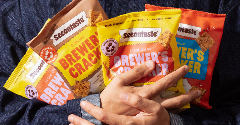
How Secon Taste is putting upcycled snacks on shelves
4 Aug 2026
Hungarian zero-waste startup Secon Taste is turning surplus food into upcycled snacks such as fibre-packed granola, instant porridge, and a circular coffee-tasting box.
Read more
Codex sets global thresholds for ‘may contain’ labels
3 Aug 2026
Codex Alimentarius has adopted its first global guidance on when to use “may contain” allergen warnings, setting thresholds intended to stop the label being used as blanket legal cover.
Read more
EU sets maximum MOAH levels to protect human health
28 Jul 2026
The EU will adopt maximum levels for mineral oil aromatic hydrocarbons (MOAH) in food to protect human health. What do manufacturers need to know?
Read more
UK publishes guidance on SPS food trade agreement with EU
27 Jul 2026
The UK government has shared guidance on how food businesses can prepare for its upcoming Sanitary and Phytosanitary (SPS) agreement with the EU.
Read more
Industry hits back at UK’s proposed healthy food rules
24 Jul 2026
Food brands, including Haribo, have hit out against the UK’s proposed nutrient profiling model, which places a new focus on free sugars that are added during manufacturing.
Read more