
Ingredients Categories
Finished Products
Finished Food Categories
- Bakery
- Beverages / Juices
- Cereal and grain products
- Confectionery
- Cooking Fats & Oils
- Dairy
- Egg products
- Fruits & Vegetables
- Infant & Baby food
- Meat, Poultry & Fish
- Nuts & Seeds products
- Other Finished Food Categories
- Pet Food
- Plant-based foods
- Prepared foods
- Sauces & Seasonings
- Sweet & Savoury Spreads
Specialised Finished Products
- Bee products
- Biotic products
- Dietary supplements
- Energy drinks
- Functional beverages
- Functional confectionery
- Functional food
- Functional powders
- Meal replacement products
- Nutricosmetics
- Other Specialised Finished Products
- Pet Dietary Supplements
- Pharma and OTC products
- Protein products
- Sugar replacers / Sweeteners
Health & Wellness Areas
Delivery Formats
Operations & Services
- 3D printing
- Analysis/ Testing
- Auditing & certifications
- Blending & mixing
- Bottling
- Certification
- Clinical trials
- Co-packing
- Coating
- Consulting
- Contract manufacturing
- Drying
- Electrospinning
- Encapsulating
- Enzymatic processing
- Extracting
- Extrusion
- Fat structuring
- Fermentation
- Filling
- Flavour development
- Freeze drying
- Granulating/ grinding/ milling / mixing
- High-pressure processing
- Labelling
- Other Operations & Services
- Packaging
- Packet filling
- Pasturising
- Quality assurance
- Saccharification
- Shear cell processing
- Spray drying
- Sterilisation
- Storage & Logistics
- Tabletting
- Toasting / roasting
- Ultra-high temperature processing
News
Which sustainability-related labels are consumers willing to pay a premium for?
Tessa Wiles, Content Editor - Food 10 Dec 2025Products with animal welfare and geographic origin labels elicit a higher willingness to pay a premium than those with carbon-related labels, research suggests.
The meta-analysis, published in the Trends in Food Science and Technology journal, analysed 173 original research papers, providing a total of 1,065 observations, covering Europe (58% of observations), North America (23%), and Asia (14%).

On average, consumers are willing to pay a 29% premium for food products with labels associated with sustainability, the researchers found. However, certain label types on specific products fetch a higher premium, and vice versa.
No one-size-fits-all: Label types leading consumers' willingness to pay
Sustainability-related labels on products may guide consumer behaviour toward more environmentally friendly consumption choices.
However, the long-term viability of these schemes for brands relies on consumers' willingness to pay for the associated premium, and while the average consumer is willing to pay an almost one-third premium for sustainability-labelled products, one size does not fit all when it comes to label type.
On average, shoppers were willing to pay 59% more than the reference or baseline price for products with animal welfare labels, the research found. The authors attributed this high premium to consumers valuing ethical and quality perceptions.
Geographic labels also drove higher premiums compared with generic sustainability labels, with an average increase of 35%. The scientists pointed to previous research that found consumers often perceive domestic origin labels as an indicator of healthfulness and safety of the product.
However, not all environmental-related claims fetch a higher premium. Carbon footprint labels, for example, were associated with the lowest percentage premium, coming in at just 12%.
The authors explained that this low valuation is consistent with previous literature, suggesting that consumers view this type of environmental attribute as having lower relative importance to other sustainability-related metrics, possibly due to perceived complexity or negative associations related to the products.
Product type and price sensitivity define the premium
The effectiveness of sustainability labels in the market also depends heavily on the food product itself.
Compared to vegetables, the researchers found that consumers were willing to pay a premium on labelled products that fell into categories such as meat, dairy, alcohol (wine and beer), coffee, and cereals.
They explained that consumers may perceive products like meat, dairy, coffee, and wine as having higher environmental or social impacts compared to vegetables and are therefore more willing to pay a premium to mitigate or address those concerns or assure origin or ethical production.
Reference or base price also plays a role in how much of a premium consumers are willing to pay, in that when the product's reference price increases, the percentage of willingness to pay decreases.
This confirms that price sensitivity is a key factor, alongside label type, in purchasing behaviour.
The evolving consumer and their changing priorities
The authors found that studies published after 2017 tended to report a significantly higher percentage of willingness to pay a premium. This finding aligns with the increased global consumer awareness and concern for sustainability-related issues that have occurred in the past decade.
A 2023 Eurobarometer report, for example, found that 73% of EU citizens surveyed agreed that the environmental impact of a product is “very important” or “rather important” when making a purchasing decision.
PwC’s 2024 Voice of the Consumer Survey found that, on average, consumers were willing to pay 9.7% more for sustainably produced or sourced goods.
However, intention to pay more is not always aligned with and consumers' real-life purchasing behaviours.
For example, McKinsey’s Sustainability in packaging 2025: Inside the minds of global consumers report found that when it comes to consumer purchasing decisions, environmental impact was rated as lower in importance than price, convenience, and shelf life.

Get more of our news on Google
Set Ingredients Network as a 'Preferred Source' to get quicker access to the news you value.
Related news

M&S launches own-brand pet food range
11 Sep 2026
UK retailer Marks & Spencer has launched its own-brand pet food line Paws & Pals – a well-timed and strategic move that will appeal to loyal shoppers, says a marketing expert.
Read more
Do the US dietary guidelines put UPFs under pressure?
10 Sep 2026
Will the US dietary guidelines change the way Americans eat, swapping ultra-processed foods for whole foods? We asked Dr Barry Popkin, renowned nutrition and obesity researcher.
Read more
Food fraud costs UK economy £2bn each year
9 Sep 2026
Food fraud is costing the UK economy up to £2 billion (€2.3 billion) every year although the food sector is more “resilient” than others, according to a recent study.
Read more
Kellogg accelerates work to remove artificial colours from all US cereals
3 Sep 2026
WK Kellogg has announced an accelerated timeline to eliminate all artificial colours and the chemical preservative, BHT, across its full US portfolio of cereals and cereal packaging.
Read more
‘Urgent gaps’ in achieving 2030 food system goals
27 Aug 2026
Global food systems are failing to meet 2030 targets across indicators including health, environment, and resilience, according to a report co-authored by the Food and Agriculture Organisation (FAO).
Read more
Chimac’s fusion sauces bring Korean flavours to Europe
25 Aug 2026
Irish sauce brand Chimac is tapping into Korea’s culinary traditions, bringing its flavours and products to European consumers who want a taste of K-food.
Read more
Savoury protein snacks shake up the on-the-go market
10 Aug 2026
Sweet flavours have dominated the high-protein snack category but savoury snacks, such as cheese bars and meat sticks, can appeal to health-conscious consumers.
Read more
Nestlé invests in regeneratively farmed wheat for KitKat
5 Aug 2026
Nestlé will pay a premium for Wildfarmed’s regeneratively farmed wheat but the CPG remains reticent to promote the move on packs of its KitKat bars.
Read more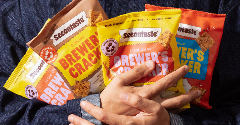
How Secon Taste is putting upcycled snacks on shelves
4 Aug 2026
Hungarian zero-waste startup Secon Taste is turning surplus food into upcycled snacks such as fibre-packed granola, instant porridge, and a circular coffee-tasting box.
Read more
Codex sets global thresholds for ‘may contain’ labels
3 Aug 2026
Codex Alimentarius has adopted its first global guidance on when to use “may contain” allergen warnings, setting thresholds intended to stop the label being used as blanket legal cover.
Read more