
Ingredients Categories
Finished Products
Finished Food Categories
- Bakery
- Beverages / Juices
- Cereal and grain products
- Confectionery
- Cooking Fats & Oils
- Dairy
- Egg products
- Fruits & Vegetables
- Infant & Baby food
- Meat, Poultry & Fish
- Nuts & Seeds products
- Other Finished Food Categories
- Pet Food
- Plant-based foods
- Prepared foods
- Sauces & Seasonings
- Sweet & Savoury Spreads
Specialised Finished Products
- Bee products
- Biotic products
- Dietary supplements
- Energy drinks
- Functional beverages
- Functional confectionery
- Functional food
- Functional powders
- Meal replacement products
- Nutricosmetics
- Other Specialised Finished Products
- Pet Dietary Supplements
- Pharma and OTC products
- Protein products
- Sugar replacers / Sweeteners
Health & Wellness Areas
Delivery Formats
Operations & Services
- 3D printing
- Analysis/ Testing
- Auditing & certifications
- Blending & mixing
- Bottling
- Certification
- Clinical trials
- Co-packing
- Coating
- Consulting
- Contract manufacturing
- Drying
- Electrospinning
- Encapsulating
- Enzymatic processing
- Extracting
- Extrusion
- Fat structuring
- Fermentation
- Filling
- Flavour development
- Freeze drying
- Granulating/ grinding/ milling / mixing
- High-pressure processing
- Labelling
- Other Operations & Services
- Packaging
- Packet filling
- Pasturising
- Quality assurance
- Saccharification
- Shear cell processing
- Spray drying
- Sterilisation
- Storage & Logistics
- Tabletting
- Toasting / roasting
- Ultra-high temperature processing
News
Cottage cheese alternative made from fermented apricot kernels
Tessa Wiles, Content Editor - Food 1 Oct 2026Revo Foods ferments leftover apricot kernels from jam and juice products into a cottage cheese alternative that naturally contains both protein and fat.
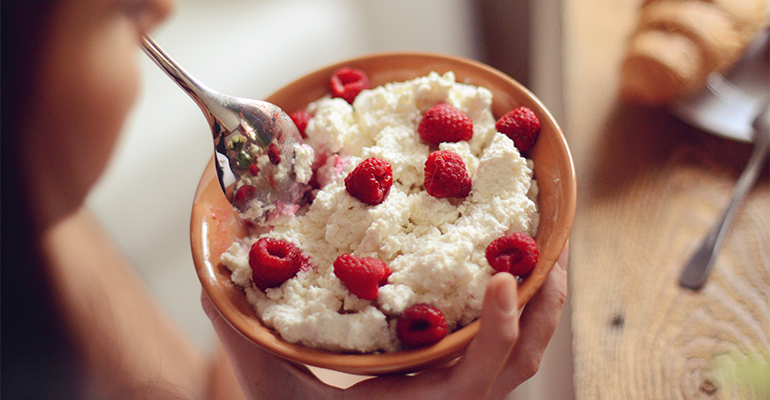
Traditional dairy cottage cheese is a creamed, acid-coagulated fresh cheese that is low in acidity and is washed during the manufacturing process. According to the Encyclopaedia of Dairy Science, cottage cheese has a slight acid, salty taste with a delicate diacetyl or creamy flavour and aroma. The body of cottage cheese, which is popular in the US, UK, and other English-speaking countries, should be “smooth and meaty, and curd particles should be discrete but not soft and pasty”.
At a glance:
- The chilled plant-based product contains only five ingredients, with no added fats, starches, or thickeners.
- Revo says the natural fat from the kernel provides creaminess, while fermentation contributes to the cottage-like texture.
- In Europe, an estimated 500,000 tonnes of fruit kernels end up as waste every year.
Austrian startup Revo Foods’ plant-based product looks like cottage cheese, is called COTTAGE PROTEIN+, and it describes the product as cottage-style. However, Robin Simsa, Revo’s commercial director, told Ingredients Network said: “We see this as a chilled speciality in its own right, and would not call it ‘vegan cottage cheese’, just as we would not call hummus a ‘vegan protein spread’.”
Chilled plant-based products are often built around a base formulation of a protein isolate and an added fat, and to replicate the texture and structure of animal fats, many formulations use coconut oil – a 2024 study, for example, found that plant-based cheese became firmer as the amount of coconut oil rose.
Austrian food technology company Revo Foods is taking a more natural approach, having developed a plant-based, chilled cottage cheese-style product made from a base of fermented sweet apricot kernels.
Revo’s five-item ingredient list – sweet apricot kernels, water, salt, vegan cultures, and chives – contains no added fat, starch, or thickeners.
Per 100g , Revo’s product delivers 11.5g of protein and 18.9g of fat, only 2g of which is saturated.
“The amazing thing is that we can work with a whole agricultural ingredient that already brings the protein and fat we need, and use fermentation to develop the taste and texture,” Simsa said.
What holds the cottage product together if apricot kernel oil is liquid?
The macronutrient profile of a sweet apricot kernel is around 40-50% fat, 18% protein, and 8-15% fibre.
Its fat consists mostly of oleic acid, making its consistency more similar to an olive oil than to a tropical oil like coconut. This means it cannot set or firm up in the product in the same way a tropical oil can.
“The fat naturally present in the kernels gives the product richness and creaminess, while fermentation develops the cottage texture,” Simsa explained. “It is the combination that works so well: the kernel already provides both protein and fat, without us having to add a separate oil.”
As for flavour and texture, Simsa put it down to the cultures.
“Similar to dairy cottage production, microorganisms develop the characteristic flavour and texture during fermentation, which is why we can keep the recipe so simple,” he said. “The key is the right combination of kernels, starter cultures, and process conditions. Different starting cultures develop a different flavour profile, so this is part of our IP [intellectual property].”
While Simsa did not disclose the specific starting cultures, he did outline Revo’s process: “We mix ground, pre-processed apricot kernels with water and starter cultures, then let fermentation develop the flavour and cottage texture, with salt completing the recipe.”
Achieving the taste and protein content with very few ingredients took years, he said.
In terms of its taste profile, sweet apricot kernels have been likened to almonds. Simsa explained that “nutty” may be a good descriptor but added that Revo’s product is “gentler” and “more subtle tasting”.
Stone fruit: Does Revo’s method work on other kernels?
Asked whether Revo’s process could be applied to other stone fruit kernels like cherry, plum, nectarine, or peach, Simsa explained that the potential is there, but it is not guaranteed.
“Each kernel has a different composition and would need its own development, so it is not something we can simply assume,” he said. “We are pragmatic in this regard and will choose the best possible ingredient for each application.”
Supplying the raw material – the kernel itself – is possibly the easier part. Kern Tec, an Austrian B2B company creating ingredients from stone fruit kernels, estimates that in Europe alone kernel waste is around 500,000 tonnes per year.
The constraint Simsa describes lies with the fermentation process itself, not the raw material.
When asked where Revo sources its kernels, Simsa was tight-lipped.
“We purchase from different suppliers to ensure a stable supply chain, using apricot kernels left over from fruit processing such as juice and jam production,” he said. “It makes sense to give a nutritious ingredient a new purpose instead of throwing it away, and that is something consumers immediately understand.”

Get more of our news on Google
Set Ingredients Network as a 'Preferred Source' to get quicker access to the news you value.
Related news

Is creatine going mainstream in food and drink formulation?
24 Sep 2026
The functional ingredient creatine is gaining traction in the food and drink industry, as brands ramp up production investment and explore new applications.
Read more
Researchers call for spouted baby food pouches to be classified as drinks
23 Sep 2026
Half of spouted baby food pouches contain liquids that delay the development of feeding skills and should be called drinks, according to researchers.
Read more
New GRAS rules offer consumers confidence but companies are concerned
22 Sep 2026
Public health campaigners are celebrating the US government’s move to close the Generally Recognised as Safe (GRAS) loophole, but companies worry it will stifle innovation.
Read more
Kremlin takes control of Nestlé Russia’s assets
18 Sep 2026
Nestlé says it is committed to “taking all necessary steps to protect its rights” after Russian authorities take temporary control of its operations in the country.
Read more
Lidl says Britain 'significantly off track' with healthy and sustainable eating
15 Sep 2026
Discounter retailer Lidl has raised concerns about healthy and sustainable eating habits across Britain, spotlighting how affordability remains a barrier for consumers.
Read more
Do the US dietary guidelines put UPFs under pressure?
10 Sep 2026
Will the US dietary guidelines change the way Americans eat, swapping ultra-processed foods for whole foods? We asked Dr Barry Popkin, renowned nutrition and obesity researcher.
Read more
Food fraud costs UK economy £2bn each year
9 Sep 2026
Food fraud is costing the UK economy up to £2 billion (€2.3 billion) every year although the food sector is more “resilient” than others, according to a recent study.
Read more
Kellogg accelerates work to remove artificial colours from all US cereals
3 Sep 2026
WK Kellogg has announced an accelerated timeline to eliminate all artificial colours and the chemical preservative, BHT, across its full US portfolio of cereals and cereal packaging.
Read more
Skimpflation: An ‘unfair’ and risky approach to keeping prices low
2 Sep 2026
Consumers see skimpflation – reducing the quality of ingredients due to rising costs – as more unfair than shrinkflation, making it a risky strategy according to recent research.
Read more
NielsenIQ’s EU barometer shows Britain leading in grocery inflation
31 Aug 2026
Britain was the only country to record grocery inflation above 2%, according to NielsenIQ data that compared Europe’s five biggest grocery markets from February to May 2026.
Read more