
Ingredients Categories
Finished Products
Finished Food Categories
- Bakery
- Beverages / Juices
- Cereal and grain products
- Confectionery
- Cooking Fats & Oils
- Dairy
- Egg products
- Fruits & Vegetables
- Infant & Baby food
- Meat, Poultry & Fish
- Nuts & Seeds products
- Other Finished Food Categories
- Pet Food
- Plant-based foods
- Prepared foods
- Sauces & Seasonings
- Sweet & Savoury Spreads
Specialised Finished Products
- Bee products
- Biotic products
- Dietary supplements
- Energy drinks
- Functional beverages
- Functional confectionery
- Functional food
- Functional powders
- Meal replacement products
- Nutricosmetics
- Other Specialised Finished Products
- Pet Dietary Supplements
- Pharma and OTC products
- Protein products
- Sugar replacers / Sweeteners
Health & Wellness Areas
Delivery Formats
Operations & Services
- 3D printing
- Analysis/ Testing
- Auditing & certifications
- Blending & mixing
- Bottling
- Certification
- Clinical trials
- Co-packing
- Coating
- Consulting
- Contract manufacturing
- Drying
- Electrospinning
- Encapsulating
- Enzymatic processing
- Extracting
- Extrusion
- Fat structuring
- Fermentation
- Filling
- Flavour development
- Freeze drying
- Granulating/ grinding/ milling / mixing
- High-pressure processing
- Labelling
- Other Operations & Services
- Packaging
- Packet filling
- Pasturising
- Quality assurance
- Saccharification
- Shear cell processing
- Spray drying
- Sterilisation
- Storage & Logistics
- Tabletting
- Toasting / roasting
- Ultra-high temperature processing
News
NielsenIQ’s EU barometer shows Britain leading in grocery inflation
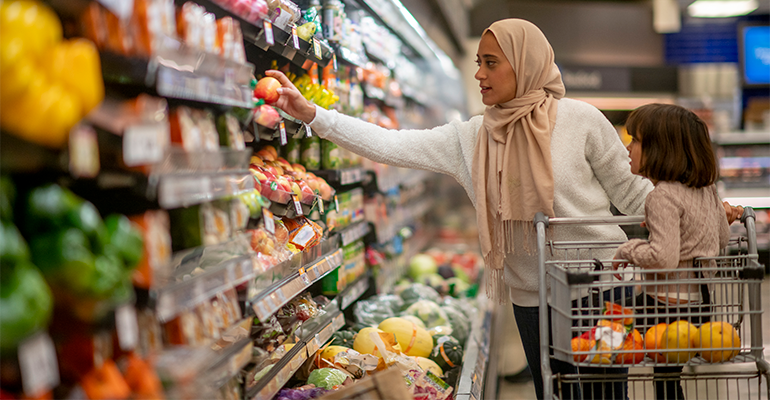
Tessa Wiles, Content Editor - Food 31 Aug 2026Britain was the only country to record grocery inflation above 2%, according to NielsenIQ data that compared Europe’s five biggest grocery markets from February to May 2026.
Of the five markets tracked in NielsenIQ’s August 2026 report, NIQ EU5 Inflation Barometer – France, Great Britain, Germany, Italy, and Spain – Great Britain recorded fast-moving consumer goods (FMCG) inflation of 2.3% over the 13 weeks to 24 May 2026, compared to the same period a year prior.
At a glance:
- Confectionery and snacks was the only category to rise in price consistently across the five markets.
- Over the period of analysis, British shoppers purchased 0.9% less, while French and Spanish shoppers bought more.
- Shoppers across all markets traded up to higher-value brands, as opposed to opting for supermarkets' own brands.
This puts the country as the only market of the five above 2%, and above the market average of 1.1%. Britain was followed by Germany (1.3%), Spain (1.2%), and Italy (0.6%). On the other end of the spectrum, France alone experienced deflation of -0.4%.
“Great Britain remains the clear outlier, with FMCG inflation holding above 2%, while France has moved back into deflationary territory,” Benjamin Cawthray, client director at NielsenIQ said in a press release.
British grocery price rises: Non-alcoholic drinks lead
Food (2.3%) and beverage (3.4%) prices inflated in Britain, with non-alcoholic beverages leading at 4.4%. Healthcare followed closely behind at 2.9%, confectionery and snacks at 2.8%, and frozen food at 2.7%.
In the other markets, prices moved in different directions, suggesting that ingredient costs alone were not responsible for the rise in Britain.
Confectionery and snacks in Germany rose 4.7% and non-alcoholic beverages fell 2.3%. Yet in Britain, non-alcoholic beverages rose 4.4%.
Confectionery and snacks were the only category that rose across the five markets.
Which grocery categories can take a price increase in Britain?
NielsenIQ’s modelling puts alcoholic beverages as the most price-sensitive category in Britain, and by some distance – with a 1% rise cutting sales by around 2.5%. Homecare, frozen food, and confectionery follow, while healthcare and pet care are the least sensitive categories.
“Consumers are less willing to bear a price increase for categories such as alcohol or homecare products, while healthcare, cosmetic, and baby care can be more aggressive with their price positioning,” the NielsenIQ report authors wrote.
As such, two of the categories carrying the largest increases in Britain – frozen food and confectionery – are those that shoppers drop the fastest.
There is a caveat to this, though, and in some cases, it can work the other way. For example, a 10% discount on alcoholic beverages led to a 33% increase in sales, suggesting that the categories where price rises cause shoppers to avoid are the same ones where a discount brings them back.
The impact of inflation in certain categories and shoppers' responses is also markedly different across markets.
“Italy shows higher overall price sensitivity than other European markets, making price increases particularly challenging outside of healthcare,” the report authors wrote.
For example, in Italy a 1% price rise in the frozen food category resulted in a 2.2% loss of sales, compared to a 1.7% loss in Britain.
Germany was the only market where alcohol was not the category shoppers dropped first when prices were raised; pet food was.
British shoppers buy fewer groceries but more expensive brands
Over the period of analysis, British shoppers spent 2.5% more on groceries. However, almost all of that was due to higher prices, not more items purchased.
In fact, they purchased 0.9% less, which was the largest drop across all five markets. Spanish shoppers bought 3.3% more, while French shoppers bought 1.9% more.
One thing shoppers in Britain did not do was switch to supermarkets' own brands. Own labels, in fact, barely moved, taking just 0.1% off British spending growth, while moving to higher-value brands added 0.7%.
Shoppers in the other four markets leaned the same way, with trading up at 1.7% in Spain, 1.4% in Italy, 0.5% in France, and 0.4% in Germany.

Get more of our news on Google
Set Ingredients Network as a 'Preferred Source' to get quicker access to the news you value.
Related news

Do the US dietary guidelines put UPFs under pressure?
10 Sep 2026
Will the US dietary guidelines change the way Americans eat, swapping ultra-processed foods for whole foods? We asked Dr Barry Popkin, renowned nutrition and obesity researcher.
Read more
Food fraud costs UK economy £2bn each year
9 Sep 2026
Food fraud is costing the UK economy up to £2 billion (€2.3 billion) every year although the food sector is more “resilient” than others, according to a recent study.
Read more
Kellogg accelerates work to remove artificial colours from all US cereals
3 Sep 2026
WK Kellogg has announced an accelerated timeline to eliminate all artificial colours and the chemical preservative, BHT, across its full US portfolio of cereals and cereal packaging.
Read more
Skimpflation: An ‘unfair’ and risky approach to keeping prices low
2 Sep 2026
Consumers see skimpflation – reducing the quality of ingredients due to rising costs – as more unfair than shrinkflation, making it a risky strategy according to recent research.
Read more
‘Urgent gaps’ in achieving 2030 food system goals
27 Aug 2026
Global food systems are failing to meet 2030 targets across indicators including health, environment, and resilience, according to a report co-authored by the Food and Agriculture Organisation (FAO).
Read more
Chimac’s fusion sauces bring Korean flavours to Europe
25 Aug 2026
Irish sauce brand Chimac is tapping into Korea’s culinary traditions, bringing its flavours and products to European consumers who want a taste of K-food.
Read more
Global demand for instant noodles continues to rise
24 Aug 2026
Global demand for instant noodles reached 124.21 billion servings last year, representing a 0.7% year-on-year increase – or 900 million extra servings.
Read more
Popular barbecue staples experience sharp price increases
19 Aug 2026
The typical cost of US shoppers’ barbecue baskets has risen by 12% over the past year – the fastest annual rise in a decade, figures from The Economist show.
Read more
Hot NPD: Nissin launches first cold-water Cup Noodles
18 Aug 2026
Nissin is taking one of Japan’s most iconic instant meals in a completely new direction with the launch of the first cold water-only Cup Noodles in the brand’s 55-year history.
Read more
Savoury protein snacks shake up the on-the-go market
10 Aug 2026
Sweet flavours have dominated the high-protein snack category but savoury snacks, such as cheese bars and meat sticks, can appeal to health-conscious consumers.
Read more