
Ingredients Categories
Finished Products
Finished Food Categories
- Bakery
- Beverages / Juices
- Cereal and grain products
- Confectionery
- Cooking Fats & Oils
- Dairy
- Egg products
- Fruits & Vegetables
- Infant & Baby food
- Meat, Poultry & Fish
- Nuts & Seeds products
- Other Finished Food Categories
- Pet Food
- Plant-based foods
- Prepared foods
- Sauces & Seasonings
- Sweet & Savoury Spreads
Specialised Finished Products
- Bee products
- Biotic products
- Dietary supplements
- Energy drinks
- Functional beverages
- Functional confectionery
- Functional food
- Functional powders
- Meal replacement products
- Nutricosmetics
- Other Specialised Finished Products
- Pet Dietary Supplements
- Pharma and OTC products
- Protein products
- Sugar replacers / Sweeteners
Health & Wellness Areas
Delivery Formats
Operations & Services
- 3D printing
- Analysis/ Testing
- Auditing & certifications
- Blending & mixing
- Bottling
- Certification
- Clinical trials
- Co-packing
- Coating
- Consulting
- Contract manufacturing
- Drying
- Electrospinning
- Encapsulating
- Enzymatic processing
- Extracting
- Extrusion
- Fat structuring
- Fermentation
- Filling
- Flavour development
- Freeze drying
- Granulating/ grinding/ milling / mixing
- High-pressure processing
- Labelling
- Other Operations & Services
- Packaging
- Packet filling
- Pasturising
- Quality assurance
- Saccharification
- Shear cell processing
- Spray drying
- Sterilisation
- Storage & Logistics
- Tabletting
- Toasting / roasting
- Ultra-high temperature processing
News
Jelly Drops made of 95% water tackle dehydration among seniors
Niamh Michail, Head of Publishing 27 Feb 2024Specialised nutrition startup Jelly Drops makes small jelly drops that contain 95% water and added electrolytes and vitamins to combat dehydration among elderly people and those with dementia who often forget to drink– a common yet previously underserved problem, it says.
Founder and CEO of the UK company Lewis Hornby came up with the idea for the product after his grandmother Pat, who had dementia, was struggling to stay hydrated. He spent 18 months developing and testing the product in close consultation with doctors and speech and language therapists before it launched.
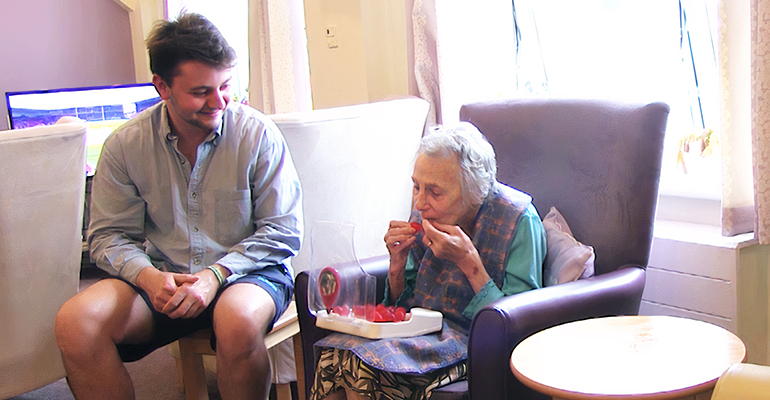
The jelly drops are made from 95% water and are flavoured with natural fruit flavourings and colours and sweetened with sucralose.
“We wanted the product to be sugar-free as oral hygiene is also a key consideration,” Hornby told Ingredients Network. “We found sucralose to be the best sweetener to produce a delicious product – this is key to user engagement.”
Jelly Drops recently began fortifying its drops with electrolytes and vitamins B6, B9, and B12, which allows the company to make a number of health claims: these nutrients contribute to normal cognitive and mental performance and help maintain a normally functioning immune system.
According to the company, the product effectively tackles a major struggle of those living with dementia and their carers; the website lists reviews from relatives and carers who describe how the product has reduced the need for hospitalisation due to severe dehydration or the use of expensive IV drips in the home.
Designed to reduce dehydration among those with dementia
There are a number of reasons why elderly people may not stay sufficiently hydrated, such as an inability to hold cups or not equating the feeling of thirst with drinking.
To combat this, Jelly Drops’ small format and vibrant colours are designed to appeal to people living with dementia. The drops have a solid texture that is similar to trifle jelly and they are very easy to chew, unlike other jelly-type sweets such as jelly beans or wine gums. (They are not recommended for people who have difficulties swallowing). One pack of six drops contains 300 ml of water.
The startup has both a consumer-facing range available to buy via its online shop and it delivers throughout the UK, US, and Canada, with plans to launch in other European countries in 2024. It also has a B2B range and supplies bulk orders to businesses in the health and care sectors, such as care homes and hospitals.
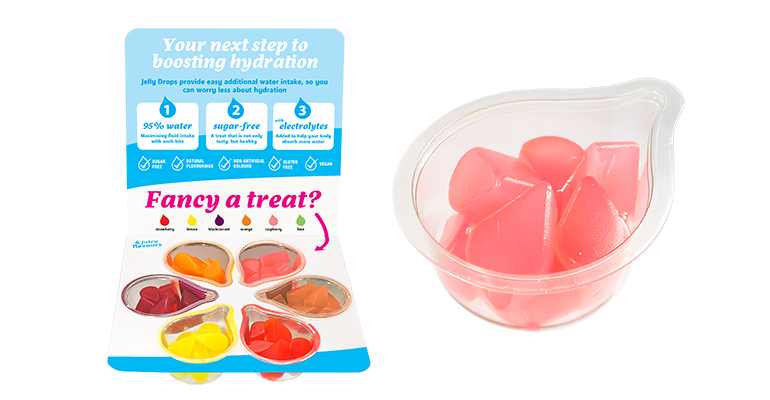 © Jelly Drop
“They come in a range of bright, eye-catching colours and are presented in a uniquely designed transparent container, which help the sweets attract attention from people with dementia, who may otherwise forget about them,” says the company.
“Both the innovative packaging and the shape of the sweets themselves, allow them to be easily accessible, even for those who are less dexterous.”
The company, which first launched Jelly Drops in the UK in 2020, has won a number of awards for the product, including from the Meaning-Centred Design Awards, National Dementia Care Awards, Imagine If Innovation Forum, and the Stephen Lloyd Awards, which support community interest companies. The company also donates 1% of profits from every box sold to the Alzheimer’s Society.
Jelly Drops’ full ingredient list is: water (95%), maltodextrin, gelling agents (gellan gum, xanthan gum, locust bean gum, acacia gum, agar), sodium citrate, sodium chloride, potassium chloride, natural flavourings, colours (curcumin, concentrated carrot extract), flavour enhancers (lactic acid, malic acid, citric acid), sweetener (sucralose), preservatives (potassium sorbate, sodium benzoate), vitamin b6 (pyridoxine hydrochloride), folic acid, vitamin b12 (cyanocobalamin).

Get more of our news on Google
Set Ingredients Network as a 'Preferred Source' to get quicker access to the news you value.
Related news

Do the US dietary guidelines put UPFs under pressure?
10 Sep 2026
Will the US dietary guidelines change the way Americans eat, swapping ultra-processed foods for whole foods? We asked Dr Barry Popkin, renowned nutrition and obesity researcher.
Read more
Food fraud costs UK economy £2bn each year
9 Sep 2026
Food fraud is costing the UK economy up to £2 billion (€2.3 billion) every year although the food sector is more “resilient” than others, according to a recent study.
Read more
Skimpflation: An ‘unfair’ and risky approach to keeping prices low
2 Sep 2026
Consumers see skimpflation – reducing the quality of ingredients due to rising costs – as more unfair than shrinkflation, making it a risky strategy according to recent research.
Read more
NielsenIQ’s EU barometer shows Britain leading in grocery inflation
31 Aug 2026
Britain was the only country to record grocery inflation above 2%, according to NielsenIQ data that compared Europe’s five biggest grocery markets from February to May 2026.
Read more
‘Urgent gaps’ in achieving 2030 food system goals
27 Aug 2026
Global food systems are failing to meet 2030 targets across indicators including health, environment, and resilience, according to a report co-authored by the Food and Agriculture Organisation (FAO).
Read more
China beverages: Is herbal innovation the future?
20 Aug 2026
Herbal and botanical innovation in China's drinks market continues to grow, with ingredients like astragalus root, ginger, and ginseng in the spotlight – and focus shifting far beyond refreshment.
Read more
Popular barbecue staples experience sharp price increases
19 Aug 2026
The typical cost of US shoppers’ barbecue baskets has risen by 12% over the past year – the fastest annual rise in a decade, figures from The Economist show.
Read more
Beyond 'nice to have': A spotlight on US functional beverages
12 Aug 2026
Functional beverage interest in the US is gaining important ground as consumers now expect function rather than see it as "nice to have", and there are clear market gaps for growth, according to Spate.
Read more
Manam Chocolate aims to bring premium Indian cacao to 'the world stage'
11 Aug 2026
Craft chocolate brand Manam Chocolate is investing in local expansion and supply chain innovation throughout India as it works to build out the premium reputation of its locally produced cacao products.
Read more
Digital twin technology gains ground in food manufacturing
6 Aug 2026
Food and beverage companies are increasingly turning to digital twins to optimise and automate manufacturing processes, but opportunities stretch far beyond this, say experts.
Read more