
Ingredients Categories
Finished Products
Finished Food Categories
- Bakery
- Beverages / Juices
- Cereal and grain products
- Confectionery
- Cooking Fats & Oils
- Dairy
- Egg products
- Fruits & Vegetables
- Infant & Baby food
- Meat, Poultry & Fish
- Nuts & Seeds products
- Other Finished Food Categories
- Pet Food
- Plant-based foods
- Prepared foods
- Sauces & Seasonings
- Sweet & Savoury Spreads
Specialised Finished Products
- Bee products
- Biotic products
- Dietary supplements
- Energy drinks
- Functional beverages
- Functional confectionery
- Functional food
- Functional powders
- Meal replacement products
- Nutricosmetics
- Other Specialised Finished Products
- Pet Dietary Supplements
- Pharma and OTC products
- Protein products
- Sugar replacers / Sweeteners
Health & Wellness Areas
Delivery Formats
Operations & Services
- 3D printing
- Analysis/ Testing
- Auditing & certifications
- Blending & mixing
- Bottling
- Certification
- Clinical trials
- Co-packing
- Coating
- Consulting
- Contract manufacturing
- Drying
- Electrospinning
- Encapsulating
- Enzymatic processing
- Extracting
- Extrusion
- Fat structuring
- Fermentation
- Filling
- Flavour development
- Freeze drying
- Granulating/ grinding/ milling / mixing
- High-pressure processing
- Labelling
- Other Operations & Services
- Packaging
- Packet filling
- Pasturising
- Quality assurance
- Saccharification
- Shear cell processing
- Spray drying
- Sterilisation
- Storage & Logistics
- Tabletting
- Toasting / roasting
- Ultra-high temperature processing
Sponsored Content
Choose delicious and versatile US peanut ingredients
15 Oct 2025The US supplies high quality, great tasting peanuts in a wide range of forms, from inshells or whole kernels, through to granulated peanuts, peanut butters, pastes, flours, oils and extract.
High quality, consistent flavour and texture are the hallmarks of peanuts grown in the USA. Universally eaten as great tasting snacks, peanuts can offer so much more. Open your eyes to the almost endless usage opportunities provided by peanut ingredients for the food manufacturing, beverage, and pet food industries.
Delicious, nutritious, sustainable, and versatile
Whether you’re producing sweet or savoury items, meat, fish, vegetarian or vegan products, food or drink, there’s a peanut ingredient for you. A nutrient dense source of plant protein containing predominantly unsaturated fat and fibre, peanuts can be included in multiple eating patterns. Their low-carbohydrate content is suitable for people following keto or low-carb lifestyles and their low glycaemic index makes them a good product for diabetics.
Delivering value as a complementary ingredient in multiple product applications and formulations, peanuts tick many boxes that are relevant for food and drink manufacturers interested in developing on-trend products appealing to diverse and evolving consumer preferences. Peanut ingredients can help you meet the growing demand for plant-based foods with clean label solutions that are non-GMO, sustainable and with organic options.
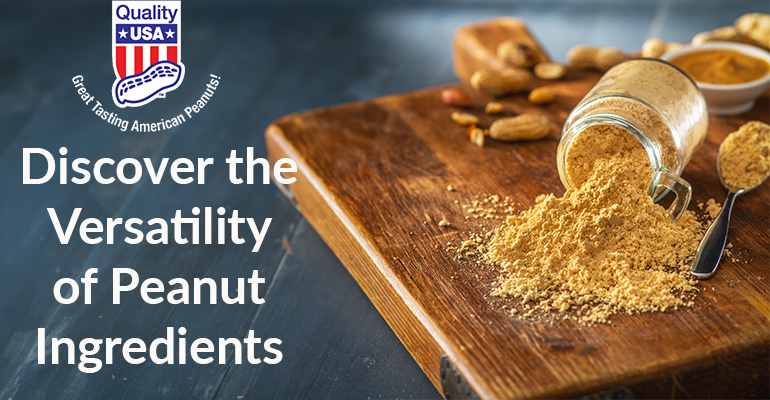
Peanut flours – available at 12% or 28% fat levels and at different roast levels – are used across a wide range of food and drinks including baked goods, confectionery, diet and nutrition bars, sauces, ice creams, beverages, and pet treats. Peanut flour binds fats in confections and baked goods, and offers a lower fat alternative to whole peanuts. The right combination of fat/protein and roast level will help you achieve the desired nutrition and flavour attributes.
If you’re looking for a robust peanut flavour and aroma, you should consider roasted peanut oil or extract. Peanut oil is a high-quality, trans-fat-free alternative for cooking oils. It adds natural peanut flavour to salad dressings, soups, bars and even frozen dairy desserts. Produced by mechanically pressing dark roasted peanuts, peanut extract is an all-natural, solvent-free product with a clean label. Typically used at a rate of 2% to 4%, it offers a cost-efficient option for bars, baked goods, confections, cereals, dressings, and more.
Needing extra texture or crunch? Roasted peanut granules or splits are excellent for use as toppings for baked goods, salads, ice creams, and more, while providing texture and taste inside biscuits and confectionery. Of course, peanuts pair perfectly with chocolate, a winning combination for consumers.
We can’t talk about peanuts without mentioning peanut butter. Available either as 100% ground peanuts, or with a little salt, sugar or vegetable oil added, peanut butters or pastes are ideal ingredients to provide that delicious peanut experience. Already widely used in confectionery, cereals, bakery, sauces, stews, curries, ice creams, cookies/biscuits, snack bars, and pet food, we’re sure there are other categories that can benefit by their use.
Are you focusing on sustainability? Did you know that peanuts have a great sustainability story to tell? Not only are peanuts a zero-waste crop, but they also come from a nitrogen fixing plant, which replenishes the nutrients depleted by other crops, resulting in less fertiliser and pesticide usage to grow the crop. Did we mention water usage? We should, as peanuts need significantly less water to grow than tree nuts or other protein sources. Through decades of sound stewardship, the US peanut industry has accomplished an average water consumption of 3.2 gallons per ounce of peanuts grown. Further, peanut farmers have cut greenhouse gas emissions in half during the last two decades. Affordable, delicious, nutritious, versatile AND sustainable – what more could your consumers want?
So now you’ve read a little about peanuts and their ingredients, are you ready to dip in and do some R&D? Reach out to us at [email protected] and we’ll connect you to the suppliers – or better still, come and talk to us at Food ingredients Europe 2025 in Paris. Tell us your needs and we’ll match you to the right ingredient. Visit the American Peanut Council (APC) at Fi Europe – held in Paris from 2-4 December 2025. You’ll find us on stand #72D39 in the USA pavilion.
Sponsored by:

This piece of content is provided by an advertiser or created on behalf of an advertiser. The views or opinions expressed in this piece of content do not reflect those of Informa.
Companies mentioned


Get more of our news on Google
Set Ingredients Network as a 'Preferred Source' to get quicker access to the news you value.
Related news

Kellogg accelerates work to remove artificial colours from all US cereals
3 Sep 2026
WK Kellogg has announced an accelerated timeline to eliminate all artificial colours and the chemical preservative, BHT, across its full US portfolio of cereals and cereal packaging.
Read more
Skimpflation: An ‘unfair’ and risky approach to keeping prices low
2 Sep 2026
Consumers see skimpflation – reducing the quality of ingredients due to rising costs – as more unfair than shrinkflation, making it a risky strategy according to recent research.
Read more
NielsenIQ’s EU barometer shows Britain leading in grocery inflation
31 Aug 2026
Britain was the only country to record grocery inflation above 2%, according to NielsenIQ data that compared Europe’s five biggest grocery markets from February to May 2026.
Read more
‘Urgent gaps’ in achieving 2030 food system goals
27 Aug 2026
Global food systems are failing to meet 2030 targets across indicators including health, environment, and resilience, according to a report co-authored by the Food and Agriculture Organisation (FAO).
Read more
Chimac’s fusion sauces bring Korean flavours to Europe
25 Aug 2026
Irish sauce brand Chimac is tapping into Korea’s culinary traditions, bringing its flavours and products to European consumers who want a taste of K-food.
Read more
Global demand for instant noodles continues to rise
24 Aug 2026
Global demand for instant noodles reached 124.21 billion servings last year, representing a 0.7% year-on-year increase – or 900 million extra servings.
Read more
Popular barbecue staples experience sharp price increases
19 Aug 2026
The typical cost of US shoppers’ barbecue baskets has risen by 12% over the past year – the fastest annual rise in a decade, figures from The Economist show.
Read more
Hot NPD: Nissin launches first cold-water Cup Noodles
18 Aug 2026
Nissin is taking one of Japan’s most iconic instant meals in a completely new direction with the launch of the first cold water-only Cup Noodles in the brand’s 55-year history.
Read more
Savoury protein snacks shake up the on-the-go market
10 Aug 2026
Sweet flavours have dominated the high-protein snack category but savoury snacks, such as cheese bars and meat sticks, can appeal to health-conscious consumers.
Read more
Digital twin technology gains ground in food manufacturing
6 Aug 2026
Food and beverage companies are increasingly turning to digital twins to optimise and automate manufacturing processes, but opportunities stretch far beyond this, say experts.
Read more