
Ingredients Categories
Finished Products
Finished Food Categories
- Bakery
- Beverages / Juices
- Cereal and grain products
- Confectionery
- Cooking Fats & Oils
- Dairy
- Egg products
- Fruits & Vegetables
- Infant & Baby food
- Meat, Poultry & Fish
- Nuts & Seeds products
- Other Finished Food Categories
- Pet Food
- Plant-based foods
- Prepared foods
- Sauces & Seasonings
- Sweet & Savoury Spreads
Specialised Finished Products
- Bee products
- Biotic products
- Dietary supplements
- Energy drinks
- Functional beverages
- Functional confectionery
- Functional food
- Functional powders
- Meal replacement products
- Nutricosmetics
- Other Specialised Finished Products
- Pet Dietary Supplements
- Pharma and OTC products
- Protein products
- Sugar replacers / Sweeteners
Health & Wellness Areas
Delivery Formats
Operations & Services
- 3D printing
- Analysis/ Testing
- Auditing & certifications
- Blending & mixing
- Bottling
- Certification
- Clinical trials
- Co-packing
- Coating
- Consulting
- Contract manufacturing
- Drying
- Electrospinning
- Encapsulating
- Enzymatic processing
- Extracting
- Extrusion
- Fat structuring
- Fermentation
- Filling
- Flavour development
- Freeze drying
- Granulating/ grinding/ milling / mixing
- High-pressure processing
- Labelling
- Other Operations & Services
- Packaging
- Packet filling
- Pasturising
- Quality assurance
- Saccharification
- Shear cell processing
- Spray drying
- Sterilisation
- Storage & Logistics
- Tabletting
- Toasting / roasting
- Ultra-high temperature processing
News
Editors’ choice: Our roundup of the most innovative global dairy products
6 Oct 2022
From omega-3 goat milk in the Netherlands to banana-flavoured cheese from China, the global dairy space is an exciting area full of new and innovative products which are constantly changing perceptions in the sector.
The products below were cited during the Dairy and Dairy Alternatives Deep Dive Day, held as part of the Fi Webinar Series, and include milk waste transformed into PHA bioplastic, fermented drinking milk, vanilla flavoured omega goat milk, organic drinking kefir and banana ice cream flavoured cheese sticks.
Let’s take a closer look…
Venvirotech milk PHA bioplastic
Venvirotech is using bacteria to transform organic waste materials into a type of bioplastic called PHA. The Spanish startup is currently working with Pascual Dairy to transform milk waste into PHA bioplastic that will then be used for dairy products. It is sustainable and non-toxic, according to the startup.
PHA bioplastic is completely organic, it biodegrades in the environment in six to nine months and has the same properties as common plastics, which means it can be mass-produced and used as a functional alternative.
“Plastic waste is obviously a disaster for the environment and the dairy sector is very dependent on plastic because its products are perishable and moist, so it’s great to see startups working to find solutions there,” said Niamh Michail, senior content editor at Fi Global.
Mimosa Eleva fermented drinking milk
Portuguese dairy manufacturer Lactogal recently launched a fermented drinking milk under its Mimosa Eleva brand. It contains both added probiotics and prebiotic fibre with inulin and amaranth to help with digestion, absorption of nutrients, and protection of the immune system with ‘all the benefits’ of natural yeast. The drinking milk is lactose-free and sweetened with stevia. It consists of two formats - liquid and spoonable.
The drinkable line-up includes – kiwi and strawberry; raspberry and apple; blueberry, goji, amaranth and almond; mango, carrot, quinoa and cinnamon. The spoonable variety includes – kiwi; peach, carrot, millet and red quinoa and raspberry, almond and flaxseeds.
“I think this really speaks to the current demand around gut health and dairy products are seen as quite a natural fit for ingredients that improve gut health because they are fermented,” said Niamh Michail, senior food editor at Fi Global.
Smart Goat vanilla flavoured multi omega goat milk
Made from natural goat milk in the Netherlands, Smart Goat’s vanilla flavoured omega milk contains fish oil, omegas-3, 6 and 9, and 15 types of vitamins and minerals to boost the immune system and maintain brain functions and strong bones.
Goat milk contains protein and fat making it “easy to digest and absorb”. Smart Goat is a brand under Thailand’s Healthsure Nutrition and is a Halal certified product.
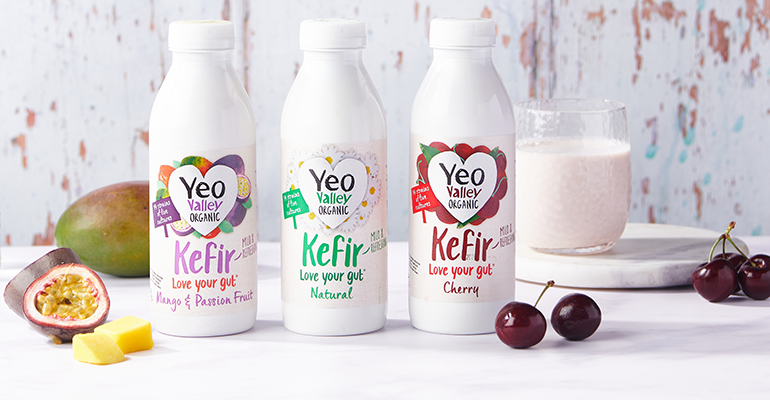
Yeo Valley organic drinking kefir
Kefir is a cultured, fermented drink made from kefir grains. UK dairy brand, Yeo Valley has just released drinkable kefir which the brand describes as “creamy, tangy and perfect for when you’re on the go”. The new kefir range is comprised of three flavours – natural, cherry and mango & passionfruit.
Content editor at Fi Global, Segi Adewusi, thought this was a particularly gut-friendly product, filled with 14 different live cultures and accessible to a wide range of consumers with busy lifestyles.
MilkFly banana ice cream flavoured cheese sticks
Milkfly, a brand under Chinese children’s food manufacturer Miaofei, develops cheese snacks specifically for children. The cheese sticks are made from milk powder imported from New Zealand. They come in a variety of newly upgraded flavours – original, strawberry, mixed fruit, and banana ice cream.
“In Asia, there has been a lot of innovation around flavours in cheese. In China, we saw banana ice cream flavoured cheese sticks from a brand called MilkFly, stir-fry chicken flavoured cheese in Japan, and a savoury snack in Korea that blended squid and cheese,” said Niamh Michail, senior food editor at Fi Global.
“The Asian region doesn’t have the same history of cheese-making as in Europe, for example, so consumers are happy to experiment with flavour combinations that would be quite unusual in other parts of the world, and brands are coming up with some novel flavour combinations to meet that demand,” she added.
Product information taken from Mintel’s Global New Product Database

Get more of our news on Google
Set Ingredients Network as a 'Preferred Source' to get quicker access to the news you value.
Related news

Skimpflation: An ‘unfair’ and risky approach to keeping prices low
2 Sep 2026
Consumers see skimpflation – reducing the quality of ingredients due to rising costs – as more unfair than shrinkflation, making it a risky strategy according to recent research.
Read more
NielsenIQ’s EU barometer shows Britain leading in grocery inflation
31 Aug 2026
Britain was the only country to record grocery inflation above 2%, according to NielsenIQ data that compared Europe’s five biggest grocery markets from February to May 2026.
Read more
‘Urgent gaps’ in achieving 2030 food system goals
27 Aug 2026
Global food systems are failing to meet 2030 targets across indicators including health, environment, and resilience, according to a report co-authored by the Food and Agriculture Organisation (FAO).
Read more
China beverages: Is herbal innovation the future?
20 Aug 2026
Herbal and botanical innovation in China's drinks market continues to grow, with ingredients like astragalus root, ginger, and ginseng in the spotlight – and focus shifting far beyond refreshment.
Read more
Popular barbecue staples experience sharp price increases
19 Aug 2026
The typical cost of US shoppers’ barbecue baskets has risen by 12% over the past year – the fastest annual rise in a decade, figures from The Economist show.
Read more
Beyond 'nice to have': A spotlight on US functional beverages
12 Aug 2026
Functional beverage interest in the US is gaining important ground as consumers now expect function rather than see it as "nice to have", and there are clear market gaps for growth, according to Spate.
Read more
Manam Chocolate aims to bring premium Indian cacao to 'the world stage'
11 Aug 2026
Craft chocolate brand Manam Chocolate is investing in local expansion and supply chain innovation throughout India as it works to build out the premium reputation of its locally produced cacao products.
Read more
Digital twin technology gains ground in food manufacturing
6 Aug 2026
Food and beverage companies are increasingly turning to digital twins to optimise and automate manufacturing processes, but opportunities stretch far beyond this, say experts.
Read more
How Secon Taste is putting upcycled snacks on shelves
4 Aug 2026
Hungarian zero-waste startup Secon Taste is turning surplus food into upcycled snacks such as fibre-packed granola, instant porridge, and a circular coffee-tasting box.
Read more
Codex sets global thresholds for ‘may contain’ labels
3 Aug 2026
Codex Alimentarius has adopted its first global guidance on when to use “may contain” allergen warnings, setting thresholds intended to stop the label being used as blanket legal cover.
Read more