
Ingredients Categories
Finished Products
Finished Food Categories
- Bakery
- Beverages / Juices
- Cereal and grain products
- Confectionery
- Cooking Fats & Oils
- Dairy
- Egg products
- Fruits & Vegetables
- Infant & Baby food
- Meat, Poultry & Fish
- Nuts & Seeds products
- Other Finished Food Categories
- Pet Food
- Plant-based foods
- Prepared foods
- Sauces & Seasonings
- Sweet & Savoury Spreads
Specialised Finished Products
- Bee products
- Biotic products
- Dietary supplements
- Energy drinks
- Functional beverages
- Functional confectionery
- Functional food
- Functional powders
- Meal replacement products
- Nutricosmetics
- Other Specialised Finished Products
- Pet Dietary Supplements
- Pharma and OTC products
- Protein products
- Sugar replacers / Sweeteners
Health & Wellness Areas
Delivery Formats
Operations & Services
- 3D printing
- Analysis/ Testing
- Auditing & certifications
- Blending & mixing
- Bottling
- Certification
- Clinical trials
- Co-packing
- Coating
- Consulting
- Contract manufacturing
- Drying
- Electrospinning
- Encapsulating
- Enzymatic processing
- Extracting
- Extrusion
- Fat structuring
- Fermentation
- Filling
- Flavour development
- Freeze drying
- Granulating/ grinding/ milling / mixing
- High-pressure processing
- Labelling
- Other Operations & Services
- Packaging
- Packet filling
- Pasturising
- Quality assurance
- Saccharification
- Shear cell processing
- Spray drying
- Sterilisation
- Storage & Logistics
- Tabletting
- Toasting / roasting
- Ultra-high temperature processing
News
Five trends shaping the future of ingredients
Tessa Wiles, Content Editor - Food 17 Feb 2026Euromonitor identifies five consumer demands forcing the industry to redesign products from the inside out in 2026.
Speaking at Fi Europe 2025, Ina Dawer, global insights manager at Euromonitor International, pointed to several macro-economic factors – including declining fertility and population growth, alongside slowing Gross Domestic Product (GDP) in many regions – as contributing to this shift in consumer priorities.
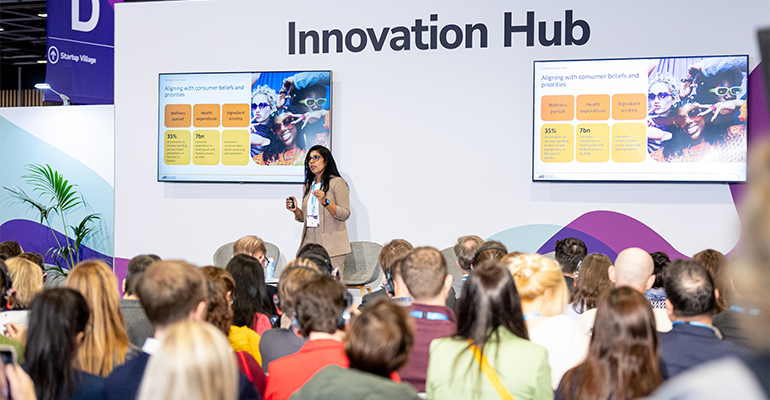
Dawer explained that priorities are moving toward health as a “non-negotiable”, with one in three willing to spend more on wellness despite economic pressures.
Nutrition is also increasingly being viewed as a way to support health from a preventive standpoint, rather than acting as a remedy, which she said is forcing companies to be “intentional [and] purpose-driven in their formulations”.
To succeed in this changing landscape, Dawer outlined five key trends the industry will need to navigate, based on analysis from Euromonitor International.
# 1: Multifunctionality and ‘hero ingredients’
Consumers “chasing single health goals” like immunity or gut health in isolation is something we will be seeing less of going forward, Dawer said.
Instead, consumers are seeking both ingredients that stack connected and layered benefits, and ones that simultaneously address physical, mental, and aesthetic wellbeing.
Protein was highlighted as an example of this evolution, having expanded from its traditional association with muscle maintenance to a “holistic wellbeing ingredient” that influences everything from metabolism and weight loss to supporting life stages such as menopause.
Other ingredient categories like nootropics and adaptogens are also being explored for their ability to blend physical, mental, and aesthetic wellbeing into a single experience.
# 2: Reduction, reformulation, and the prioritisation of nutrient density
Reformulation strategies are also changing.
In the past, efforts focused largely on reducing sugar, fat, or salt. Now, in the GLP-1 era, Dawer said reformulation focuses have shifted to properties like nutrition density and calorie efficiency.
To achieve this, manufacturers are increasingly turning to fermentation-based technologies, including microbial fermentation, enzymatic bioconversion, and precision fermentation, to enhance nutritional profiles without compromising portion sizes.
Dawer cited Danone’s Actimel brand as an example of microbial fermentation. The prebiotic dairy product is created using a controlled and slow microbial fermentation process, which allows the microbes more time to fully break down substrates and develop more complex flavours, as compared to faster fermentation that focuses on efficiency.
Enzymatic bioconversion, a technology that uses enzymes to convert organic materials into high-quality products, is another strategy companies are employing to improve the nutritional profile of their products. Dawer pointed to Nestlé as an example. The company applies the technology across dairy and plant-based applications to reduce sugar and lactose and improve protein digestibility. In 2023, Nestlé patented an enzymatic technology that it claims reduces intrinsic sugar in fruit juice, milk, and malt by up to 30%.
# 3: Clean label and evolving consumer expectations
As reformulation technologies gain ground and become more engineered, consumer perceptions around ultra-processed and what constitutes “clean label” are also shifting, Dawer said.
She outlined “six key pillars” or lenses through which consumers assess clean label products: authenticity, transparency, safety, simplicity, efficacy, and balance.
However, what consumers perceive as “good” changes depending on the category.
“For ready meals, it’s about the usage of whole foods, [...] but for beverages we are starting to see clean caffeine as a trend, where ingredients like magnesium are starting to deliver less jittery energy,” she said.
“This puts a lot of pressure again on manufacturers to think about how [they are] going to deliver these clean labels, and what a lot of companies end up doing is they fall into this trap of oversimplification.”
Rather than aiming for the shortest ingredient list possible, she said brands should focus on purposeful ingredient inclusion.
Dawer added that instead of oversimplifying formulations, brands should focus on transparent communication, pointing to Oatly, the plant-based oat drink brand, and its positioning that it is “like milk, but made for humans”.
# 4: Authenticity and science-backed proof
Rising levels of what Dawer described as “claim fatigue” mean consumers are increasingly seeking “truth” and “authenticity” backed by scientific data.
This is particularly true for millennials and gen Z, who view health from both a scientific and “spiritual” lens, often taking supplements and using trackers to measure progress.
For brands, Dawer said, this places a greater emphasis on substantiation. Marketing alone is no longer sufficient; consumers expect tangible evidence of efficacy.
“Trust is not going to come from marketing,” Dawer said. Companies must make “authenticity operational by connecting the lab with the labour and the lived experience”.
# 5: Sensorial wellness
Dawer identified that consumers today are “overstimulated, fatigued, emotionally scattered”, and are seeking “escapable” and indulgent experiences [such as] “things that they can feel through the sensorial cues of texture, mouth, feel, colour, flavour, and so on”.
However, she added that functional benefits must now be paired with “sensorial cues” that allow consumers to feel the product working. But this comes with a caveat: functionality cannot come at the expense of taste.
As an example, she referenced PepsiCo’s 2020 launch of Driftwell, a functional water line with ingredients like chamomile, lavender, magnesium, and L-theanine.
“PepsiCo had to withdraw that product from the market because the taste wasn't really welcomed by consumers,” she said.
Ultimately, “what they are really looking for is not just visible results anymore. They want to be able to feel those results”.
Looking ahead, she said, successful ingredient innovation will depend on products that are not just formulated, but “designed” for a total experience.

Get more of our news on Google
Set Ingredients Network as a 'Preferred Source' to get quicker access to the news you value.
Related news

M&S launches own-brand pet food range
11 Sep 2026
UK retailer Marks & Spencer has launched its own-brand pet food line Paws & Pals – a well-timed and strategic move that will appeal to loyal shoppers, says a marketing expert.
Read more
Do the US dietary guidelines put UPFs under pressure?
10 Sep 2026
Will the US dietary guidelines change the way Americans eat, swapping ultra-processed foods for whole foods? We asked Dr Barry Popkin, renowned nutrition and obesity researcher.
Read more
Food fraud costs UK economy £2bn each year
9 Sep 2026
Food fraud is costing the UK economy up to £2 billion (€2.3 billion) every year although the food sector is more “resilient” than others, according to a recent study.
Read more
Kellogg accelerates work to remove artificial colours from all US cereals
3 Sep 2026
WK Kellogg has announced an accelerated timeline to eliminate all artificial colours and the chemical preservative, BHT, across its full US portfolio of cereals and cereal packaging.
Read more
‘Urgent gaps’ in achieving 2030 food system goals
27 Aug 2026
Global food systems are failing to meet 2030 targets across indicators including health, environment, and resilience, according to a report co-authored by the Food and Agriculture Organisation (FAO).
Read more
Chimac’s fusion sauces bring Korean flavours to Europe
25 Aug 2026
Irish sauce brand Chimac is tapping into Korea’s culinary traditions, bringing its flavours and products to European consumers who want a taste of K-food.
Read more
Savoury protein snacks shake up the on-the-go market
10 Aug 2026
Sweet flavours have dominated the high-protein snack category but savoury snacks, such as cheese bars and meat sticks, can appeal to health-conscious consumers.
Read more
Nestlé invests in regeneratively farmed wheat for KitKat
5 Aug 2026
Nestlé will pay a premium for Wildfarmed’s regeneratively farmed wheat but the CPG remains reticent to promote the move on packs of its KitKat bars.
Read more
How Secon Taste is putting upcycled snacks on shelves
4 Aug 2026
Hungarian zero-waste startup Secon Taste is turning surplus food into upcycled snacks such as fibre-packed granola, instant porridge, and a circular coffee-tasting box.
Read more
Codex sets global thresholds for ‘may contain’ labels
3 Aug 2026
Codex Alimentarius has adopted its first global guidance on when to use “may contain” allergen warnings, setting thresholds intended to stop the label being used as blanket legal cover.
Read more