
Ingredients Categories
Finished Products
Finished Food Categories
- Bakery
- Beverages / Juices
- Cereal and grain products
- Confectionery
- Cooking Fats & Oils
- Dairy
- Egg products
- Fruits & Vegetables
- Infant & Baby food
- Meat, Poultry & Fish
- Nuts & Seeds products
- Other Finished Food Categories
- Pet Food
- Plant-based foods
- Prepared foods
- Sauces & Seasonings
- Sweet & Savoury Spreads
Specialised Finished Products
- Bee products
- Biotic products
- Dietary supplements
- Energy drinks
- Functional beverages
- Functional confectionery
- Functional food
- Functional powders
- Meal replacement products
- Nutricosmetics
- Other Specialised Finished Products
- Pet Dietary Supplements
- Pharma and OTC products
- Protein products
- Sugar replacers / Sweeteners
Health & Wellness Areas
Delivery Formats
Operations & Services
- 3D printing
- Analysis/ Testing
- Auditing & certifications
- Blending & mixing
- Bottling
- Certification
- Clinical trials
- Co-packing
- Coating
- Consulting
- Contract manufacturing
- Drying
- Electrospinning
- Encapsulating
- Enzymatic processing
- Extracting
- Extrusion
- Fat structuring
- Fermentation
- Filling
- Flavour development
- Freeze drying
- Granulating/ grinding/ milling / mixing
- High-pressure processing
- Labelling
- Other Operations & Services
- Packaging
- Packet filling
- Pasturising
- Quality assurance
- Saccharification
- Shear cell processing
- Spray drying
- Sterilisation
- Storage & Logistics
- Tabletting
- Toasting / roasting
- Ultra-high temperature processing
News
Oatly loses legal battle over ‘Post milk generation’ claim
David Burrows, Freelance Journalist 26 Mar 2026Oatly has lost a long legal battle with the UK dairy industry and cannot use the term “Post milk generation” in its marketing.
In February, the Supreme Court in the UK upheld the earlier decision of the Court of Appeal, confirming that Oatly’s trade mark “Post milk generation” contravened the rules protecting reserved dairy terms.
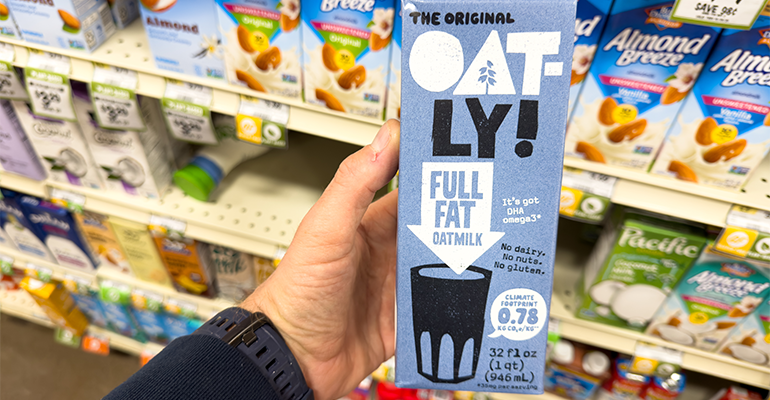
Dairy UK, which represents major dairy processors in the UK, said the decision “finally provides clarity on how dairy terms can – and cannot – be used in branding and marketing”.
The ruling came in the same week that the Swedish company announced its first fully profitable year.
“[...] today has also been a reminder of what we are up against,” said Bryan Carroll, general manager UK and Ireland at Oatly, of the ruling. “This is a clear move to stifle competition by Big Dairy,” he added.
Court case ruling explained
The decision has inevitably attracted a lot of attention, with much of the reporting focusing on whether consumers are actually confused by use of the term ‘milk’ on non-dairy products.
However, lawyers at DWF who advised Dairy UK during the proceedings told Ingredients Network that this case does not address confusion.
“The word ‘confusion’ appears zero times in the judgment,” said Dominic Watkins, global lead consumer sector, at DWF. “It was all a question of law,” he added.
The principal point, Watkins explained, is that the use of the term milk in law can only be used – whether in the name or any associated designation on the product – if the product meets the milk definition under EU law or falls into one of the exempted product types set out in the underlying regulations, which includes coconut milk.
Watkins added: “The issue was never one of confusion as the appeal concerns the proper interpretation of Parliament and Council Regulation (EU) No. 1308/2013 of 17 December 2013 establishing a common organisation of the markets in agricultural products (the ‘2013 Regulation’) that, amongst many other things, regulates the use of dairy terms, such as milk, cheese, and yoghurt, in relation to the marketing of agricultural products.”
Under Regulation (EU) 1308/2013, designations for milk and milk products are reserved exclusively for products derived from animal milk. So, the Supreme Court has now confirmed that ‘Post milk generation’ falls within the scope of that prohibition.
Oatly argued that the phrase wasn’t being used to name the product and therefore shouldn’t count as a prohibited ‘designation’.
As the market for dairy alternatives has grown, so too has the use of dairy denominations in product names.
Watkins said the fundamental question was whether the trade mark - Post milk generation - when applied to foods illegally used the word ‘milk’.
“This decision confirms that doing so is illegal,” Watkins explained. “It also confirms that it is OK to say 'milk-free' as it is permitted because it is clearly being used to describe a characteristic quality of the product – that it does not contain any milk.”
Maria O’Loan, head of the environment team at Tughans law firm, said the judgment “significantly strengthens regulatory protection of dairy designations and sends a clear message to plant-based brands: creative branding cannot sidestep statutory restrictions where consumer understanding is at stake.”
Alexander Grist from Britton & Time solicitors said: “The decision is a reminder that clever branding still operates within firm legal boundaries. Food labelling law is about fair competition as much as consumer protection, and when it comes to dairy terms, the courts are prepared to enforce the rules strictly.”
A blocker for plant-based innovation?
Whether the decision stifles innovation or restricts the growth of the dairy-free category remains to be seen.
Oatly’s Carroll used social media to highlight the latest UK Nielsen data showing that dairy drinks volume sales declined in the last year, whilst Oatly’s grew by 2.9%. “And in more recent time periods that is accelerating as new innovation and new formats attract new shoppers and more occasions,” he noted.
Carroll, referring to the latest financial results, said the company’s “taste-led strategy is working. 2025 saw the launch of our best-selling Matcha Latte which has catapulted to a category topper,” he explained. “Our growth is accelerating, with more and more people enjoying our delicious drinks in more occasions than ever before.”
Lottie Unwin, a brand and marketing expert, captured the zeitgeist of those who came out in support of Oatly when she wrote: “I care about British dairy farmers. The industry is struggling. That deserves real solutions. But banning competitors from using everyday language doesn't make people want dairy milk more.”

Get more of our news on Google
Set Ingredients Network as a 'Preferred Source' to get quicker access to the news you value.
Related news

Do the US dietary guidelines put UPFs under pressure?
10 Sep 2026
Will the US dietary guidelines change the way Americans eat, swapping ultra-processed foods for whole foods? We asked Dr Barry Popkin, renowned nutrition and obesity researcher.
Read more
Food fraud costs UK economy £2bn each year
9 Sep 2026
Food fraud is costing the UK economy up to £2 billion (€2.3 billion) every year although the food sector is more “resilient” than others, according to a recent study.
Read more
Skimpflation: An ‘unfair’ and risky approach to keeping prices low
2 Sep 2026
Consumers see skimpflation – reducing the quality of ingredients due to rising costs – as more unfair than shrinkflation, making it a risky strategy according to recent research.
Read more
NielsenIQ’s EU barometer shows Britain leading in grocery inflation
31 Aug 2026
Britain was the only country to record grocery inflation above 2%, according to NielsenIQ data that compared Europe’s five biggest grocery markets from February to May 2026.
Read more
‘Urgent gaps’ in achieving 2030 food system goals
27 Aug 2026
Global food systems are failing to meet 2030 targets across indicators including health, environment, and resilience, according to a report co-authored by the Food and Agriculture Organisation (FAO).
Read more
China beverages: Is herbal innovation the future?
20 Aug 2026
Herbal and botanical innovation in China's drinks market continues to grow, with ingredients like astragalus root, ginger, and ginseng in the spotlight – and focus shifting far beyond refreshment.
Read more
Popular barbecue staples experience sharp price increases
19 Aug 2026
The typical cost of US shoppers’ barbecue baskets has risen by 12% over the past year – the fastest annual rise in a decade, figures from The Economist show.
Read more
Beyond 'nice to have': A spotlight on US functional beverages
12 Aug 2026
Functional beverage interest in the US is gaining important ground as consumers now expect function rather than see it as "nice to have", and there are clear market gaps for growth, according to Spate.
Read more
Manam Chocolate aims to bring premium Indian cacao to 'the world stage'
11 Aug 2026
Craft chocolate brand Manam Chocolate is investing in local expansion and supply chain innovation throughout India as it works to build out the premium reputation of its locally produced cacao products.
Read more
Digital twin technology gains ground in food manufacturing
6 Aug 2026
Food and beverage companies are increasingly turning to digital twins to optimise and automate manufacturing processes, but opportunities stretch far beyond this, say experts.
Read more