
Ingredients Categories
Finished Products
Finished Food Categories
- Bakery
- Beverages / Juices
- Cereal and grain products
- Confectionery
- Cooking Fats & Oils
- Dairy
- Egg products
- Fruits & Vegetables
- Infant & Baby food
- Meat, Poultry & Fish
- Nuts & Seeds products
- Other Finished Food Categories
- Pet Food
- Plant-based foods
- Prepared foods
- Sauces & Seasonings
- Sweet & Savoury Spreads
Specialised Finished Products
- Bee products
- Biotic products
- Dietary supplements
- Energy drinks
- Functional beverages
- Functional confectionery
- Functional food
- Functional powders
- Meal replacement products
- Nutricosmetics
- Other Specialised Finished Products
- Pet Dietary Supplements
- Pharma and OTC products
- Protein products
- Sugar replacers / Sweeteners
Health & Wellness Areas
Delivery Formats
Operations & Services
- 3D printing
- Analysis/ Testing
- Auditing & certifications
- Blending & mixing
- Bottling
- Certification
- Clinical trials
- Co-packing
- Coating
- Consulting
- Contract manufacturing
- Drying
- Electrospinning
- Encapsulating
- Enzymatic processing
- Extracting
- Extrusion
- Fat structuring
- Fermentation
- Filling
- Flavour development
- Freeze drying
- Granulating/ grinding/ milling / mixing
- High-pressure processing
- Labelling
- Other Operations & Services
- Packaging
- Packet filling
- Pasturising
- Quality assurance
- Saccharification
- Shear cell processing
- Spray drying
- Sterilisation
- Storage & Logistics
- Tabletting
- Toasting / roasting
- Ultra-high temperature processing
News
Pink Albatross on getting the right formulation for clean label ice cream
Niamh Michail, Head of Publishing 27 Oct 2023
Plant-based ice cream brand Pink Albatross has made its clean label ingredient list a focal point of its branding and packaging. “We only use ingredients we can draw…. And it's quite difficult to draw methylcellulose or mono and di-glycerides of fatty acids,” it says.
Based in Madrid, Pink Albatross has become a market leader in the plant-based ice cream category in Spain, recently overtaking Ben & Jerry’s, according to co-founder of the company Jose Luis Biaggio.
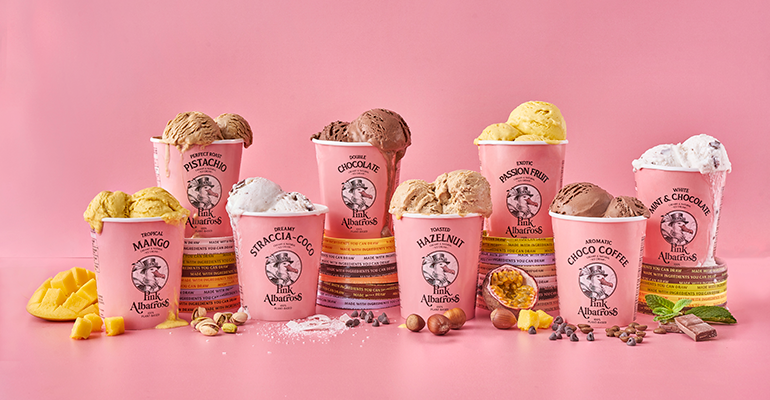
It is listed in a total of 1,500 supermarkets around Spain including Carrefour, Corte Ingles, and Costco, and is also present in Portugal and Germany. It expects to launch in Carrefour in France in the next few months.
The brand has eight flavours in its current range: chocolate & coffee; hazelnut; passionfruit; mango; coconut; chocolate; straccia-coco; mint & chocolate; and pistachio. In the coming months, it plans on launching chocolate covered ice cream lollies.
Biaggio told Ingredients Network the company is proud of its clean label ingredient list. “We only use ingredients that we can draw. You can draw a mango or a cashew nut. It's quite difficult to draw methylcellulose or mono and di-glycerides of fatty acids. Nobody knows what that is, however, they are quite common in the ice cream industry.”
The importance of having a clean label ingredient list was personal, the co-founder explained.
"One of my biggest pain points when I was looking for food for my daughter was going to the supermarket and having to check if the products were suitable,” Biaggio said. “And each time I thought, 'what is that ingredient?'. So that's why we dedicate about one-third of the pack just to telling people about the ingredients.”
Although required to list the ingredients in text form to comply with food labelling regulations, Pink Albatross also draws its ingredients in pictorial form.
"There is no definition of clean label so we tell you what it means,” Biaggio said. “We only use ingredients that have been obtained by mechanical force, heat, or fermentation. That's it. If there is anything else like solvents or chemicals, we are not going to use it.
"So, even the cocoa that we use is not Dutch cocoa because that is a chemical process that uses a solvent to bring the acidity level of the cocoa down. We don't use any Dutch processed cocoa.”
He added: “It is quite challenging to be our ingredient supplier!”
‘Optimised for pleasure, not nutrition’
The ingredient list of Pink Albatross’ pistachio ice cream is water, coconut milk, cashew nut paste, sugar, pistachio paste, coconut oil, vegetable gums, and salt. It uses sugar to sweeten its ice cream, which it describes as an indulgent product.
"We haven't optimised for nutrition, we've optimised for pleasure,” said Luke Saldanha, co-founder.
Saldanha added that the use of nut butters helped it achieve the creamy texture of dairy while reducing off flavours.
“The combination of cashew and coconut is like a canvas,” he said. “It absorbs flavour really well without giving off flavours as opposed to almond or soy-based ice cream that always has an aftertaste. We found in our research and product development that this combination of these two milks - cashew nut milk and coconut milk - helped us have that canvas. It also adds to the texture."
Reduced air content helps reduce need for additives
Artificial emulsifiers are often used in ice cream to ensure that it can be scooped straight from the freezer and does not form a solid, frozen block. How does Pink Albatross achieve this without the use of artificial emulsifiers or additives?
"It was challenging,” Biaggio said. “On the one end, it's [thanks to] the ingredients that we use and the calibre of the ingredients we use. Point number two is the recipe and the moment that the ingredients are added into the recipe. And point number three is very important: the manufacturing facility and how we use that facility. For example, we extract the product at a much lower temperature than normal so the air that we inject into the product stays in the product.
“Air is one of the key ingredients of ice cream,” he explained. “If you go to any supermarket brand and look at the size of the pack that you are going to buy, it's usually one litre. But if you look at the weight, it will be 500 grams. Half of what you're buying is air. People think, 'oh this is cheap!' Yes, well… you're not buying ice cream, you're buying air.
“What premium ice cream does is diminish the amount of air, so you have much more flavour in your mouth, it lasts longer in your mouth.”
Pink Albatross uses a relatively small amount of air – the product weighs 350 grams for 480 millilitres - gives it the mouthfeel and flavour punch it wants, Biaggio said.
Flavours inspired by ice cream parlours
The range of flavours it chose to offer also reflects the premium nature of the brand.
"Instead of going to see what [flavours] are on the shelf, we went to the ice cream parlours,” said Biaggio. “What are they selling that the other manufacturers are not bringing into the aisle? So pistachio is one of our most sold flavours [...] and it's always one of the top flavours in ice cream parlours.”
In terms of pricing, its products are similar to Häagen-Dazs and Ben & Jerry's products.
"If you price it above the leaders of the category, you are creating a barrier for people to try it. We want to make it feasible for people to try our product. And one thing we have seen is that when people do try it, the repurchase rate is huge.”

Get more of our news on Google
Set Ingredients Network as a 'Preferred Source' to get quicker access to the news you value.
Related news

Do the US dietary guidelines put UPFs under pressure?
10 Sep 2026
Will the US dietary guidelines change the way Americans eat, swapping ultra-processed foods for whole foods? We asked Dr Barry Popkin, renowned nutrition and obesity researcher.
Read more
Food fraud costs UK economy £2bn each year
9 Sep 2026
Food fraud is costing the UK economy up to £2 billion (€2.3 billion) every year although the food sector is more “resilient” than others, according to a recent study.
Read more
Kellogg accelerates work to remove artificial colours from all US cereals
3 Sep 2026
WK Kellogg has announced an accelerated timeline to eliminate all artificial colours and the chemical preservative, BHT, across its full US portfolio of cereals and cereal packaging.
Read more
Skimpflation: An ‘unfair’ and risky approach to keeping prices low
2 Sep 2026
Consumers see skimpflation – reducing the quality of ingredients due to rising costs – as more unfair than shrinkflation, making it a risky strategy according to recent research.
Read more
‘Urgent gaps’ in achieving 2030 food system goals
27 Aug 2026
Global food systems are failing to meet 2030 targets across indicators including health, environment, and resilience, according to a report co-authored by the Food and Agriculture Organisation (FAO).
Read more
Seven-Eleven uses microbial testing tech to extend katsudon shelf life
26 Aug 2026
Japanese retail company Seven-Eleven has improved its factory’s microbial environment to keep comfort-food staple, katsudon, fresher for longer.
Read more
Chimac’s fusion sauces bring Korean flavours to Europe
25 Aug 2026
Irish sauce brand Chimac is tapping into Korea’s culinary traditions, bringing its flavours and products to European consumers who want a taste of K-food.
Read more
Global demand for instant noodles continues to rise
24 Aug 2026
Global demand for instant noodles reached 124.21 billion servings last year, representing a 0.7% year-on-year increase – or 900 million extra servings.
Read more
China beverages: Is herbal innovation the future?
20 Aug 2026
Herbal and botanical innovation in China's drinks market continues to grow, with ingredients like astragalus root, ginger, and ginseng in the spotlight – and focus shifting far beyond refreshment.
Read more
Popular barbecue staples experience sharp price increases
19 Aug 2026
The typical cost of US shoppers’ barbecue baskets has risen by 12% over the past year – the fastest annual rise in a decade, figures from The Economist show.
Read more