
Ingredients Categories
Finished Products
Finished Food Categories
- Bakery
- Beverages / Juices
- Cereal and grain products
- Confectionery
- Cooking Fats & Oils
- Dairy
- Egg products
- Fruits & Vegetables
- Infant & Baby food
- Meat, Poultry & Fish
- Nuts & Seeds products
- Other Finished Food Categories
- Pet Food
- Plant-based foods
- Prepared foods
- Sauces & Seasonings
- Sweet & Savoury Spreads
Specialised Finished Products
- Bee products
- Biotic products
- Dietary supplements
- Energy drinks
- Functional beverages
- Functional confectionery
- Functional food
- Functional powders
- Meal replacement products
- Nutricosmetics
- Other Specialised Finished Products
- Pet Dietary Supplements
- Pharma and OTC products
- Protein products
- Sugar replacers / Sweeteners
Health & Wellness Areas
Delivery Formats
Operations & Services
- 3D printing
- Analysis/ Testing
- Auditing & certifications
- Blending & mixing
- Bottling
- Certification
- Clinical trials
- Co-packing
- Coating
- Consulting
- Contract manufacturing
- Drying
- Electrospinning
- Encapsulating
- Enzymatic processing
- Extracting
- Extrusion
- Fat structuring
- Fermentation
- Filling
- Flavour development
- Freeze drying
- Granulating/ grinding/ milling / mixing
- High-pressure processing
- Labelling
- Other Operations & Services
- Packaging
- Packet filling
- Pasturising
- Quality assurance
- Saccharification
- Shear cell processing
- Spray drying
- Sterilisation
- Storage & Logistics
- Tabletting
- Toasting / roasting
- Ultra-high temperature processing
News
The coffee supply chain is failing farmers, says Solidaridad
Will Chu, Freelance Journalist 30 Jul 2024The coffee industry’s economic model means its profits do not reach farmers, despite there being enough value to be shared all along the supply chain, according to a new report by Solidaridad Network and IDH.
The publication, commissioned by non-profit Solidaridad Network and IDH, argues that farmer prices are disconnected from consumer prices, with farm labour often unpaid and unaccounted for. Both IDH and Solidaridad work to make agri-food supply chains more sustainable and equitable for workers.
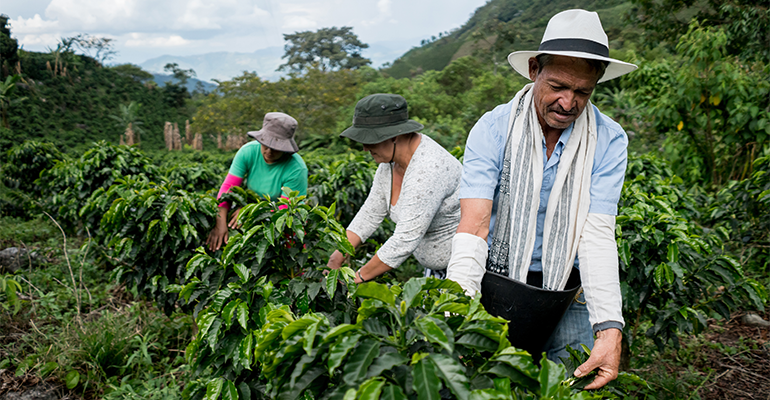
The report’s authors make a case for how value concentrates away from farmers further down the value chain between importer and retailer, with a lack of mechanisms to distribute value.
“The long term impact of underpaying smallholder and family farmers ultimately affects the whole industry, and it will take an economic perspective to systemically and sustainably address this issue,” the report concludes.
“The coffee industry is so diverse and complex that there is no quick fix. Trading conditions need to account for this complexity, and stakeholders in coffee supply chains need to implement mechanisms to distribute value and promote economic viability of farming.”
Germany is the world’s third largest consumer after the US and Brazil
The report: ‘The Grounds for Sharing: A study of value distribution in the coffee industry’ focused on Germany as the largest consumer of coffee in Europe, and the world’s third largest consumer after the USA and Brazil. The country is also the largest importer of green coffee in Europe, with a major coffee roasting industry.
Here, the average price of coffee products sold in German retail stores was €9.71 per kilogram (kg). For this aggregated coffee product, once costs and taxes were deducted, cumulated net profit margins amounted to €1.09/kg - 11% of total retail value.
Further findings revealed that the retail, roasting and coffee cultivation stages along with the German coffee tax each amounted to between 21% and 23% of the total value of the coffee products.
Coffee formats include ground, whole beans, soft pods, and capsules
Key to a coffee product’s profit margin was its format, where brands such as Tchibo, Jacobs Douwe Egberts (JDE) Peet's, and Dallmayr accounted for 20%, 18%, and 16% respectively of all ground coffee sales in Germany in 2021.
Similarly, the share of sales in whole beans in the same year, was led by Tchibo (24%), Lavazza (19%), and Dallmayr (9%).
The 2021 primary share of sales in soft pods went to JDE Peet's (28%) followed by Tchibo (12%), and Dallmayr (3%), while the year’s share of sales in capsules overwhelmingly went to JDE Peet's (38%), Nestlé (19%), and Tchibo (13%).
“…consumers’ willingness to pay increases when moving from ground coffee and whole bean to soft pods, and most prominently to capsules,” the report reads. <“…Pods and capsules offer precision consumption and a convenient method of preparation that also preserves the quality of the coffee…hence a higher willingness to pay. In the meantime, the costs associated with these different product formats grow at a lower rate than the willingness to pay, thereby increasing profitability.”
Farmers in a disadvantaged bargaining position due to limited insight
The report goes on to highlight that in contrast with these strong variations at retail and roasting stages, price paid at the coffee cultivation stage did not change according to product type (format).
Delving deeper into the findings, the authors also suggested that it was this large difference of product formats along with cost of production at coffee cultivation stage that made it difficult for farmers to draw uniform conclusions on value creation in certified supply chains.
“…an important number of coffee farmers have limited insights, opportunities and control over the final form and destination of the coffee they produce/export,” they wrote. “This puts most farmers in a disadvantaged bargaining position when it comes to getting value for their coffee. The disconnect between end-product and farm production leaves farmers with limited, if any, points of leverage to capture a share of the end-product.”
Joint sourcing practices and mechanisms the recommendations for value redistribution
In a series of recommendations, IDH and Solidaridad said they would look to enhance farmer prosperity through joint sourcing practices and mechanisms for value redistribution. This included the sector engagement to develop sourcing principles that enable value redistribution in the supply chain and enhance farmer prosperity. They commented that the ultimate goal of this cooperation was to convene a sector commitment around industry preferred mechanisms to distribute value.
“Sourcing principles for value redistribution can include a broad set of procurement and portfolio management practices. The consortium therefore invites the coffee community to jointly define what value redistribution would mean for the sector. A group of companies and other stakeholders will be invited to co-develop this ambition.”
A key finding of the study was that the added value in the coffee sector concentrated in the downward part of the chain and did not make its way to farmers. As yet, there are no established mechanisms that enable re-distribution of value at scale.
Together with partners, IDH and Solidaridad said they would develop and pilot mechanisms for “adding, creating, and transferring value in the supply chain.”
“These mechanisms can be linked to existing initiatives, need to be scalable and account for the diversity of farmers in origin,” they concluded. “Learnings from these pilots and mechanisms will be integrated in the collective work with the sector on sourcing practices.”

Get more of our news on Google
Set Ingredients Network as a 'Preferred Source' to get quicker access to the news you value.
Related news

Do the US dietary guidelines put UPFs under pressure?
10 Sep 2026
Will the US dietary guidelines change the way Americans eat, swapping ultra-processed foods for whole foods? We asked Dr Barry Popkin, renowned nutrition and obesity researcher.
Read more
Health and wellness engagement matures across Middle East and Africa
4 Sep 2026
Many consumers in the Middle East and Africa are now proactively engaged in health and wellness, looking to integrate better habits and products into their daily lives, say experts.
Read more
Skimpflation: An ‘unfair’ and risky approach to keeping prices low
2 Sep 2026
Consumers see skimpflation – reducing the quality of ingredients due to rising costs – as more unfair than shrinkflation, making it a risky strategy according to recent research.
Read more
‘Urgent gaps’ in achieving 2030 food system goals
27 Aug 2026
Global food systems are failing to meet 2030 targets across indicators including health, environment, and resilience, according to a report co-authored by the Food and Agriculture Organisation (FAO).
Read more
Seven-Eleven uses microbial testing tech to extend katsudon shelf life
26 Aug 2026
Japanese retail company Seven-Eleven has improved its factory’s microbial environment to keep comfort-food staple, katsudon, fresher for longer.
Read more
Chimac’s fusion sauces bring Korean flavours to Europe
25 Aug 2026
Irish sauce brand Chimac is tapping into Korea’s culinary traditions, bringing its flavours and products to European consumers who want a taste of K-food.
Read more
Global demand for instant noodles continues to rise
24 Aug 2026
Global demand for instant noodles reached 124.21 billion servings last year, representing a 0.7% year-on-year increase – or 900 million extra servings.
Read more
Popular barbecue staples experience sharp price increases
19 Aug 2026
The typical cost of US shoppers’ barbecue baskets has risen by 12% over the past year – the fastest annual rise in a decade, figures from The Economist show.
Read more
Hot NPD: Nissin launches first cold-water Cup Noodles
18 Aug 2026
Nissin is taking one of Japan’s most iconic instant meals in a completely new direction with the launch of the first cold water-only Cup Noodles in the brand’s 55-year history.
Read more
Manam Chocolate aims to bring premium Indian cacao to 'the world stage'
11 Aug 2026
Craft chocolate brand Manam Chocolate is investing in local expansion and supply chain innovation throughout India as it works to build out the premium reputation of its locally produced cacao products.
Read more