
Ingredients Categories
Finished Products
Finished Food Categories
- Bakery
- Beverages / Juices
- Cereal and grain products
- Confectionery
- Cooking Fats & Oils
- Dairy
- Egg products
- Fruits & Vegetables
- Infant & Baby food
- Meat, Poultry & Fish
- Nuts & Seeds products
- Other Finished Food Categories
- Pet Food
- Plant-based foods
- Prepared foods
- Sauces & Seasonings
- Sweet & Savoury Spreads
Specialised Finished Products
- Bee products
- Biotic products
- Dietary supplements
- Energy drinks
- Functional beverages
- Functional confectionery
- Functional food
- Functional powders
- Meal replacement products
- Nutricosmetics
- Other Specialised Finished Products
- Pet Dietary Supplements
- Pharma and OTC products
- Protein products
- Sugar replacers / Sweeteners
Health & Wellness Areas
Delivery Formats
Operations & Services
- 3D printing
- Analysis/ Testing
- Auditing & certifications
- Blending & mixing
- Bottling
- Certification
- Clinical trials
- Co-packing
- Coating
- Consulting
- Contract manufacturing
- Drying
- Electrospinning
- Encapsulating
- Enzymatic processing
- Extracting
- Extrusion
- Fat structuring
- Fermentation
- Filling
- Flavour development
- Freeze drying
- Granulating/ grinding/ milling / mixing
- High-pressure processing
- Labelling
- Other Operations & Services
- Packaging
- Packet filling
- Pasturising
- Quality assurance
- Saccharification
- Shear cell processing
- Spray drying
- Sterilisation
- Storage & Logistics
- Tabletting
- Toasting / roasting
- Ultra-high temperature processing
News
Children’s food and drink claims centre on health and wellness
Natasha Spencer-Jolliffe, Freelance Journalist 1 May 2024A new report by HealthFocus International shows parents are at the forefront of health and wellness trends, leading the way for packaging claims on children’s products.
Parents leading the way is a dominant trend in the food and drink industry, consumer beliefs and behaviour company HealthFocus International states as it publishes its Top 10 Consumer Trends Report.

The trend, Parents Lead the Way, is the idea that parenthood is a tipping point for choosing more control over personal health and wellness. Compared to other consumers, parents are more proactive in learning about health, trying new foods with health benefits, and paying a higher price point for healthy food.
“Parenting has become a catalyst for stronger engagement in the world of health and wellness, and parents are fuelling many of today’s top dietary trends,” Cali Amos, director of Human Insights, shared in the report.
Health and wellness food findings
“For a majority [of people], becoming a parent coincides with enhanced interest in health, nutrition, and safety: caring for others changes their perspectives on food and beverage choices and how health is subsequently affected,” Julie Johnson, President of HealthFocus International told Ingredients Network.
Findings from The Changing World of Health and Wellness for the Family, a 2022 Global Report from HealthFocus International, indicate that 75% of parents are willing to pay more for foods that are healthier for them and their families, compared to 63% of other consumers. Both parents and other consumers interviewed were 40 years of age or younger.
The report suggests that awareness of healthy foods also varied between parents and non-parents. The results show that 73% of parents have gone out of their way to learn about nutrition and its impact on health, and 61% of other consumers share this sentiment.
HealthFocus International’s results also indicate variations in the actions taken by parents and other consumers once they know about a particular product’s health and wellness credentials. Of those asked, 70% of parents confirmed they usually try new foods and drinks that offer health benefits as soon as they are aware of them, compared to 55% of other consumers.
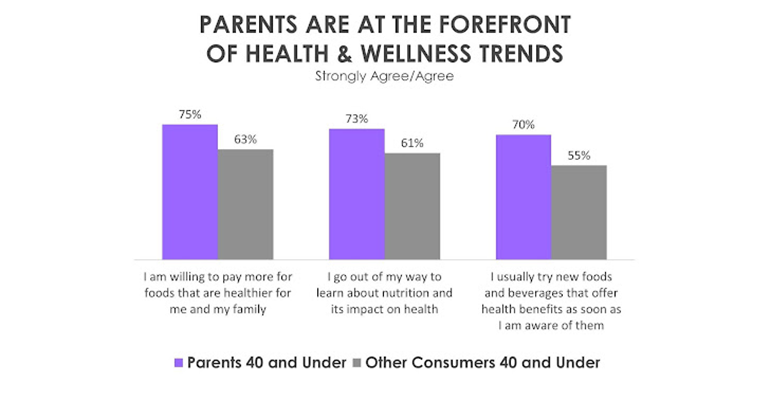 Data from The Changing World of Health and Wellness for the Family, a 2022 Global Report from HealthFocus International.| Image courtesy of HealthFocus International
Parents Lead the Way trend
“Parents care about so many things when choosing for their kids,” says Johnson. In nearly every category, households with children at home report more interest, vigilance, and engaged behaviours, HealthFocus International reports.
For instance, when selecting foods and beverages, parents focus more on health benefits such as gut health and immunity, ingredients, and other top health and wellness trends like clean eating, transparency, and sustainability.
Claims on food and drink for children that resonate the most with parents are: ‘fresh’, ‘natural’, ‘no preservatives’, ‘no artificial colours and flavours’ and ‘high fibre’.
“Parents also face a variety of challenges when providing for their family,” says Johnson. According to new data from its HealthFocus 2024 Global Trend Study, parents say the top barriers to improving their children’s nutrition include children asking for products they see or hear about, their children’s preferences, and the expense of healthy foods and beverages.
Changing manufacturers and brands’ formulations
“There’s been a massive shift in how manufacturers try to reach kids and parents,” Johnson says. The shift has been significantly influenced by the past two generations of parents who have access to more information about nutrition and health, shaping their view of what’s healthy and what they feel is okay to bring home.
“Currently, more informed parents have higher criteria for choices for their children, and manufacturers have responded by accentuating – or even changing – ingredient or nutrition attributes,” Johnson adds.
When children ask for the same products, parents who would have dismissed these options in previous formulations see manufacturers highlighting formulations that include whole grain content, less sugar than other leading brands and added fibre, for instance. Manufacturing considerations and packaging claims like these connect parents’ dedication to health and nutrition with their children’s enjoyment.
“We’ve also seen manufacturers actively embrace categories that are not typically exciting to kids in ways parents and children can agree on,” says Johnson, highlighting that yoghurt is a great example. Squeeze pouches, yoghurt tube snacks (which can also be frozen before adding to lunch boxes), and lines specific to toddlers and children with appealing packaging and information about the benefits of probiotics for children resonate with children and parents.
An influx of portable foods, including many combinations of products such as meat and cheese, hummus and crackers, and single-serve items like peanut butter and salad dressing, are product categories satisfying both parents and children. These food options appeal to anyone on the go, but they have particular appeal for those packing lunch boxes daily.
“We will see increasing options in single-serve and portable, with a growing number of healthier-for-you products in these categories,” Johnson says. “Even though they’re almost always at a higher unit price, the convenience of healthier products is enticing to both parents and non-parents alike,” Johnson adds.
Regarding health, nutrition, and food choices for the family, parents today are not the same as parents decades ago. Parents’ knowledge and preferences drive many of today’s top dietary trends.
“So, although children still have a massive influence on their parents’ food and beverage spending, we anticipate seeing more and more manufacturer efforts working to win over parents while making their products interesting and appealing to children and continuing to move into the portable products space,” Johnson adds.

Get more of our news on Google
Set Ingredients Network as a 'Preferred Source' to get quicker access to the news you value.
Related news

Do the US dietary guidelines put UPFs under pressure?
10 Sep 2026
Will the US dietary guidelines change the way Americans eat, swapping ultra-processed foods for whole foods? We asked Dr Barry Popkin, renowned nutrition and obesity researcher.
Read more
Health and wellness engagement matures across Middle East and Africa
4 Sep 2026
Many consumers in the Middle East and Africa are now proactively engaged in health and wellness, looking to integrate better habits and products into their daily lives, say experts.
Read more
Skimpflation: An ‘unfair’ and risky approach to keeping prices low
2 Sep 2026
Consumers see skimpflation – reducing the quality of ingredients due to rising costs – as more unfair than shrinkflation, making it a risky strategy according to recent research.
Read more
‘Urgent gaps’ in achieving 2030 food system goals
27 Aug 2026
Global food systems are failing to meet 2030 targets across indicators including health, environment, and resilience, according to a report co-authored by the Food and Agriculture Organisation (FAO).
Read more
Seven-Eleven uses microbial testing tech to extend katsudon shelf life
26 Aug 2026
Japanese retail company Seven-Eleven has improved its factory’s microbial environment to keep comfort-food staple, katsudon, fresher for longer.
Read more
Chimac’s fusion sauces bring Korean flavours to Europe
25 Aug 2026
Irish sauce brand Chimac is tapping into Korea’s culinary traditions, bringing its flavours and products to European consumers who want a taste of K-food.
Read more
Global demand for instant noodles continues to rise
24 Aug 2026
Global demand for instant noodles reached 124.21 billion servings last year, representing a 0.7% year-on-year increase – or 900 million extra servings.
Read more
Popular barbecue staples experience sharp price increases
19 Aug 2026
The typical cost of US shoppers’ barbecue baskets has risen by 12% over the past year – the fastest annual rise in a decade, figures from The Economist show.
Read more
Hot NPD: Nissin launches first cold-water Cup Noodles
18 Aug 2026
Nissin is taking one of Japan’s most iconic instant meals in a completely new direction with the launch of the first cold water-only Cup Noodles in the brand’s 55-year history.
Read more
Manam Chocolate aims to bring premium Indian cacao to 'the world stage'
11 Aug 2026
Craft chocolate brand Manam Chocolate is investing in local expansion and supply chain innovation throughout India as it works to build out the premium reputation of its locally produced cacao products.
Read more