
Ingredients Categories
Finished Products
Finished Food Categories
- Bakery
- Beverages / Juices
- Cereal and grain products
- Confectionery
- Cooking Fats & Oils
- Dairy
- Egg products
- Fruits & Vegetables
- Infant & Baby food
- Meat, Poultry & Fish
- Nuts & Seeds products
- Other Finished Food Categories
- Pet Food
- Plant-based foods
- Prepared foods
- Sauces & Seasonings
- Sweet & Savoury Spreads
Specialised Finished Products
- Bee products
- Biotic products
- Dietary supplements
- Energy drinks
- Functional beverages
- Functional confectionery
- Functional food
- Functional powders
- Meal replacement products
- Nutricosmetics
- Other Specialised Finished Products
- Pet Dietary Supplements
- Pharma and OTC products
- Protein products
- Sugar replacers / Sweeteners
Health & Wellness Areas
Delivery Formats
Operations & Services
- 3D printing
- Analysis/ Testing
- Auditing & certifications
- Blending & mixing
- Bottling
- Certification
- Clinical trials
- Co-packing
- Coating
- Consulting
- Contract manufacturing
- Drying
- Electrospinning
- Encapsulating
- Enzymatic processing
- Extracting
- Extrusion
- Fat structuring
- Fermentation
- Filling
- Flavour development
- Freeze drying
- Granulating/ grinding/ milling / mixing
- High-pressure processing
- Labelling
- Other Operations & Services
- Packaging
- Packet filling
- Pasturising
- Quality assurance
- Saccharification
- Shear cell processing
- Spray drying
- Sterilisation
- Storage & Logistics
- Tabletting
- Toasting / roasting
- Ultra-high temperature processing
News
Smaller snack sizes represent big growth opportunity for PepsiCo
David Burrows, Freelance Journalist 5 Mar 2025Brands are responding to consumer demand for healthier products by developing classic snacks in smaller portion sizes, meaning fewer calories, lower sodium, and lower fat.
There was a “slowdown” in snacks last year, according to PepsiCo chief executive officer Ramon Laguarta.
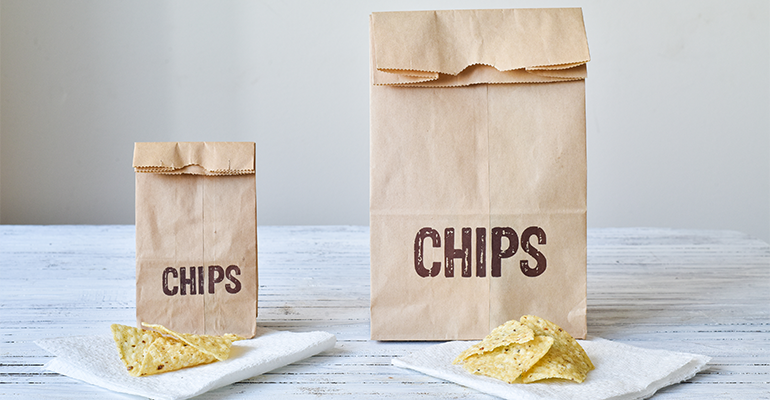
“Our No 1 priority this year has been stabilising the category, making sure that consumers come back to the category,” he told analysts in early February. “I think […] we can say that we see that happening. We're seeing the category starting to grow again on volume in the last three months.”
Smaller portions are a big opportunity, he said.
Probably “the No 1 solution for consumers to stay in our categories is small portions of our favourites – ideally, improved favourites with lower sodium and lower fat, and [fewer] artificial [ingredients] – so, portion control of our favourites is a big strategy”, he explained.
PepsiCo is also investing in out-of-home through its “Simply” options for foodservice. These are versions of its products without artificial flavours or colours. Laguarta promised “more effort” on baked and lightly salted options.
‘Sincere nods’ towards healthier snacks
Brands have long talked a good game on healthier snacks, but some of those listening in to Laguarta’s call sense more “sincere nods” to health.
“It may be wishful thinking,” said Nick Budden, an independent strategist with Flavor Forward Strategy who has worked for Tropicana and GoodPop, “or maybe big brands are starting to take health more seriously. Small brands, take note and build [a] moat.”
Laguarta was, naturally, quizzed on the success of GLP-1 medications such as Ozempic and Wegovy. Again, he mentioned portion control.
PepsiCo continues to study GLP-1s closely, he explained, but “because of the lower levels of adoption and people coming in and out of the treatment, we see very little impact in our business and in our category at this point”.
However, he did highlight “a higher level of awareness in general of American consumers towards health and wellness”, adding: “And this is driven by potentially all the conversation around obesity drugs, but also other conversations that are happening around the space of health and wellness.”
Mighty sales for mini-meals
Euromonitor has forecast that the “ready-to-heat” category will grow from €48.8 billion to more than €66 billion by 2028, with under-35s driving this shift.
“The way we eat is changing,” said Unilever in January, as it announced that mini-meals have delivered mid-single digit growth over the past five years.
Brands are trying to create solutions for consumers in those moments that they are looking for a 200- or 300-calorie product that will keep them going.
Unilever highlighted Euromonitor International research suggesting that the popularity of mini-meals in Europe is all about lifestyle: 20% of people asked said they did not have time to cook, 16% said that they did not know how to cook well, and 15% said they would rather spend their time doing something else.
“The younger generation views food differently,” said Marcelo Morishito Costa, mini-meals global innovation manager for Unilever. “They want fast, convenient, and often all-in-one solutions that still deliver on taste and nutrition.”
Unilever, owner of Pot Noodle, reported “strong mid-single digit growth” in markets where it has launched mini-meals, most notably Germany, Poland, Pakistan, the US, and India.
Successfully marketing products that match local tastes and trends has been vital. In India, for example, the Spicy Kimchi and Black Bean K-Pot varieties tapped into the recent growing trend for all things Korean.
Whether the price of meals has, in the current economic climate, also fuelled the growth of mini-meals is moot.
Asked about the pivot, Laguarda said: “This is not only a value-driven decision. […] It's been also a multi-year evolution of the category where more occasions or more calories are being eaten in small meals versus large meals. And I think that is something that will continue as consumers' lifestyle[s] evolve that way.”

Get more of our news on Google
Set Ingredients Network as a 'Preferred Source' to get quicker access to the news you value.
Related news

Do the US dietary guidelines put UPFs under pressure?
10 Sep 2026
Will the US dietary guidelines change the way Americans eat, swapping ultra-processed foods for whole foods? We asked Dr Barry Popkin, renowned nutrition and obesity researcher.
Read more
Food fraud costs UK economy £2bn each year
9 Sep 2026
Food fraud is costing the UK economy up to £2 billion (€2.3 billion) every year although the food sector is more “resilient” than others, according to a recent study.
Read more
Kellogg accelerates work to remove artificial colours from all US cereals
3 Sep 2026
WK Kellogg has announced an accelerated timeline to eliminate all artificial colours and the chemical preservative, BHT, across its full US portfolio of cereals and cereal packaging.
Read more
Skimpflation: An ‘unfair’ and risky approach to keeping prices low
2 Sep 2026
Consumers see skimpflation – reducing the quality of ingredients due to rising costs – as more unfair than shrinkflation, making it a risky strategy according to recent research.
Read more
NielsenIQ’s EU barometer shows Britain leading in grocery inflation
31 Aug 2026
Britain was the only country to record grocery inflation above 2%, according to NielsenIQ data that compared Europe’s five biggest grocery markets from February to May 2026.
Read more
‘Urgent gaps’ in achieving 2030 food system goals
27 Aug 2026
Global food systems are failing to meet 2030 targets across indicators including health, environment, and resilience, according to a report co-authored by the Food and Agriculture Organisation (FAO).
Read more
Chimac’s fusion sauces bring Korean flavours to Europe
25 Aug 2026
Irish sauce brand Chimac is tapping into Korea’s culinary traditions, bringing its flavours and products to European consumers who want a taste of K-food.
Read more
Global demand for instant noodles continues to rise
24 Aug 2026
Global demand for instant noodles reached 124.21 billion servings last year, representing a 0.7% year-on-year increase – or 900 million extra servings.
Read more
Popular barbecue staples experience sharp price increases
19 Aug 2026
The typical cost of US shoppers’ barbecue baskets has risen by 12% over the past year – the fastest annual rise in a decade, figures from The Economist show.
Read more
Hot NPD: Nissin launches first cold-water Cup Noodles
18 Aug 2026
Nissin is taking one of Japan’s most iconic instant meals in a completely new direction with the launch of the first cold water-only Cup Noodles in the brand’s 55-year history.
Read more