
Ingredients Categories
Finished Products
Finished Food Categories
- Bakery
- Beverages / Juices
- Cereal and grain products
- Confectionery
- Cooking Fats & Oils
- Dairy
- Egg products
- Fruits & Vegetables
- Infant & Baby food
- Meat, Poultry & Fish
- Nuts & Seeds products
- Other Finished Food Categories
- Pet Food
- Plant-based foods
- Prepared foods
- Sauces & Seasonings
- Sweet & Savoury Spreads
Specialised Finished Products
- Bee products
- Biotic products
- Dietary supplements
- Energy drinks
- Functional beverages
- Functional confectionery
- Functional food
- Functional powders
- Meal replacement products
- Nutricosmetics
- Other Specialised Finished Products
- Pet Dietary Supplements
- Pharma and OTC products
- Protein products
- Sugar replacers / Sweeteners
Health & Wellness Areas
Delivery Formats
Operations & Services
- 3D printing
- Analysis/ Testing
- Auditing & certifications
- Blending & mixing
- Bottling
- Certification
- Clinical trials
- Co-packing
- Coating
- Consulting
- Contract manufacturing
- Drying
- Electrospinning
- Encapsulating
- Enzymatic processing
- Extracting
- Extrusion
- Fat structuring
- Fermentation
- Filling
- Flavour development
- Freeze drying
- Granulating/ grinding/ milling / mixing
- High-pressure processing
- Labelling
- Other Operations & Services
- Packaging
- Packet filling
- Pasturising
- Quality assurance
- Saccharification
- Shear cell processing
- Spray drying
- Sterilisation
- Storage & Logistics
- Tabletting
- Toasting / roasting
- Ultra-high temperature processing
News
Upcycled veggie promise: IKEA launches broccoli leaf soup
Kacey Culliney, Freelance Journalist 3 Feb 2026IKEA is launching a soup made with upcycled broccoli leaves, following a partnership with non-profit Axfoundation.
Axfoundation has run successful large-scale trials with several food companies, wholesalers and retailers in Sweden.
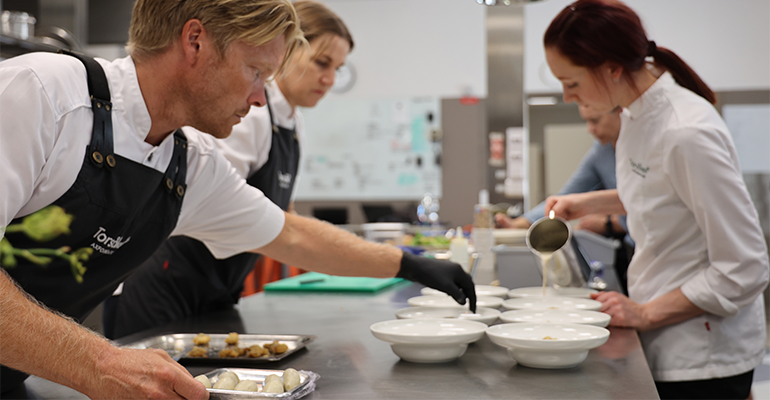
This month, IKEA Sweden will launch a soup made from the discarded leaves of broccoli – the result of a food sustainability project kickstarted in 2024 by local non-profit Axfoundation in collaboration with specialist supplier Grönsakshallen Sorunda.
Axfoundation's “The Whole Plant” initiative, designed to bolster food innovation, reduce waste, and increase resource efficiency in Swedish vegetable farming, builds on EU-funded research conducted by the Swedish University of Agricultural Sciences (SLU).
The project brings together growers, processors, wholesalers, and food companies to conduct large-scale trials and commercialise innovative products using more parts of harvested plants.
IKEA Sweden's soup launch is one concrete result of the project. Swedish food company Sevan has also developed yellow pea and broccoli leaf patties and a local wholesaler has scaled distribution of organic Swedish broccoli leaves.
Broccoli leaves: A ‘highly versatile and promising’ food ingredient
Axfoundation said broccoli leaves have proven highly versatile and promising as a food ingredient during the ongoing trials and can be considered for an array of dishes and products, particularly given their resemblance to spinach leaves.
Using these discarded leaves can significantly help curb waste. According to the Swedish Board of Agriculture, 2,800 tons of broccoli are harvested each year in the country, yet only around 20% of the plant is typically used – the florets – with the stem and leaves largely left in the field.
Axfoundation said Sweden's broccoli harvest could be doubled if the fully edible upper leaves were used for consumption.
Speaking to Ingredients Network, Veronica Öhrvik, agronomist and project leader for Future Food at Axfoundation, said the goal is to “substantially increase” the harvest in 2026 and launch more broccoli leaf products.
“There is already a larger demand than supply, hence we believe that there will be more products with broccoli leaves, and not only soup,” Öhrvik said.
According to SLU research, broccoli leaves are more nutrient-dense than their floret counterparts too, containing fibre, vitamin C, and vitamin K, and so hold plenty of promise as a valuable food ingredient.
“Broccoli leaves are a clear example of a nutritious resource that is left unused today, representing a significant loss for both human health and the environment,” Öhrvik said.
It is important, therefore, that focus shifts from producing more food to “making better use of what we already produce”, she said – a concept proven efficient and scaleable via this project.
IKEA Sweden will launch the broccoli leaf soup across all its stores at the end of January.
According to Erika Norrman, country food manager at IKEA Sweden, this move aligns well with the company's core values.
“Creating more from less is part of our DNA and runs through all of our product development,” Norrman said. IKEA also wants to increase access to plant-based foods and so the broccoli leaf soup is an affordable way of doing this, she said.
Supply chain collaboration
According to Öhrvik, Axfoundation's work with the entire supply chain is a critical aspect to scaling and expanding such work. “From our experience, bringing together the entire value chain to solve problems and assuring that all parts in the value chain will benefit from the solution is a success factor.”
Communication between farmers, suppliers, food manufacturers, and academia also creates a strong landscape for innovation, she said.
“What we learnt in the broccoli leaf project is that the solution is not always the obvious. In this project, the key was not a vegetable food producer but a production unit producing processed meat. There is something really positive in opportunities showing up in unexpected places and through new collaborations.”
Beyond its “The Whole Plant” initiative, Axfoundation has a variety of upcycling food ingredient projects happening, including work to use discarded bovine blood and promoting wider consumption of fish parts beyond the fillet.
“The upcycled food ingredients we are working with today are excellent and healthy for us. By not using it as food, we waste so many nutrients and put pressure on the environment without any reason. Those ingredients are just as good as the ones sold today, and with higher food prices, we believe that more food ingredients will be upcycled and in the long-run considered just 'food ingredients',” Öhrvik said.

Get more of our news on Google
Set Ingredients Network as a 'Preferred Source' to get quicker access to the news you value.
Related news

Do the US dietary guidelines put UPFs under pressure?
10 Sep 2026
Will the US dietary guidelines change the way Americans eat, swapping ultra-processed foods for whole foods? We asked Dr Barry Popkin, renowned nutrition and obesity researcher.
Read more
Food fraud costs UK economy £2bn each year
9 Sep 2026
Food fraud is costing the UK economy up to £2 billion (€2.3 billion) every year although the food sector is more “resilient” than others, according to a recent study.
Read more
Kellogg accelerates work to remove artificial colours from all US cereals
3 Sep 2026
WK Kellogg has announced an accelerated timeline to eliminate all artificial colours and the chemical preservative, BHT, across its full US portfolio of cereals and cereal packaging.
Read more
Skimpflation: An ‘unfair’ and risky approach to keeping prices low
2 Sep 2026
Consumers see skimpflation – reducing the quality of ingredients due to rising costs – as more unfair than shrinkflation, making it a risky strategy according to recent research.
Read more
NielsenIQ’s EU barometer shows Britain leading in grocery inflation
31 Aug 2026
Britain was the only country to record grocery inflation above 2%, according to NielsenIQ data that compared Europe’s five biggest grocery markets from February to May 2026.
Read more
‘Urgent gaps’ in achieving 2030 food system goals
27 Aug 2026
Global food systems are failing to meet 2030 targets across indicators including health, environment, and resilience, according to a report co-authored by the Food and Agriculture Organisation (FAO).
Read more
Chimac’s fusion sauces bring Korean flavours to Europe
25 Aug 2026
Irish sauce brand Chimac is tapping into Korea’s culinary traditions, bringing its flavours and products to European consumers who want a taste of K-food.
Read more
Global demand for instant noodles continues to rise
24 Aug 2026
Global demand for instant noodles reached 124.21 billion servings last year, representing a 0.7% year-on-year increase – or 900 million extra servings.
Read more
Popular barbecue staples experience sharp price increases
19 Aug 2026
The typical cost of US shoppers’ barbecue baskets has risen by 12% over the past year – the fastest annual rise in a decade, figures from The Economist show.
Read more
Hot NPD: Nissin launches first cold-water Cup Noodles
18 Aug 2026
Nissin is taking one of Japan’s most iconic instant meals in a completely new direction with the launch of the first cold water-only Cup Noodles in the brand’s 55-year history.
Read more