
Ingredients Categories
Finished Products
Finished Food Categories
- Bakery
- Beverages / Juices
- Cereal and grain products
- Confectionery
- Cooking Fats & Oils
- Dairy
- Egg products
- Fruits & Vegetables
- Infant & Baby food
- Meat, Poultry & Fish
- Nuts & Seeds products
- Other Finished Food Categories
- Pet Food
- Plant-based foods
- Prepared foods
- Sauces & Seasonings
- Sweet & Savoury Spreads
Specialised Finished Products
- Bee products
- Biotic products
- Dietary supplements
- Energy drinks
- Functional beverages
- Functional confectionery
- Functional food
- Functional powders
- Meal replacement products
- Nutricosmetics
- Other Specialised Finished Products
- Pet Dietary Supplements
- Pharma and OTC products
- Protein products
- Sugar replacers / Sweeteners
Health & Wellness Areas
Delivery Formats
Operations & Services
- 3D printing
- Analysis/ Testing
- Auditing & certifications
- Blending & mixing
- Bottling
- Certification
- Clinical trials
- Co-packing
- Coating
- Consulting
- Contract manufacturing
- Drying
- Electrospinning
- Encapsulating
- Enzymatic processing
- Extracting
- Extrusion
- Fat structuring
- Fermentation
- Filling
- Flavour development
- Freeze drying
- Granulating/ grinding/ milling / mixing
- High-pressure processing
- Labelling
- Other Operations & Services
- Packaging
- Packet filling
- Pasturising
- Quality assurance
- Saccharification
- Shear cell processing
- Spray drying
- Sterilisation
- Storage & Logistics
- Tabletting
- Toasting / roasting
- Ultra-high temperature processing
News
Breakthrough buckwheat brands promote brain health claims
Natasha Spencer-Jolliffe, Freelance Journalist 25 Aug 2023
As buckwheat emerges as a superfood ingredient on the plant-based scene, attention is turning to its brain health claims and the research behind buckwheat’s ability to enhance cognitive function.
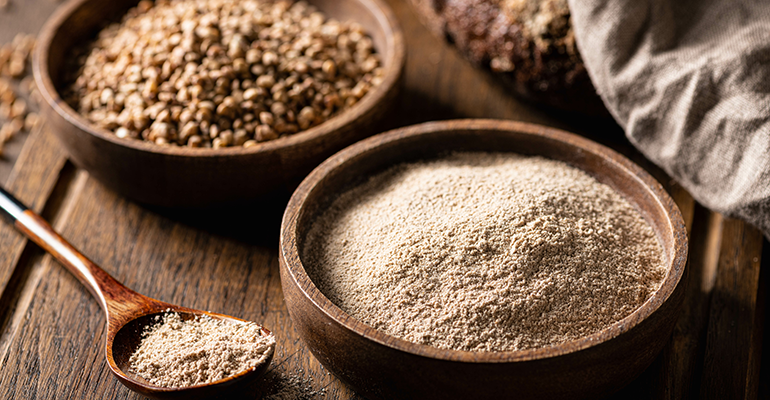
Buckwheat, a small grain-like seed, is popping up throughout the plant-based sector in formulations as a go-to superfood ingredient.
Recognised as a key ingredient to watch, buckwheat is a type of seed known as a pseudocereal, eaten as a cereal grain, like quinoa.

Naturally gluten-free, buckwheat contains multiple vitamins and minerals. Buckwheat is richer in minerals than other pseudocereals and cereals, containing minerals including manganese, copper, magnesium, iron and phosphorus. Compared to some seeds and grains, the body can easily absorb minerals found in buckwheat, as they contain low amounts of phytic acid.
Formulators who adopt the ingredient into their product formulations often create gluten‐free products with nutrient‐dense ingredients. They target consumers’ interest in preventing or overcoming various health‐related problems and helping to enhance brain health.
While shoppers understand the importance of nutrition and brain performance, the industry also looks for ingredients with brain health claims backed by research and regulatory approval. Ingredients such as ashwagandha and fibre-rich foods, Mintel states, do have this evidential support and offer gut-brain support to improve mental functioning.
Buckwheat brands: Latvia’s Fermentful
Buckwheat is an ingredient growing in prominence among industry players, trend forecasters and consumers. Subsequently, it is making its way onto manufacturers’ formulation pipelines.
Latvian startup Fermentful launched its plant-based fermented drinks in April 2023, utilising green buckwheat and winning the EIT Foods Marketed Innovation Prize. Operating within the functional beverage segment, the traditional kefir fermented milk drink made from kefir grains uses buckwheat to target mental, physical and environmental health.
“At Fermentful, we firmly believe in harnessing the medicinal potential of food, where preventive and targeted nutrition can reduce the reliance on medical treatments,” Anda Penka, founder of Fermentful, told Ingredients Network.
“Alarming statistics reveal that a quarter of the EU population experiences depression or anxiety each year, with a substantial portion of major depression left untreated,” Penka says.
“Thankfully, science underscores the strong connection between a healthy gut microbiome, referred to as the gut-brain axis, and our overall physical and mental health,” Penka continues. “We strive to maintain and restore health for a healthier future by offering plant-based, probiotic-rich food as effective nutritional therapy.”
 © AdobeStock/CHZU
Green Smile highlights brain performance
Green Smile is a Ukranian plant-based drink utilising domestic buckwheat as its hero ingredient. Created by the brand, Loostdorf, Green Smile is made with 100% Ukrainian buckwheat and contains five ingredients: buckwheat flour, sunflower oil, carrageenan (red seaweed), water and salt.
Described by New Nutrition Business as the country’s top-selling plant-based milk brand, Green Smile places a bright spotlight on buckwheat as a “superhero cereal”, along with championing its potential to improve brain health, mood and sleep. In its marketing, Green Smile states buckwheat “helps our brain to think, nerves not to strain, and the mood to be always on the positive wave”.
Dubai-based brand Nature’s Own Factory, meanwhile, makes buckwheat tea and chocolate spread. Using Tartary buckwheat seeds, the brand states the ingredient can help enhance cognitive function by improving memory and, as caffeine-free, can normalise sleep and improve overall wellbeing.
Justifying nutritional claims
Various health-related benefits such as the hypocholesterolemic, hypoglycemic, anticancer and anti‐inflammatory properties link buckwheat and its byproducts to enhance functional food formulation potential, 2021 researchers say.
Formulators supplement buckwheat’s use with cereal crops. Researchers can enhance its nutritive value or replace cereal grains with gluten‐free product formulations, scientists in a 2022 study said.
A 2022 mice study found buckwheat flour and its starch can prevent age-related cognitive decline by increasing the production of the brain-derived neurotrophic factor (BDNF) in the hippocampal part of the body’s limbic system, contributing to sustained neuronal plasticity.
In 2022, researchers stated that grains are a “major source of sustainable protein for health”. Moving the use of grains from feed to traditional foods, plant-based dairy replacement products, and meat analogue foodstuffs may speed up this shift.
The future for buckwheat: More research and understanding needed
Due to its high-protein biological value and nutraceuticals, buckwheat is a prevalent ingredient in ready-to-serve and ready-to-cook foods. “It is imperative to create a cognisance about the cooking methods, nutritional benefits and health implications of buckwheat,” the researchers said.
“We’re definitely interested in identifying a wider range of plant-based crop ingredients,” Sophie Armour, senior communications manager and spokesperson at The Good Food Institute Europe (GFI), told Ingredients Network.
“This can help to build more diversified and therefore less vulnerable supply chains, enable utilisation of locally grown crops–and buckwheat could be one example of many efforts to do that,” Armour adds. “In general, each new crop ingredient for plant-based meat, seafood, eggs and dairy should be evaluated according to their protein content, quality, and function,” Armour continues.

Get more of our news on Google
Set Ingredients Network as a 'Preferred Source' to get quicker access to the news you value.
Related news

Do the US dietary guidelines put UPFs under pressure?
10 Sep 2026
Will the US dietary guidelines change the way Americans eat, swapping ultra-processed foods for whole foods? We asked Dr Barry Popkin, renowned nutrition and obesity researcher.
Read more
Food fraud costs UK economy £2bn each year
9 Sep 2026
Food fraud is costing the UK economy up to £2 billion (€2.3 billion) every year although the food sector is more “resilient” than others, according to a recent study.
Read more
Health and wellness engagement matures across Middle East and Africa
4 Sep 2026
Many consumers in the Middle East and Africa are now proactively engaged in health and wellness, looking to integrate better habits and products into their daily lives, say experts.
Read more
Kellogg accelerates work to remove artificial colours from all US cereals
3 Sep 2026
WK Kellogg has announced an accelerated timeline to eliminate all artificial colours and the chemical preservative, BHT, across its full US portfolio of cereals and cereal packaging.
Read more
Skimpflation: An ‘unfair’ and risky approach to keeping prices low
2 Sep 2026
Consumers see skimpflation – reducing the quality of ingredients due to rising costs – as more unfair than shrinkflation, making it a risky strategy according to recent research.
Read more
‘Urgent gaps’ in achieving 2030 food system goals
27 Aug 2026
Global food systems are failing to meet 2030 targets across indicators including health, environment, and resilience, according to a report co-authored by the Food and Agriculture Organisation (FAO).
Read more
China beverages: Is herbal innovation the future?
20 Aug 2026
Herbal and botanical innovation in China's drinks market continues to grow, with ingredients like astragalus root, ginger, and ginseng in the spotlight – and focus shifting far beyond refreshment.
Read more
Popular barbecue staples experience sharp price increases
19 Aug 2026
The typical cost of US shoppers’ barbecue baskets has risen by 12% over the past year – the fastest annual rise in a decade, figures from The Economist show.
Read more
Women’s hormonal health: Familiar ingredients beat novel actives
13 Aug 2026
Hormonal symptoms affect women across life stages, and FMCG Gurus says the ingredients best placed to support them are those with which they are already familiar.
Read more
Beyond 'nice to have': A spotlight on US functional beverages
12 Aug 2026
Functional beverage interest in the US is gaining important ground as consumers now expect function rather than see it as "nice to have", and there are clear market gaps for growth, according to Spate.
Read more