
Ingredients Categories
Finished Products
Finished Food Categories
- Bakery
- Beverages / Juices
- Cereal and grain products
- Confectionery
- Cooking Fats & Oils
- Dairy
- Egg products
- Fruits & Vegetables
- Infant & Baby food
- Meat, Poultry & Fish
- Nuts & Seeds products
- Other Finished Food Categories
- Pet Food
- Plant-based foods
- Prepared foods
- Sauces & Seasonings
- Sweet & Savoury Spreads
Specialised Finished Products
- Bee products
- Biotic products
- Dietary supplements
- Energy drinks
- Functional beverages
- Functional confectionery
- Functional food
- Functional powders
- Meal replacement products
- Nutricosmetics
- Other Specialised Finished Products
- Pet Dietary Supplements
- Pharma and OTC products
- Protein products
- Sugar replacers / Sweeteners
Health & Wellness Areas
Delivery Formats
Operations & Services
- 3D printing
- Analysis/ Testing
- Auditing & certifications
- Blending & mixing
- Bottling
- Certification
- Clinical trials
- Co-packing
- Coating
- Consulting
- Contract manufacturing
- Drying
- Electrospinning
- Encapsulating
- Enzymatic processing
- Extracting
- Extrusion
- Fat structuring
- Fermentation
- Filling
- Flavour development
- Freeze drying
- Granulating/ grinding/ milling / mixing
- High-pressure processing
- Labelling
- Other Operations & Services
- Packaging
- Packet filling
- Pasturising
- Quality assurance
- Saccharification
- Shear cell processing
- Spray drying
- Sterilisation
- Storage & Logistics
- Tabletting
- Toasting / roasting
- Ultra-high temperature processing
News
China ramps up cultivated meat research with new innovation base
Rik Moors 18 Feb 2025China has opened its first fermentation and cultivated meat research centre in Beijing.
The $10.9-million New Protein Food Science and Technology Innovation Base, located in the Fengtai District, is a joint initiative by the local government and meat processor Shounong Food Group.
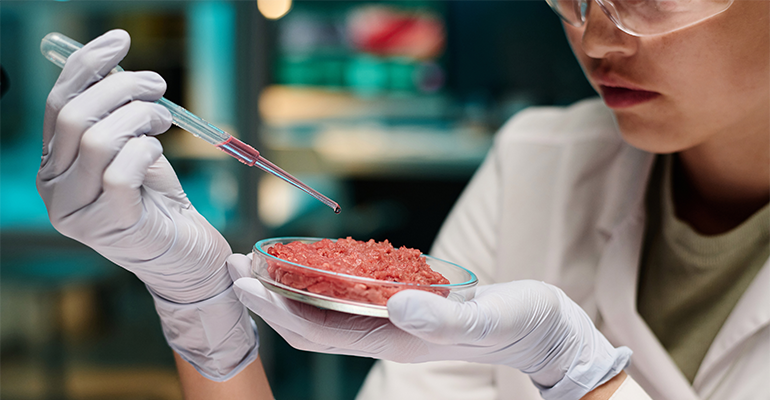
The centre is designed to bridge the gap between laboratory research and industrial production, accelerating the commercialisation of cultivated meat.
At its launch event, Cui Xulong, Fengtai District’s deputy mayor, said: “The new protein food science and technology innovation base will help complete the transformation of laboratory results into engineering and industrialisation, and lay a good development prospect for the commercialisation of cell-cultured meat.”
The site currently houses a 200-litre cell culture line and a 2,000-litre microbial protein production line, with expansion plans for larger pilot facilities, including two 2,000-litre cultivated meat bioreactors and three microbial protein lines of up to 5,000 litres.
Researchers showcased microbial protein bars, fermented tofu-based meat alternatives, and cultivated marbled steak, highlighting the centre’s innovation potential.
Alternative proteins central to China's food security strategy
Since 2004, China has been a major net importer of agricultural products. The opening of the cultivated meat facility aligns with the country’s broader strategy to ensure food security and reduce reliance on agricultural imports.
In 2022, President Xi Jinping called for increased self-sufficiency in food production, reinforcing this priority in the 14th Five-Year Plan (2021-25). The plan highlights the need for technological innovation in food production, with specific references to cell-based meat, synthetic egg cream, and recombinant protein cultivation.
The Chinese government’s approach to research into alternative proteins mirrors its approach in industries such as solar energy, electric vehicles, and lithium-ion batteries. Recent initiatives include the Ministry of Science and Technology’s “Green Biological Manufacturing” project, launched in 2020, which allocated $93 million for biomanufacturing research, including $20 million reserved for the development of alternative proteins.
A three-year government-funded project on artificial meat manufacturing was announced in 2021 and is being led by Jiangnan University, a major agricultural science research institution. Research into bioprinting cultivated meat was also unveiled in 2023 by the China Meat Food Research Center, which demonstrated 3D printing of mixed cells with edible materials.
China’s five-year agricultural plan encourages research in cultivated meat and recombinant proteins, while its five-year bioeconomy development plan prioritises novel food technologies. Focus areas include developments of the next generation of agricultural bioproducts, such as biological fertilisers, feeds, and pesticides.
Meating dietary needs
With nearly 100 million tonnes of meat ingested every year, China is the world’s largest meat consumer, accounting for 28% of global consumption. However, dietary patterns are evolving.
Per capita protein consumption in China already surpasses that of the US, with more than 60% coming from plant-based sources like vegetables, legumes, and nuts. A 2024 consumer survey found that 98% of Chinese respondents were open to increasing their plant-based food intake when informed about health and sustainability benefits.
By 2060, 50% of China’s protein consumption should come from plant-based, fermentation-derived, and cultivated meats in order to achieve a “climate-safe scenario”, according to research firm Asia Research and Engagement. Under this projection, 24% of consumption should come from plant-based proteins, 16% from fermentation-derived proteins, and 10% from cultivated meat and seafood.
Achieving this new mix of proteins will require major continued investments to scale alternative protein production, with a total capital expenditure between 2020 and 2060 of $731 billion to produce more than six million tonnes of plant-based, nearly four million tonnes of fermentation-derived, and 2.5 million tonnes of cultivated meat – scaling up the number of cultivated meat production facilities to 1,270 by 2060.
Cultivating geopolitical tension and competition
China’s push into alternative proteins has drawn international attention, particularly from the United States.
A 2024 letter from Republican US Congress members warned that “China’s use of synthetic biology and agricultural biotechnology [are] a targeted attempt to dominate global food supply chains”.
The letter called on the director of national intelligence and the US Department of Agriculture (USDA) Office of Homeland Security to “conduct a focused analysis on the potential implications of China’s advancements in innovative protein technologies and their potential to disrupt global food supply chains”.
It also urged the US government to maintain its competitive edge in food production, possibly signalling increased interest in US investment in cultivated meat and alternative proteins.
Alternative protein research is also taking off in other corners of the world. The EU Bezos Earth Fund opened its Centre for Sustainable Protein at Imperial College London last year. The centre, which received $30 million in funding from the Bezos Earth Fund, focuses on cultivated meat, precision fermentation, and AI-driven food innovation.
And earlier this year, Indian consumers tasted their first bites of cultivated chicken – with expectations for commercially available cultivated meat to hit the shelves before the end of this year.

Get more of our news on Google
Set Ingredients Network as a 'Preferred Source' to get quicker access to the news you value.
Related news

Do the US dietary guidelines put UPFs under pressure?
10 Sep 2026
Will the US dietary guidelines change the way Americans eat, swapping ultra-processed foods for whole foods? We asked Dr Barry Popkin, renowned nutrition and obesity researcher.
Read more
Skimpflation: An ‘unfair’ and risky approach to keeping prices low
2 Sep 2026
Consumers see skimpflation – reducing the quality of ingredients due to rising costs – as more unfair than shrinkflation, making it a risky strategy according to recent research.
Read more
‘Urgent gaps’ in achieving 2030 food system goals
27 Aug 2026
Global food systems are failing to meet 2030 targets across indicators including health, environment, and resilience, according to a report co-authored by the Food and Agriculture Organisation (FAO).
Read more
Seven-Eleven uses microbial testing tech to extend katsudon shelf life
26 Aug 2026
Japanese retail company Seven-Eleven has improved its factory’s microbial environment to keep comfort-food staple, katsudon, fresher for longer.
Read more
Chimac’s fusion sauces bring Korean flavours to Europe
25 Aug 2026
Irish sauce brand Chimac is tapping into Korea’s culinary traditions, bringing its flavours and products to European consumers who want a taste of K-food.
Read more
Global demand for instant noodles continues to rise
24 Aug 2026
Global demand for instant noodles reached 124.21 billion servings last year, representing a 0.7% year-on-year increase – or 900 million extra servings.
Read more
China beverages: Is herbal innovation the future?
20 Aug 2026
Herbal and botanical innovation in China's drinks market continues to grow, with ingredients like astragalus root, ginger, and ginseng in the spotlight – and focus shifting far beyond refreshment.
Read more
Popular barbecue staples experience sharp price increases
19 Aug 2026
The typical cost of US shoppers’ barbecue baskets has risen by 12% over the past year – the fastest annual rise in a decade, figures from The Economist show.
Read more
Hot NPD: Nissin launches first cold-water Cup Noodles
18 Aug 2026
Nissin is taking one of Japan’s most iconic instant meals in a completely new direction with the launch of the first cold water-only Cup Noodles in the brand’s 55-year history.
Read more
Manam Chocolate aims to bring premium Indian cacao to 'the world stage'
11 Aug 2026
Craft chocolate brand Manam Chocolate is investing in local expansion and supply chain innovation throughout India as it works to build out the premium reputation of its locally produced cacao products.
Read more