
Ingredients Categories
Finished Products
Finished Food Categories
- Bakery
- Beverages / Juices
- Cereal and grain products
- Confectionery
- Cooking Fats & Oils
- Dairy
- Egg products
- Fruits & Vegetables
- Infant & Baby food
- Meat, Poultry & Fish
- Nuts & Seeds products
- Other Finished Food Categories
- Pet Food
- Plant-based foods
- Prepared foods
- Sauces & Seasonings
- Sweet & Savoury Spreads
Specialised Finished Products
- Bee products
- Biotic products
- Dietary supplements
- Energy drinks
- Functional beverages
- Functional confectionery
- Functional food
- Functional powders
- Meal replacement products
- Nutricosmetics
- Other Specialised Finished Products
- Pet Dietary Supplements
- Pharma and OTC products
- Protein products
- Sugar replacers / Sweeteners
Health & Wellness Areas
Delivery Formats
Operations & Services
- 3D printing
- Analysis/ Testing
- Auditing & certifications
- Blending & mixing
- Bottling
- Certification
- Clinical trials
- Co-packing
- Coating
- Consulting
- Contract manufacturing
- Drying
- Electrospinning
- Encapsulating
- Enzymatic processing
- Extracting
- Extrusion
- Fat structuring
- Fermentation
- Filling
- Flavour development
- Freeze drying
- Granulating/ grinding/ milling / mixing
- High-pressure processing
- Labelling
- Other Operations & Services
- Packaging
- Packet filling
- Pasturising
- Quality assurance
- Saccharification
- Shear cell processing
- Spray drying
- Sterilisation
- Storage & Logistics
- Tabletting
- Toasting / roasting
- Ultra-high temperature processing
News
Consumers want more plant-based meat without GM ingredients
Beth Newhart, Freelance Journalist 28 Nov 2023
Plant-based meat has been a hot and popular category for several years, but not all North American shoppers are embracing vegetarian alternatives that contain genetically modified (GM) ingredients, according to the Non-GMO Project.
Improvements in the taste, quality and versatility of plant-based meat have helped those options become more mainstream and commonly available at restaurants and grocery stores. However, many vegan meat products contain genetically engineered ingredients that help the product to resemble the taste and texture of animal meat.

According to North American non-profit the Non-GMO Project, more shoppers now believe that “some plant-based foods may offer no real benefits over traditional, conventional products like meat, eggs and dairy,” and that GMOs should be avoided.
Balancing sustainability and health choices
Consumers have pushed for more vegetarian and vegan choices on menus because they care more about health, wellness and sustainability. People perceive a plant-based diet as healthier than one that contains animal products. The climate crisis has also led to greater awareness on how meat production negatively impacts the environment.
Those looking to stop eating meat or to eat less of it have turned to meat alternatives to help make the transition. Major brands like Beyond Meat, Impossible, Quorn and Gardein make plant-based burgers, chicken, sausage and fish that nearly taste like the real thing.
But even though consumers expect that taste to match what they are used to with animal meat, they do not want to sacrifice their equally high expectations for ingredient quality.
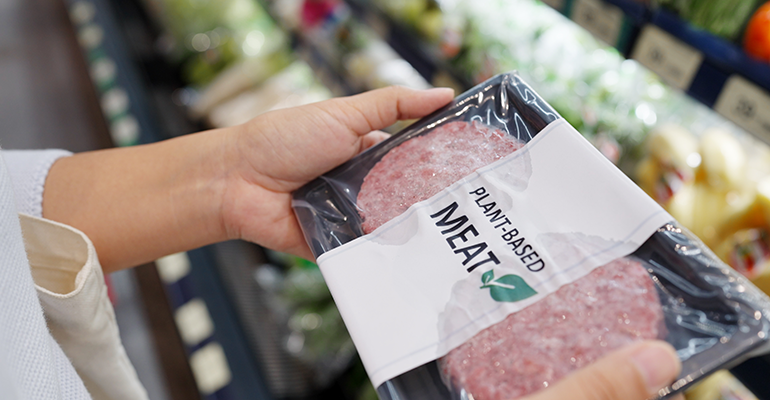 © AdobeStock/ChayTee
The Non-GMO Project cited data which found that 55% of all U.S. and Canadian shoppers believe plant-based foods are better for the planet, but 50% believe that GMO agriculture is harmful to the environment.
"In the innovative plant-based space, [shoppers] are again saying that GMOs are not wanted or needed," said Megan Westgate, executive director of the Non-GMO Project.
"We believe products should be labelled so that consumers have the freedom to choose non-GMO in every aisle of the grocery store. If GMOs aren't going to be labelled, then we're here to ensure eaters still have the right to avoid GMOs on their whole shopping list."
Shopper wants vs. industry efficiency
The Non-GMO Project works to verify that food products are free from modified ingredients, and says its verification is “North America's most rigorous certification for avoiding GMOs.”
Similar to other label certifications like USDA Organic or Gluten Free, food and beverage companies have to apply and submit their products for verification.
The organisation said that between 2019-2021, sales of Non-GMO Project Verified frozen plant-based meat increased seven times faster than comparable products that were not verified. In the same time period, plant-based cheese sales for unverified products grew by 17%, while verified options grew at 99% growth.
“Consumers are more engaged than ever with what goes into their shopping cart, making positive choices for their health and the health of the planet,” the Non-GMO Project said in a blog post. “They're asking more of the plant-based industry, including clean, whole ingredients and third-party certifications, like Non-GMO Project verification.”
 © AdobeStock/Jackie Davies
But even though consumers are being quite clear in what they want, the nonprofit said that the biotechnology industry is still “rapidly accelerating its development of alternative proteins for consumer consumption, which are largely unregulated and unlabelled in the U.S. and Canada.”
The Non-GMO Project calls for stricter laws relating to GMOs, particularly in North America. Over the summer, the EU proposed a plan to deregulate the use of GMOs in food “in order to satisfy the biotech industry’s unquenchable thirst for efficiency and speed to market,” the Non-GMO Project said.
But this move to redefine GMOs and change regulations could eliminate label requirements for food and beverage brands, leaving shoppers with less information about the ingredients and sourcing of the products they buy.

Get more of our news on Google
Set Ingredients Network as a 'Preferred Source' to get quicker access to the news you value.
Related news

Do the US dietary guidelines put UPFs under pressure?
10 Sep 2026
Will the US dietary guidelines change the way Americans eat, swapping ultra-processed foods for whole foods? We asked Dr Barry Popkin, renowned nutrition and obesity researcher.
Read more
Food fraud costs UK economy £2bn each year
9 Sep 2026
Food fraud is costing the UK economy up to £2 billion (€2.3 billion) every year although the food sector is more “resilient” than others, according to a recent study.
Read more
Skimpflation: An ‘unfair’ and risky approach to keeping prices low
2 Sep 2026
Consumers see skimpflation – reducing the quality of ingredients due to rising costs – as more unfair than shrinkflation, making it a risky strategy according to recent research.
Read more
NielsenIQ’s EU barometer shows Britain leading in grocery inflation
31 Aug 2026
Britain was the only country to record grocery inflation above 2%, according to NielsenIQ data that compared Europe’s five biggest grocery markets from February to May 2026.
Read more
‘Urgent gaps’ in achieving 2030 food system goals
27 Aug 2026
Global food systems are failing to meet 2030 targets across indicators including health, environment, and resilience, according to a report co-authored by the Food and Agriculture Organisation (FAO).
Read more
China beverages: Is herbal innovation the future?
20 Aug 2026
Herbal and botanical innovation in China's drinks market continues to grow, with ingredients like astragalus root, ginger, and ginseng in the spotlight – and focus shifting far beyond refreshment.
Read more
Popular barbecue staples experience sharp price increases
19 Aug 2026
The typical cost of US shoppers’ barbecue baskets has risen by 12% over the past year – the fastest annual rise in a decade, figures from The Economist show.
Read more
Beyond 'nice to have': A spotlight on US functional beverages
12 Aug 2026
Functional beverage interest in the US is gaining important ground as consumers now expect function rather than see it as "nice to have", and there are clear market gaps for growth, according to Spate.
Read more
Manam Chocolate aims to bring premium Indian cacao to 'the world stage'
11 Aug 2026
Craft chocolate brand Manam Chocolate is investing in local expansion and supply chain innovation throughout India as it works to build out the premium reputation of its locally produced cacao products.
Read more
Digital twin technology gains ground in food manufacturing
6 Aug 2026
Food and beverage companies are increasingly turning to digital twins to optimise and automate manufacturing processes, but opportunities stretch far beyond this, say experts.
Read more